Implement a function in OCaml that takes a number as an input and checks whether it...
Implement a function in OCaml that takes a number as an input and checks whether it is a prime number. The result should be a Boolean value.
Homework Answers
Hello,
Before giving answer to the question first check what is prime number?
Ans : Prime number is a number which is divisible by 1 or itself.
Ex; 2,3,5,7
Code:
let prime : int -> bool
= fun number ->
  match number with
     0 -> false
   | 1 -> false
   | _ -> let a = (number - 1) in
            let rec checkZero a number =
              match a with
                 1 -> true
               | _ -> match number mod a with
                         0 -> false
                       | _ -> checkZero (a - 1) number
              in
              checkZero a number
;;
Code Explanation:

Step 1: First check if a number is 0 or 1 return false. because they are not a prime number.
Step 2: We need to divide an input number, say 17 from values 2 to 17 and check the remainder. If remainder is 0 number is not prime. No number is divisible by more than half of itself.
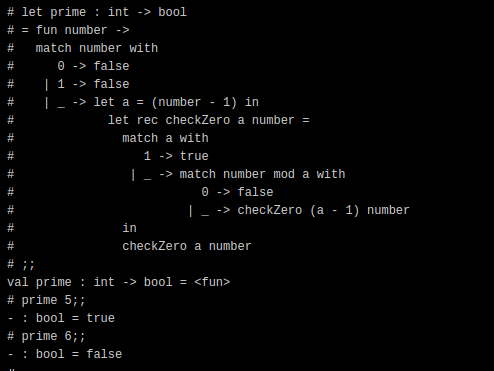
Test Result:
Please let me know if you have any questions in comments section.
Thanks.
# let prime: int -> bool # = fun number -> # match number with # 0 -> false 1-> false >let a = (number - 1) in let rec checkZero a number = match a with 1 -> true .->match number mod a with 0 -> false -> checkZero (a - 1) number in checkZero a number # ;; val prime int -> bool = <fun> # prime 5;; : bool = true # prime 6;; : bool = false
Add Answer to:
Implement a function in OCaml that takes a number as an input
and checks whether it...
2a Please code in Ocaml: TODO: Implement an OCaml function sum_top_4 : int list -> int...
2a Please code in Ocaml: TODO: Implement an OCaml function sum_top_4 : int list -> int list, which takes a list of integers and adds the sum of the top four elements to the head of the list (e.g. the input list [1;1;1;1;3;2] should become the output list [4;1;1;1;1;3;2]). starter code: let sum_top_4 (xs : int list) : int list = (* your work here *) [ ]
New to Ocaml, suppose to implement a function which takes two tuples (a,b) (c,d) and determine...
New to Ocaml, suppose to implement a function which takes two tuples (a,b) (c,d) and determine if a/b equal to c/d. abcd are all int. Stuck on the point that a/b , c/d are different type... Can someone help me implement this small piece of code in Ocaml?
2b Please code in language: Ocaml TODO: Implement a recursive OCaml function ascending : int ->...
2b Please code in language: Ocaml TODO: Implement a recursive OCaml function ascending : int -> int list, which accepts an integer n as input (again, assume n ≥ 0), and returns a list of integers from 0 to n in ascending order. starter code: let ascending (n : int) : int list = (* your work here *) [ ]
Write a function “isPrime” that takes an int “n” and checks this number to decide if...
Write a function “isPrime” that takes an int “n” and checks this number to decide if it is an prime number or not. Python answers only since that's the class I am in.
java Write an application that input a number from the user and checks if all digits...
java Write an application that input a number from the user and checks if all digits are prime numbers using method prime. The number entered can be of any size. If all digits are prime your program should stop. Use do/while for reading the input and any loop format to test if the number is prime. When checking the prime numbers don’t use an if to check numbers from 1 – 9; you need to find an algorithm to check...
Write the function deep_contains. It takes as input a number and a list. That list might...
 Write the function deep_contains. It takes as input a number and a list. That list might contain lists as elements, and those lists might contain lists, etc. The deep_contains' function should return a Boolean indicating whether the number is contained inputted list, or a sublist of it, or a sublist of that, and so forth. For example: deep_contains (3, (1,3,5]) returns True deep_contains(3, 11, [3,5]]) returns True deep_contains (3, 1, [[3,4],5),6]) returns True deep_contains (2, (1,3,5]) returns False This function...
1. Write a program that takes a number as input and check whether the number is...
1. Write a program that takes a number as input and check whether the number is positive, negative or zero. 2. Write a C++ program that prompts the user to enter a number and checks whether the entered number is even or odd. 3. Using switch-case statement write a C++ program that prompts the user to enter 1, 2 or 3 and display "Red" if selection is 1, "Yellow" if selection is 2, or "Green" if selection is 3. 4. Write...
Write a stored function that takes a number as its input and returns that number as...
Write a stored function that takes a number as its input and returns that number as currency, i.e. it should have a leading dollar sign, only have two decimal places, and have commas for the thousands. If the number is negative the result should be in parenthesis, accounting format, -123.45 returns ($123.45). If the input is a non-number, e.g. “Hello”, the function should return $0.00
Write a program that takes a file as input and checks whether or not the content...
Write a program that takes a file as input and checks whether or not the content of the file is balanced. In the context of this assignment “balanced” means that your program will check to make sure that for each left bracket there is a closing right bracket. Examples: [ ( ) ] { } à balanced. [ ( ] ) { } à unbalanced. Here is the list of brackets/braces that program must support: (: left parentheses...
Implement a binary search function that takes an integer query key and determines whether it is...
Implement a binary search function that takes an integer query key and determines whether it is in a sorted array of n integers. It should return the index of the key, if found, otherwise it should return a negative number. You should implement the function both iteratively and recursively to be sure you really understand the algorithm. Just for the fun of it, you might want to verify the O(log(n)) complexity of your function by counting the number of comparisons...
 Write the function deep_contains. It takes as input a number and a list. That list might contain lists as elements, and those lists might contain lists, etc. The deep_contains' function should return a Boolean indicating whether the number is contained inputted list, or a sublist of it, or a sublist of that, and so forth. For example: deep_contains (3, (1,3,5]) returns True deep_contains(3, 11, [3,5]]) returns True deep_contains (3, 1, [[3,4],5),6]) returns True deep_contains (2, (1,3,5]) returns False This function...
Most questions answered within 3 hours.
-
Where is the error in this code sequence?
String s1 = "Hello";
String s2 = "ello";...
asked 10 months ago -
Financial data for Joel de Paris, Inc., for last year
follow:
Joel de Paris, Inc.
Balance...
asked 10 months ago -
Consider this reaction:
Al2(SO4)3 (aq)+ BaCl3
(aq) Al2Cl6 (aq)- +
3BaSO4(s) . What is the...
asked 10 months ago -
Suppose that Savneet is considering increasing her
recent random sample from 20 car rentals to 40...
asked 10 months ago -
Trucks arrive at an unloading terminal at an average rate of 120
per hour.
Trucks arrive...
asked 10 months ago -
Why are methanol and ethanol completely soluble in water while
octanol is not very little soluble....
asked 10 months ago -
A facilities manager at a university reads in a research report
that the mean amount of...
asked 10 months ago -
When the CuSO4 is rehydrated by adding water to the anhydrous
compound, is this an endothermic...
asked 10 months ago -
A ray of sunlight is passing from diamond into crown glass; the
angle of incidence is...
asked 10 months ago -
A block of mass 0.249 kg is placed on top of a light, vertical
spring of...
asked 10 months ago -
how do the kidneys compensate in the presences of acidosis
a) trigger hyperventilate
b) reserve acid...
asked 10 months ago -
Question 501 pts
The rental rate of capital to the firm increases. Which of the
following...
asked 10 months ago