Fill in the missing C code according to the comments. #include <stdio.h> typedef struct { ...
Fill in the missing C code according to the comments.
#include <stdio.h>
typedef struct {
int num;
char name[25];
} student;
int main(){
student s1;
//assign the value of 1234 to num in
the s1 structure
//assign the value of Bob the Builder
to name in s1 structure
//display the value of num in the s1 structure
//display the value of name is the s1 structure
student *s2;
//assign the value of 7754 to num in
the s2 structure
//assign the value of Bullwinkle to
name in s2 structure
//display the value of num in the s2 structure
//display the value of name is the s2 structure
return 0;
}//end main()
Homework Answers
#include <stdio.h>
#include <string.h>
#include <stdlib.h>

typedef struct {
   int num;
   char name[25];
} student;

int main(){
   student s1;

   //assign the value of 1234 to num in the s1 structure
   s1.num = 1234;
   //assign the value of Bob the Builder to name in s1 structure
   strcpy(s1.name, "Bob the Builder");


   //display the value of num in the s1 structure
   printf("%d\n",s1.num);
   //display the value of name is the s1 structure
   printf("%s\n",s1.name);

   student *s2 = (student*)malloc(sizeof(student));

   //assign the value of 7754 to num in the s2 structure
   s2->num = 7754;
   //assign the value of Bullwinkle to name in s2 structure
   strcpy(s2->name, "Bullwinkle");

   //display the value of num in the s2 structure
   printf("%d\n",s2->num);
   //display the value of name is the s2 structure
   printf("%s\n",s2->name);

   return 0;
}//end main()
Add Answer to:
Fill in the missing C code according to the comments.
#include <stdio.h>
typedef struct {
...
PLease explain output of these two programs: 1. #include <stdio.h> typedef struct { char *name; int...
PLease explain output of these two programs: 1. #include <stdio.h> typedef struct { char *name; int x, y; int h, w; } box; typedef struct { unsigned int baud : 5; unsigned int div2 : 1; unsigned int use_external_clock : 1; } flags; int main(int argc, char** argv){ printf("The size of box is %d bytes\n", sizeof(box)); printf("The size of flags is %d bytes\n", sizeof(flags)); return 0; } 2. #include <stdio.h> #include <string.h> /* define simple structure */ struct { unsigned...
Canvas → XC D Question 13 Given the code below: typedef struct p { char topic...
 Canvas → XC D Question 13 Given the code below: typedef struct p { char topic [20]; int nunWords; > page; typedef struct mag char name[20]; page pages [250); int numPages; } magazine; magazine m; How would you declare an array of 20 magazines? struct magazine[20] magazine[20] magazine myStack(20) None of the above struct m[191 Question 14 Given the code below: typedef struct char topic[20] Canvas & XC struct m[19] Question 14 Given the code below: typedef struct char topic[20];...
Complete the program below in C please #include <stdio.h> #inlcude <stdlib.h> #include <time.h> typedef struct {...
Complete the program below in C please #include <stdio.h> #inlcude <stdlib.h> #include <time.h> typedef struct { int points; int strength; } Hero; /* print out the hero given by the parameter */ void printHero( ... ) { . . } void main() { Hero heroA, heroB; /* initialize both heroes to your choice of values */ . /* Pick one hero using rand(). Print out that hero */ . }
Given the following program: #include <stdio.h> struct student { int id; char name[20]; char grade; };...
Given the following program: #include <stdio.h> struct student { int id; char name[20]; char grade; }; void func(struct student stud); int main() { struct student astud; astud.id=9401; strcpy(astud.name, "Joe"); astud.grade = 'A'; func(astud); return 0; } Abdelghani Bellaachia, CSCI 1121 Page: 16 void func(struct student astud) { printf(" Id is: %d \n", astud.id); printf(" Name is: %s \n", astud.name); printf(" Grade is: %c \n", astud.grade); } Modify this program to include the address of a student as a separate structure....
C ++ 1. Write down the missing code according to the comments. #include <cstdlib> #include <iostream>...
C ++ 1. Write down the missing code according to the comments. #include <cstdlib> #include <iostream> using namespace std; void fun1(int radius) { /* dynamic memory management */ double * dmptr; double circumference; /* add the code below to: - allocate a memory location for a double and nameless variable in heap and assign its address to the pointer - assign 3.14 to the variable in heap via the pointer....
Please complete the c++ code. The code that needs completing is outlined in the comments. #include...
Please complete the c++ code. The code that needs completing is outlined in the comments. #include <stdio.h> #include<stdlib.h> #include<math.h> struct student{ int id; int score;}; struct student* allocate(){ /*Allocate memory for ten students*/ /*return the pointer*/ } void generate(struct student* students){ /*Generate random and unique ID and scores for ten students, ID being between 1 and 10, scores between 0 and 100*/ } void output(struct student* students){ /*Output information about the ten students in the format: ID1 Score1 ID2 score2...
QUESTION 6 What is the output of following C code? struct numbers { int x...
QUESTION 6 What is the output of following C code? struct numbers { int x = 2; int y = 3; } int main() { struct numbers nums; nums.x = 110; nums.y = 100; printf("%d\n%d", nums.x, nums.y); return 0; } A. Compile-time Error B. 110 100 C. 2 3 D. Run-time Error 2 points QUESTION 7 What is the output of following C code? typedef struct student { char *stud; }s1; int main() { s1 s; s.stud...
I NEED HELP FINDING THE BUG IN THIS CODE USING THE GDB #include #include <stdio.h> <string.h>...
 I NEED HELP FINDING THE BUG IN THIS CODE USING THE GDB
#include #include <stdio.h> <string.h> Return the result of appending the characters in s2 to s1 Assumption: enough space has been allocated for sl to store the extra characters. char* append (char s1[ ], char s2[ ]) int sllenstrlen (s1); int s2lenstrlen (s2) int k; for (k=0; k<s21en; k++) { sl [kts11en] = s2 [k] ; return sl; int main () char strl [10]; char str2 [10]; while (1)...
I NEED HELP FINDING THE BUG IN THIS CODE USING THE GDB
#include #include <stdio.h> <string.h> Return the result of appending the characters in s2 to s1 Assumption: enough space has been allocated for sl to store the extra characters. char* append (char s1[ ], char s2[ ]) int sllenstrlen (s1); int s2lenstrlen (s2) int k; for (k=0; k<s21en; k++) { sl [kts11en] = s2 [k] ; return sl; int main () char strl [10]; char str2 [10]; while (1)...
Please fill in the code to reverse a linked list. IN C++ #include <stdio.h> #include <stdlib.h>...
Please fill in the code to reverse a linked list. IN C++ #include <stdio.h> #include <stdlib.h> #include <iostream> using namespace std; /* Link list node */ struct Node { int data; // your code here }; /* Function to reverse the linked list */ static void reverse(struct Node** head_ref) { // your code here } /* Function to push a node */ void push(struct Node** head_ref, int new_data) { // your code here } /* Function to print linked list...
The following C code defines a structure for student and then creates a student structure type...
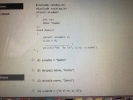 The following C code defines a structure for student and then
creates a student structure type variable by setting the no as 8
and name as "Demo". One statement is missing in this C code. Please
select one statement from the following options to make this
program work.
s ions s saved Status include <stdio.h> include <string. h struct student int no; char name void main struct student s; S. no 8 print f("Ed 8s In", s. no, s. name)...
The following C code defines a structure for student and then
creates a student structure type variable by setting the no as 8
and name as "Demo". One statement is missing in this C code. Please
select one statement from the following options to make this
program work.
s ions s saved Status include <stdio.h> include <string. h struct student int no; char name void main struct student s; S. no 8 print f("Ed 8s In", s. no, s. name)...
 Canvas → XC D Question 13 Given the code below: typedef struct p { char topic [20]; int nunWords; > page; typedef struct mag char name[20]; page pages [250); int numPages; } magazine; magazine m; How would you declare an array of 20 magazines? struct magazine[20] magazine[20] magazine myStack(20) None of the above struct m[191 Question 14 Given the code below: typedef struct char topic[20] Canvas & XC struct m[19] Question 14 Given the code below: typedef struct char topic[20];...
 I NEED HELP FINDING THE BUG IN THIS CODE USING THE GDB
#include #include <stdio.h> <string.h> Return the result of appending the characters in s2 to s1 Assumption: enough space has been allocated for sl to store the extra characters. char* append (char s1[ ], char s2[ ]) int sllenstrlen (s1); int s2lenstrlen (s2) int k; for (k=0; k<s21en; k++) { sl [kts11en] = s2 [k] ; return sl; int main () char strl [10]; char str2 [10]; while (1)...
I NEED HELP FINDING THE BUG IN THIS CODE USING THE GDB
#include #include <stdio.h> <string.h> Return the result of appending the characters in s2 to s1 Assumption: enough space has been allocated for sl to store the extra characters. char* append (char s1[ ], char s2[ ]) int sllenstrlen (s1); int s2lenstrlen (s2) int k; for (k=0; k<s21en; k++) { sl [kts11en] = s2 [k] ; return sl; int main () char strl [10]; char str2 [10]; while (1)...
 The following C code defines a structure for student and then
creates a student structure type variable by setting the no as 8
and name as "Demo". One statement is missing in this C code. Please
select one statement from the following options to make this
program work.
s ions s saved Status include <stdio.h> include <string. h struct student int no; char name void main struct student s; S. no 8 print f("Ed 8s In", s. no, s. name)...
The following C code defines a structure for student and then
creates a student structure type variable by setting the no as 8
and name as "Demo". One statement is missing in this C code. Please
select one statement from the following options to make this
program work.
s ions s saved Status include <stdio.h> include <string. h struct student int no; char name void main struct student s; S. no 8 print f("Ed 8s In", s. no, s. name)...
Most questions answered within 3 hours.
-
Where is the error in this code sequence?
String s1 = "Hello";
String s2 = "ello";...
asked 10 months ago -
Financial data for Joel de Paris, Inc., for last year
follow:
Joel de Paris, Inc.
Balance...
asked 10 months ago -
Consider this reaction:
Al2(SO4)3 (aq)+ BaCl3
(aq) Al2Cl6 (aq)- +
3BaSO4(s) . What is the...
asked 10 months ago -
Suppose that Savneet is considering increasing her
recent random sample from 20 car rentals to 40...
asked 10 months ago -
Trucks arrive at an unloading terminal at an average rate of 120
per hour.
Trucks arrive...
asked 10 months ago -
Why are methanol and ethanol completely soluble in water while
octanol is not very little soluble....
asked 10 months ago -
A facilities manager at a university reads in a research report
that the mean amount of...
asked 10 months ago -
When the CuSO4 is rehydrated by adding water to the anhydrous
compound, is this an endothermic...
asked 10 months ago -
A ray of sunlight is passing from diamond into crown glass; the
angle of incidence is...
asked 10 months ago -
A block of mass 0.249 kg is placed on top of a light, vertical
spring of...
asked 10 months ago -
how do the kidneys compensate in the presences of acidosis
a) trigger hyperventilate
b) reserve acid...
asked 10 months ago -
Question 501 pts
The rental rate of capital to the firm increases. Which of the
following...
asked 10 months ago