Bode Plots Theory: - Why the Bode plot (magnitude) of a second-order network with two distinct...
Bode Plots Theory:
- Why the Bode plot (magnitude) of a second-order network with two distinct real poles does not have an overshoot ?
- What is the value of the overshoot of the Bode plot (magnitude) of a second-order network with a pair of complex conjugate poles ?
- What is the loss of the Bode plot (magnitude) of a first-order system at its -3 dB frequency ?
- What is the loss of the Bode plot (magnitude) of a second-order system at its -3 dB frequency?
Homework Answers


Add Answer to:
Bode Plots Theory:
- Why the Bode plot (magnitude) of a second-order network with
two distinct...
Do magnitude plots only. 8.2. Draw the bode plot for the network equation o + 8)jo+2...
 Do magnitude plots only.
8.2. Draw the bode plot for the network equation o + 8)jo+2 .Jw
Do magnitude plots only.
8.2. Draw the bode plot for the network equation o + 8)jo+2 .Jw
Problem: A. For every Bode magnitude plot, do the following: (a)Find the Bode gain, K. (b)List...
 Problem:
A. For every Bode magnitude plot, do the following: (a)Find the Bode gain, K. (b)List the corner frequency for each factor. (c)Draw the straight line Bode magnitude plot for each factor, using the correct slope. (d) Carefully combine the plots into a composite straight line plot, using graphical addition at (e) (f) the corner frequencies. Use a heavy line for this composite plot. Go back and add the appropriate corrections at corners (±3 dB for simple poles/zeros) By hand,...
Problem:
A. For every Bode magnitude plot, do the following: (a)Find the Bode gain, K. (b)List the corner frequency for each factor. (c)Draw the straight line Bode magnitude plot for each factor, using the correct slope. (d) Carefully combine the plots into a composite straight line plot, using graphical addition at (e) (f) the corner frequencies. Use a heavy line for this composite plot. Go back and add the appropriate corrections at corners (±3 dB for simple poles/zeros) By hand,...
For all problems -given a transfer function G(s) sketch the magnitude and phase characteristics in the...
 For all problems -given a transfer function G(s) sketch the magnitude and phase characteristics in the logarithmic scale (i.e. Bode-plots) of the system using the following rules-of-thumb: i. "Normalize" the G(s) by extracting poles/zeros, substituting s-jw and writing the TF using DC-gain KO and time-constants i. Arange break-points (poles, zeros or on for complex-conjugate poles) in ascending order ii Based on the term Ko(ju)Fk, determine: initial slope of the magnitude-response asymptote for low frequencies as F k 20 dB/dec (e.g....
Question 12 Consider the magnitude of the Bode plot for the following network function Gliw)= 107...
 Question 12 Consider the magnitude of the Bode plot for the following network function Gliw)= 107 Uw) (1+jw)(10+ jw)(103+Jw)(10* + Jw) What value below is the best approximation for the value of G(jw) at w= 100 rad/s? e 10 dB 20 dB -20 dB 0 0 dB
Problem 3 (20 points) A Bode plot is a graph of the frequency response of a system. It is a combi...
 Problem 3 (20 points) A Bode plot is a graph of the frequency response of a system. It is a combination of a magnitude plot, expressing the magnitude in dB of the frequency response, and a phase plot expressing the phase shift. Both quantities are plotted on a horizontal axis proportional to the logarithm of the frequency. Below is an example of a Bode plot created in Matlab. Bode Diagram 0 -20 3-40 E-60 -80 180 90 10 10 10...
please identify if it first or second order. For the following, generate simple bode plots (both...
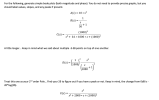 please identify if it first or second order.
For the following, generate simple bode plots (both magnitude and phase). You do not need to provide precise graphs, but you should label values, slopes, and any peaks if present. A(s) 10 1 B(s) S -+1 50 (1000)2 C(s) s20.1 1000 s+(1000) A little longer... Keep in mind what we said about multiple -3 dB points on top of one another. C 1 D(s)=1000) 1 (1000 Treat this one as your 2nd...
please identify if it first or second order.
For the following, generate simple bode plots (both magnitude and phase). You do not need to provide precise graphs, but you should label values, slopes, and any peaks if present. A(s) 10 1 B(s) S -+1 50 (1000)2 C(s) s20.1 1000 s+(1000) A little longer... Keep in mind what we said about multiple -3 dB points on top of one another. C 1 D(s)=1000) 1 (1000 Treat this one as your 2nd...
For the system transfer function given by: s +10 $2 x (82100.+10) 1. Identify each term in the tr...
 For the system transfer function given by: s +10 $2 x (82100.+10) 1. Identify each term in the transfer function (constant, poles, zeros) (a) For any constant terms, what is the dB magnitude? What is the phase angle? (b) For any real poles not at the origin, what is the break frequency? (c) For any real zeros not at the origin, what is the break frequency? 2. Give the value of the DB magnitude and phase angle at w =...
Hw 10 Problem 2 2. Draw the magnitude characteristic of the Bode plot of the following...
 Hw 10 Problem 2 2. Draw the magnitude characteristic of the Bode plot of the following transfer function: HG) = (s +5)(s +10) 5 + 5 + 10) a) Identify the poles and zeros. Enter values beginning with the poles and zeros whose real parts are closest to the origin in the complex plane. b) Identify the breakpoint frequencies. Enter the breakpoints in increasing order. c) Express the transfer function in the standard form: H(S) = (Tpis + 1)(Tp25 +...
g) The Bode magnitude plot of a system is given below (note gains are in dB...
 g) The Bode magnitude plot of a system is given below (note gains are in dB scale). What are the five (approximate) amplitudes of the sinusoidal outputs if the inputs are u(t) = sin(w t) (i.e. input amplitude is 1) where w are respectively: i) 0.1 rad/s; ii) 2.1 rad/s; iii) 3 rad/s; iv) 4.3 rad/s; v) 10 rad/s. Magnitude gain - dB 10 100 Frequency - [rad/s]
QUESTION 2 Consider this 2" order transfer function which was discussed in lecture G(s) 10s+9 The Bode plots (magnitude, phase) for this G(s) are provided in this handout. For the following...
 QUESTION 2 Consider this 2" order transfer function which was discussed in lecture G(s) 10s+9 The Bode plots (magnitude, phase) for this G(s) are provided in this handout. For the following frequency (i.e."o") values, do complex number calculations as performed in lecture, to verify that this magnitude curve (in decibels) and phase curve (in degrees) are correct “o',-0.03, 0.2, 1, 6, 20, and 60 rad/sec Be sure to show your work CLEARLY, and indicate on the Bode plots the magnitude/phase...
 Do magnitude plots only.
8.2. Draw the bode plot for the network equation o + 8)jo+2 .Jw
Do magnitude plots only.
8.2. Draw the bode plot for the network equation o + 8)jo+2 .Jw
 Problem:
A. For every Bode magnitude plot, do the following: (a)Find the Bode gain, K. (b)List the corner frequency for each factor. (c)Draw the straight line Bode magnitude plot for each factor, using the correct slope. (d) Carefully combine the plots into a composite straight line plot, using graphical addition at (e) (f) the corner frequencies. Use a heavy line for this composite plot. Go back and add the appropriate corrections at corners (±3 dB for simple poles/zeros) By hand,...
Problem:
A. For every Bode magnitude plot, do the following: (a)Find the Bode gain, K. (b)List the corner frequency for each factor. (c)Draw the straight line Bode magnitude plot for each factor, using the correct slope. (d) Carefully combine the plots into a composite straight line plot, using graphical addition at (e) (f) the corner frequencies. Use a heavy line for this composite plot. Go back and add the appropriate corrections at corners (±3 dB for simple poles/zeros) By hand,...
 For all problems -given a transfer function G(s) sketch the magnitude and phase characteristics in the logarithmic scale (i.e. Bode-plots) of the system using the following rules-of-thumb: i. "Normalize" the G(s) by extracting poles/zeros, substituting s-jw and writing the TF using DC-gain KO and time-constants i. Arange break-points (poles, zeros or on for complex-conjugate poles) in ascending order ii Based on the term Ko(ju)Fk, determine: initial slope of the magnitude-response asymptote for low frequencies as F k 20 dB/dec (e.g....
 Question 12 Consider the magnitude of the Bode plot for the following network function Gliw)= 107 Uw) (1+jw)(10+ jw)(103+Jw)(10* + Jw) What value below is the best approximation for the value of G(jw) at w= 100 rad/s? e 10 dB 20 dB -20 dB 0 0 dB
 Problem 3 (20 points) A Bode plot is a graph of the frequency response of a system. It is a combination of a magnitude plot, expressing the magnitude in dB of the frequency response, and a phase plot expressing the phase shift. Both quantities are plotted on a horizontal axis proportional to the logarithm of the frequency. Below is an example of a Bode plot created in Matlab. Bode Diagram 0 -20 3-40 E-60 -80 180 90 10 10 10...
 please identify if it first or second order.
For the following, generate simple bode plots (both magnitude and phase). You do not need to provide precise graphs, but you should label values, slopes, and any peaks if present. A(s) 10 1 B(s) S -+1 50 (1000)2 C(s) s20.1 1000 s+(1000) A little longer... Keep in mind what we said about multiple -3 dB points on top of one another. C 1 D(s)=1000) 1 (1000 Treat this one as your 2nd...
please identify if it first or second order.
For the following, generate simple bode plots (both magnitude and phase). You do not need to provide precise graphs, but you should label values, slopes, and any peaks if present. A(s) 10 1 B(s) S -+1 50 (1000)2 C(s) s20.1 1000 s+(1000) A little longer... Keep in mind what we said about multiple -3 dB points on top of one another. C 1 D(s)=1000) 1 (1000 Treat this one as your 2nd...
 For the system transfer function given by: s +10 $2 x (82100.+10) 1. Identify each term in the transfer function (constant, poles, zeros) (a) For any constant terms, what is the dB magnitude? What is the phase angle? (b) For any real poles not at the origin, what is the break frequency? (c) For any real zeros not at the origin, what is the break frequency? 2. Give the value of the DB magnitude and phase angle at w =...
 Hw 10 Problem 2 2. Draw the magnitude characteristic of the Bode plot of the following transfer function: HG) = (s +5)(s +10) 5 + 5 + 10) a) Identify the poles and zeros. Enter values beginning with the poles and zeros whose real parts are closest to the origin in the complex plane. b) Identify the breakpoint frequencies. Enter the breakpoints in increasing order. c) Express the transfer function in the standard form: H(S) = (Tpis + 1)(Tp25 +...
 g) The Bode magnitude plot of a system is given below (note gains are in dB scale). What are the five (approximate) amplitudes of the sinusoidal outputs if the inputs are u(t) = sin(w t) (i.e. input amplitude is 1) where w are respectively: i) 0.1 rad/s; ii) 2.1 rad/s; iii) 3 rad/s; iv) 4.3 rad/s; v) 10 rad/s. Magnitude gain - dB 10 100 Frequency - [rad/s]
 QUESTION 2 Consider this 2" order transfer function which was discussed in lecture G(s) 10s+9 The Bode plots (magnitude, phase) for this G(s) are provided in this handout. For the following frequency (i.e."o") values, do complex number calculations as performed in lecture, to verify that this magnitude curve (in decibels) and phase curve (in degrees) are correct “o',-0.03, 0.2, 1, 6, 20, and 60 rad/sec Be sure to show your work CLEARLY, and indicate on the Bode plots the magnitude/phase...
Most questions answered within 3 hours.
-
Where is the error in this code sequence?
String s1 = "Hello";
String s2 = "ello";...
asked 10 months ago -
Financial data for Joel de Paris, Inc., for last year
follow:
Joel de Paris, Inc.
Balance...
asked 10 months ago -
Consider this reaction:
Al2(SO4)3 (aq)+ BaCl3
(aq) Al2Cl6 (aq)- +
3BaSO4(s) . What is the...
asked 10 months ago -
Suppose that Savneet is considering increasing her
recent random sample from 20 car rentals to 40...
asked 10 months ago -
Trucks arrive at an unloading terminal at an average rate of 120
per hour.
Trucks arrive...
asked 10 months ago -
Why are methanol and ethanol completely soluble in water while
octanol is not very little soluble....
asked 10 months ago -
A facilities manager at a university reads in a research report
that the mean amount of...
asked 10 months ago -
When the CuSO4 is rehydrated by adding water to the anhydrous
compound, is this an endothermic...
asked 10 months ago -
A ray of sunlight is passing from diamond into crown glass; the
angle of incidence is...
asked 10 months ago -
A block of mass 0.249 kg is placed on top of a light, vertical
spring of...
asked 10 months ago -
how do the kidneys compensate in the presences of acidosis
a) trigger hyperventilate
b) reserve acid...
asked 10 months ago -
Question 501 pts
The rental rate of capital to the firm increases. Which of the
following...
asked 10 months ago