when conducting a hypothesis test on a population proportion, the value of q is defined as...
when conducting a hypothesis test on a population proportion, the value of q is defined as p+1. true or false
Homework Answers
Solution:
False
"During conducting a hypothesis test on a population proportion,
the value of  is defined as
  .
.
Therefore,
when conducting a hypothesis test on a population proportion,
the value of
is defined as  is a False statement.
Add Answer to:
when conducting a hypothesis test on a population
proportion, the value of q is defined as...
When conducting a hypothesis test concerning the population proportion, the value of the test statistic is calculated as ____________.
When conducting a hypothesis test concerning the population proportion, the value of the test statistic is calculated as ____________.rev: 07_06_2018_QC_CS-130873Multiple Choicez=x−−μoσ/n√tdf=x−−μos/n√z=p−−popo(1−po)n√tdf=p−−popo(1−po)n√
What happens to the the p-value of a hypothesis test of a population proportion when the...
What happens to the the p-value of a hypothesis test of a population proportion when the sample size increases. For example, you took two samples from the same population, one of size 50 and one of size 100. You got the same sample proportion in each case. (a) The p-value is larger for the sample of size 50. (b) The p-value is larger for the sample of size 100. (c) The p-value is the same for each of the sample...
Question 21 (4 points) For a hypothesis test about a population proportion or mean, if the...
 Question 21 (4 points) For a hypothesis test about a population proportion or mean, if the level of significance is less than the p- value, the null hypothesis is rejected. (Ch10) True False Question 22 (4 points) Everything else being constant, increasing the sample size decreases the probability of committing a Type II error. (Ch10) True False The power of a statistical test is the probability of not rejecting the null hypothesis when it is true. (Ch10) True False Question...
You are conducting a hypothesis test for the population proportion. You selected a sample of 30...
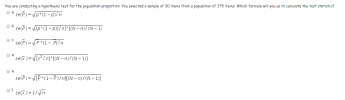 You are conducting a hypothesis test for the population proportion. You selected a sample of 30 items from a population of 375 items. Which formula will you us to calculate the test statistic? a sep)= p*(1-p)/n O se(P)= [p*(1-P)]/n]*((N - n)/(N − 1) Ocselp) = VP*(1 - Žin od se(k)= Vis?/n]*((N = n)/(N − 1)] se()= P*(1-P)/nI(N-n)/(N - 1)] of se()=slvn
In a hypothesis test for a single proportion or mean, the critical value approach and the...
In a hypothesis test for a single proportion or mean, the critical value approach and the p-value approach will sometimes not agree in their conclusion. True or False
For an hypothesis test on the population proportion for the alternative hypothesis is LESS THAN, if...
For an hypothesis test on the population proportion for the alternative hypothesis is LESS THAN, if the p-value was 0.04, what is the test statistic? A -1.751 B 1.751 C -0.516 D 0.516
The alternate hypothesis is a statement that the value of a population parameter (such as proportion,...
 The alternate hypothesis is a statement that the value of a population parameter (such as proportion, mean, or standard deviation) is equal to some claimed value. True O False A Uniform probability distribution is applicable to the scenarios where the set of possible outcomes can take on values in a continuous range (e.g. real numbers), such as the temperature on a given day." True False A larger standard deviation indicates that the data is further away from; hence, the normal...
Ch10.2 Hypothesis Tests for a Population Proportion Z-Test for a population proportion resting Hypotheses Regarding a...
 Ch10.2 Hypothesis Tests for a Population Proportion Z-Test for a population proportion resting Hypotheses Regarding a Population Proportion, p. se the following steps to perform a Z-Test for a Proportion P-Value Approach By Hand Step 3 Compute the test statistic mple 1: The percentage of physicians who are women is 27.9%. In a survey of physicians employed by a large university health system, 45 of 120 randomly selected physicians were women. Use the P-value approach to determine whether there is...
For some p+q 1, where p denotes the proportion of defective genes in the relevant population and ...
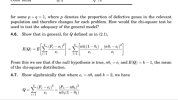 The
following is from Jean Dickinson's Nonparametric statistical
inference. Excercise 4.6
for some p+q 1, where p denotes the proportion of defective genes in the relevant population and therefore changes for each problem. How would the chi-square test be used to test the adequacy of the general model? 4.6. Show that in general, for Q defined as in (2.1), ne(1-0), (n0- ei From this we see that if the null hypothesis is true, no; -e and E)-k 1, the mean...
The
following is from Jean Dickinson's Nonparametric statistical
inference. Excercise 4.6
for some p+q 1, where p denotes the proportion of defective genes in the relevant population and therefore changes for each problem. How would the chi-square test be used to test the adequacy of the general model? 4.6. Show that in general, for Q defined as in (2.1), ne(1-0), (n0- ei From this we see that if the null hypothesis is true, no; -e and E)-k 1, the mean...
You conduct a hypothesis test about a population proportion p at a significance level of a...
 You conduct a hypothesis test about a population proportion p at a significance level of a = .01 using a random sample of size n = 38. Your test statistic follows a standard normal distribution when the null hypothesis is true as an equality, and its value obtained from the sample is z = -2.75. Use the Distributions tool to help you answer the questions that follow. Select a Distribution Distributions 0 1 2 3 If you perform a lower...
 Question 21 (4 points) For a hypothesis test about a population proportion or mean, if the level of significance is less than the p- value, the null hypothesis is rejected. (Ch10) True False Question 22 (4 points) Everything else being constant, increasing the sample size decreases the probability of committing a Type II error. (Ch10) True False The power of a statistical test is the probability of not rejecting the null hypothesis when it is true. (Ch10) True False Question...
 You are conducting a hypothesis test for the population proportion. You selected a sample of 30 items from a population of 375 items. Which formula will you us to calculate the test statistic? a sep)= p*(1-p)/n O se(P)= [p*(1-P)]/n]*((N - n)/(N − 1) Ocselp) = VP*(1 - Žin od se(k)= Vis?/n]*((N = n)/(N − 1)] se()= P*(1-P)/nI(N-n)/(N - 1)] of se()=slvn
 The alternate hypothesis is a statement that the value of a population parameter (such as proportion, mean, or standard deviation) is equal to some claimed value. True O False A Uniform probability distribution is applicable to the scenarios where the set of possible outcomes can take on values in a continuous range (e.g. real numbers), such as the temperature on a given day." True False A larger standard deviation indicates that the data is further away from; hence, the normal...
 Ch10.2 Hypothesis Tests for a Population Proportion Z-Test for a population proportion resting Hypotheses Regarding a Population Proportion, p. se the following steps to perform a Z-Test for a Proportion P-Value Approach By Hand Step 3 Compute the test statistic mple 1: The percentage of physicians who are women is 27.9%. In a survey of physicians employed by a large university health system, 45 of 120 randomly selected physicians were women. Use the P-value approach to determine whether there is...
 The
following is from Jean Dickinson's Nonparametric statistical
inference. Excercise 4.6
for some p+q 1, where p denotes the proportion of defective genes in the relevant population and therefore changes for each problem. How would the chi-square test be used to test the adequacy of the general model? 4.6. Show that in general, for Q defined as in (2.1), ne(1-0), (n0- ei From this we see that if the null hypothesis is true, no; -e and E)-k 1, the mean...
The
following is from Jean Dickinson's Nonparametric statistical
inference. Excercise 4.6
for some p+q 1, where p denotes the proportion of defective genes in the relevant population and therefore changes for each problem. How would the chi-square test be used to test the adequacy of the general model? 4.6. Show that in general, for Q defined as in (2.1), ne(1-0), (n0- ei From this we see that if the null hypothesis is true, no; -e and E)-k 1, the mean...
 You conduct a hypothesis test about a population proportion p at a significance level of a = .01 using a random sample of size n = 38. Your test statistic follows a standard normal distribution when the null hypothesis is true as an equality, and its value obtained from the sample is z = -2.75. Use the Distributions tool to help you answer the questions that follow. Select a Distribution Distributions 0 1 2 3 If you perform a lower...
Most questions answered within 3 hours.
-
Where is the error in this code sequence?
String s1 = "Hello";
String s2 = "ello";...
asked 10 months ago -
Financial data for Joel de Paris, Inc., for last year
follow:
Joel de Paris, Inc.
Balance...
asked 10 months ago -
Consider this reaction:
Al2(SO4)3 (aq)+ BaCl3
(aq) Al2Cl6 (aq)- +
3BaSO4(s) . What is the...
asked 10 months ago -
Suppose that Savneet is considering increasing her
recent random sample from 20 car rentals to 40...
asked 10 months ago -
Trucks arrive at an unloading terminal at an average rate of 120
per hour.
Trucks arrive...
asked 10 months ago -
Why are methanol and ethanol completely soluble in water while
octanol is not very little soluble....
asked 10 months ago -
A facilities manager at a university reads in a research report
that the mean amount of...
asked 10 months ago -
When the CuSO4 is rehydrated by adding water to the anhydrous
compound, is this an endothermic...
asked 10 months ago -
A ray of sunlight is passing from diamond into crown glass; the
angle of incidence is...
asked 10 months ago -
A block of mass 0.249 kg is placed on top of a light, vertical
spring of...
asked 10 months ago -
how do the kidneys compensate in the presences of acidosis
a) trigger hyperventilate
b) reserve acid...
asked 10 months ago -
Question 501 pts
The rental rate of capital to the firm increases. Which of the
following...
asked 10 months ago