Build a concept map for a mature protein. Think about the road taken from a gene...
Build a concept map for a mature protein. Think about the road taken from a gene to a mature and normal functioning protein. Think about how it is made, processed, and set up to do its function for the cell. Focus on key things you know about the cell for the protein to be made and work properly and show these connections in the cell.
Homework Answers
Mature protein;
Role of mature protein sequence in maltose binding protein;
Secretion of amber fragments of an E. coli periplasmic protein, the maltose-binding protein, was studied to determine if the mature portion of the protein is required for its export across the cytoplasmic membrane. A fragment lacking 25–35 amino acid residues at the C terminus is secreted at normal levels, suggesting that this sequence is not required for secretion. This is in contrast to the results obtained with the periplasmic protein β-lactamase. In studying another fragment of one-third the molecular weight of the intact protein, we found that the majority of the fragment is not recovered from the periplasmic fraction. However, a small amount of secretion of this polypeptide was observed. This fragment is synthesized as a larger molecular weight form when cells are induced for the synthesis of a maltose-binding protein-β-galactosidase hybrid protein, which was previously shown to block the proper localization and processing of envelope proteins. This result is consistent with the idea that the larger form is a precursor with an unprocessed signal sequence, whereas in the absence of the hybrid protein the fragment is a processed mature form. Thus secretion of the smaller fragment may be occurring up to the point where the signal sequence is removed. That this fragment has passed through the cytoplasmic membrane is further supported by its accessibility to externally added trypsin. We suggest that the fragment may be secreted to the periplasm, but cannot assume a water-soluble conformation; the majority of the polypeptide may be associated with the external surface of the cytoplasmic membrane. Thus the mature sequence of maltose-binding protein, at least its C-terminal two thirds, may not be required for its export across the cytoplasmic membrane
? Road taken from gene to a mature and normal function protein;
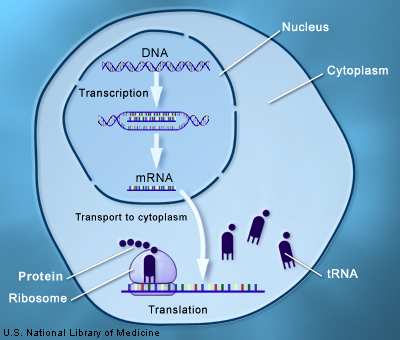
A gene directs the synthesis of a protein by a two-step process. First, the instructions in the gene in the DNA are copied into a messenger RNA (mRNA) molecule. The sequence of nucleotides in the gene determines the sequence of nucleotides in the mRNA. This step is called transcription.
Most genes contain the information needed to make functional molecules called proteins. (A few genes produce other molecules that help the cell assemble proteins.) The journey from gene to protein is complex and tightly controlled within each cell. It consists of two major steps: transcription and translation. Together, transcription and translation are known as gene expression.
During the process of transcription, the information stored in a gene's DNA is transferred to a similar molecule called RNA (ribonucleic acid) in the cell nucleus. Both RNA and DNA are made up of a chain of nucleotide bases, but they have slightly different chemical properties. The type of RNA that contains the information for making a protein is called messenger RNA (mRNA) because it carries the information, or message, from the DNA out of the nucleus into the cytoplasm.
Translation, the second step in getting from a gene to a protein, takes place in the cytoplasm. The mRNA interacts with a specialized complex called a ribosome, which "reads" the sequence of mRNA bases. Each sequence of three bases, called a codon, usually codes for one particular amino acid. (Amino acids are the building blocks of proteins.) A type of RNA called transfer RNA (tRNA) assembles the protein, one amino acid at a time. Protein assembly continues until the ribosome encounters a “stop” codon (a sequence of three bases that does not code for an amino acid).
The flow of information from DNA to RNA to proteins is one of the fundamental principles of molecular biology. It is so important that it is sometimes called the “central dogma.”
Function of protein;
| Table 1. Protein Types and Functions | ||
|---|---|---|
| Type | Examples | Functions |
| Digestive Enzymes | Amylase, lipase, pepsin, trypsin | Help in digestion of food by catabolizing nutrients into monomeric units |
| Transport | Hemoglobin, albumin | Carry substances in the blood or lymph throughout the body |
| Structural | Actin, tubulin, keratin | Construct different structures, like the cytoskeleton |
| Hormones | Insulin, thyroxine | Coordinate the activity of different body systems |
| Defense | Immunoglobulins | Protect the body from foreign pathogens |
| Contractile | Actin, myosin | Effect muscle contraction |
| Storage | Legume storage proteins, egg white (albumin) | Provide nourishment in early development of the embryo and the seedling |
Two special and common types of proteins are enzymes and hormones. Enzymes, which are produced by living cells, are catalysts in biochemical reactions (like digestion) and are usually complex or conjugated proteins. Each enzyme is specific for the substrate (a reactant that binds to an enzyme) it acts on. The enzyme may help in breakdown, rearrangement, or synthesis reactions. Enzymes that break down their substrates are called catabolic enzymes, enzymes that build more complex molecules from their substrates are called anabolic enzymes, and enzymes that affect the rate of reaction are called catalytic enzymes. It should be noted that all enzymes increase the rate of reaction and, therefore, are considered to be organic catalysts. An example of an enzyme is salivary amylase, which hydrolyzes its substrate amylose, a component of starch.
Add Answer to:
Build a concept map for a mature protein. Think about the road
taken from a gene...
Part 4: The APC protein Sam, I'm really worried about hearing my test results today," Jane...
 Part 4: The APC protein Sam, I'm really worried about hearing my test results today," Jane said as they headed in for another visit with their genetic counselor. "After Ms. Meeker explained your results to us, l've been dreading hearing whether or not I have the mutation, too Sam nodded, saying, "l can understand how you feel. I'm glad I can be here at the appointment, too, to support you. Whatever happens, you know your family is here for you....
Part IV—The APC Protein “Sam, I’m really worried about seeing my test results today,” Jane said...
Part IV—The APC Protein “Sam, I’m really worried about seeing my test results today,” Jane said as they headed in for another visit with their genetic counselor. “After Ms. Meeker explained your results to us, I’ve been dreading hearing whether or not I have the mutation too.” Sam nodded, saying, “I can understand how you feel. I’m glad I can be here at the appointment to support you. Whatever happens, you know your family is here for you.” Ms. Meeker...
Genetics Worksheet Week 3: Gene Regulation and Epigenetics 1. Duchenne muscular dystrophy is caused by a mutation in a gene that is 2.5 million nucleotides in length and encodes a protein called dyst...
 Genetics Worksheet Week 3: Gene Regulation and Epigenetics 1. Duchenne muscular dystrophy is caused by a mutation in a gene that is 2.5 million nucleotides in length and encodes a protein called dystrophin. The dystrophin protein itself is 3684 amino acids in length. Calculate below the approximate size of the mRNA that encodes dystrophin. Approximately what percentage of the gene that encodes dystrophin is intron sequence? The human genome encodes a much greater variety and number of proteins than the...
Case 8 Hemoglobin, the Oxygen Carrier Focus concept A mutation in the gene for hemoglobin results...
 Case 8 Hemoglobin, the Oxygen Carrier Focus concept A mutation in the gene for hemoglobin results in an altered protein responsible for the disease sickle cell anemia. An understanding of the biochemistry of the disease may suggest possible treatments Prerequisite Hemoglobin structure and function concepts Background Normal adult hemoglobin is called Hemoglobin A (Hb A). Ninety-eight percent ofaduk hemoglobin is Hb A and 2% is Hb A. There are other forms of hemoglobin. For example, the deve loping fetus has...
I think I can pinpoint my confusion a bit better. Here comes my updated question (I'm...
I think I can pinpoint my confusion a bit better. Here comes my updated question (I'm not sure what the standard way of doing things is - please let me know if I should delete the old version). The major change is that I removed focus from the third question which probably is a purely mathematical question (in the notation below, it asks what properties of (M,T) together with (M,T) being consistent, forces (M,T) to be unique.). Say that a...
The Case Study in Cancer Part I Ann is a 27-year-old nurse working at the local...
The Case Study in Cancer Part I Ann is a 27-year-old nurse working at the local hospital in surgery. She had worked hard to move into the specialty, and she was enjoying her career, friends, and family. She and her partner had been living together for about a year, and she was content. As a nurse, Ann knew the importance of doing breast self-exams, and did them regularly. In the shower one morning, she felt a lump she wasn’t familiar...
Required: I need to paraphrase the answer because it is plagiarized. . Question: What is the...
Required: I need to paraphrase the answer because it is plagiarized. . Question: What is the function of beta cells in the pancreas? Answer: Beta cells (β cells) are a type of cell found in pancreatic islets that synthesize and secrete insulin and amylin. Beta cells make up 50–70% of the cells in human islets. In patients with type I or type II diabetes, beta-cell mass and function are diminished, leading to insufficient insulin secretion and hyperglycemia. The pancreas is...
1. Bacteria such as E.coll and staph belong to which Domain? A. Animalia B. Eukarya C....
 1. Bacteria such as E.coll and staph belong to which Domain? A. Animalia B. Eukarya C. Archaea D. Bacteria 2. In general terms, prokaryotic cells are cells that? A. Have a nucleus B. Do not have a nucleus. 3. Think about the name E. coli 4X56. In that name which refers to the serotype? A E B. coli C4X56 4. Which of the following best describes the type of bacteria that are important to ecology, and once were thought to...
Let’s build a dynamic string tokenizer! Start with the existing template and work on the areas...
Let’s build a dynamic string tokenizer! Start with the existing template and work on the areas marked with TODO in the comments: Homework 8 Template.c Note: If you turn the template back into me without adding any original work you will receive a 0. By itself the template does nothing. You need to fill in the code to dynamically allocate an array of strings that are returned to the user. Remember: A string is an array. A tokenizer goes through...
PLEASE COMPUTER TYPED* OR VERY CLEAR HANDWRITING with details 1. Radioactive (14C) uridine (lots of it)...
 PLEASE COMPUTER TYPED* OR VERY CLEAR HANDWRITING with
details
1. Radioactive (14C) uridine (lots of it) is added to a growing culture of bacteria for 10 seconds and then the drug rifamycin is added (rifamycin blocks the initiation of transcription, but not continued elongation of RNA polymerases that have already begun transcribing). At two-minute intervals, 1 ml samples are removed and placed on ice. The bacteria are lysed (broken open) and an enzyme is added that will chew up all...
PLEASE COMPUTER TYPED* OR VERY CLEAR HANDWRITING with
details
1. Radioactive (14C) uridine (lots of it) is added to a growing culture of bacteria for 10 seconds and then the drug rifamycin is added (rifamycin blocks the initiation of transcription, but not continued elongation of RNA polymerases that have already begun transcribing). At two-minute intervals, 1 ml samples are removed and placed on ice. The bacteria are lysed (broken open) and an enzyme is added that will chew up all...
 Part 4: The APC protein Sam, I'm really worried about hearing my test results today," Jane said as they headed in for another visit with their genetic counselor. "After Ms. Meeker explained your results to us, l've been dreading hearing whether or not I have the mutation, too Sam nodded, saying, "l can understand how you feel. I'm glad I can be here at the appointment, too, to support you. Whatever happens, you know your family is here for you....
 Genetics Worksheet Week 3: Gene Regulation and Epigenetics 1. Duchenne muscular dystrophy is caused by a mutation in a gene that is 2.5 million nucleotides in length and encodes a protein called dystrophin. The dystrophin protein itself is 3684 amino acids in length. Calculate below the approximate size of the mRNA that encodes dystrophin. Approximately what percentage of the gene that encodes dystrophin is intron sequence? The human genome encodes a much greater variety and number of proteins than the...
 Case 8 Hemoglobin, the Oxygen Carrier Focus concept A mutation in the gene for hemoglobin results in an altered protein responsible for the disease sickle cell anemia. An understanding of the biochemistry of the disease may suggest possible treatments Prerequisite Hemoglobin structure and function concepts Background Normal adult hemoglobin is called Hemoglobin A (Hb A). Ninety-eight percent ofaduk hemoglobin is Hb A and 2% is Hb A. There are other forms of hemoglobin. For example, the deve loping fetus has...
 1. Bacteria such as E.coll and staph belong to which Domain? A. Animalia B. Eukarya C. Archaea D. Bacteria 2. In general terms, prokaryotic cells are cells that? A. Have a nucleus B. Do not have a nucleus. 3. Think about the name E. coli 4X56. In that name which refers to the serotype? A E B. coli C4X56 4. Which of the following best describes the type of bacteria that are important to ecology, and once were thought to...
 PLEASE COMPUTER TYPED* OR VERY CLEAR HANDWRITING with
details
1. Radioactive (14C) uridine (lots of it) is added to a growing culture of bacteria for 10 seconds and then the drug rifamycin is added (rifamycin blocks the initiation of transcription, but not continued elongation of RNA polymerases that have already begun transcribing). At two-minute intervals, 1 ml samples are removed and placed on ice. The bacteria are lysed (broken open) and an enzyme is added that will chew up all...
PLEASE COMPUTER TYPED* OR VERY CLEAR HANDWRITING with
details
1. Radioactive (14C) uridine (lots of it) is added to a growing culture of bacteria for 10 seconds and then the drug rifamycin is added (rifamycin blocks the initiation of transcription, but not continued elongation of RNA polymerases that have already begun transcribing). At two-minute intervals, 1 ml samples are removed and placed on ice. The bacteria are lysed (broken open) and an enzyme is added that will chew up all...
Most questions answered within 3 hours.
-
Where is the error in this code sequence?
String s1 = "Hello";
String s2 = "ello";...
asked 10 months ago -
Financial data for Joel de Paris, Inc., for last year
follow:
Joel de Paris, Inc.
Balance...
asked 10 months ago -
Consider this reaction:
Al2(SO4)3 (aq)+ BaCl3
(aq) Al2Cl6 (aq)- +
3BaSO4(s) . What is the...
asked 10 months ago -
Suppose that Savneet is considering increasing her
recent random sample from 20 car rentals to 40...
asked 10 months ago -
Trucks arrive at an unloading terminal at an average rate of 120
per hour.
Trucks arrive...
asked 10 months ago -
Why are methanol and ethanol completely soluble in water while
octanol is not very little soluble....
asked 10 months ago -
A facilities manager at a university reads in a research report
that the mean amount of...
asked 10 months ago -
When the CuSO4 is rehydrated by adding water to the anhydrous
compound, is this an endothermic...
asked 10 months ago -
A ray of sunlight is passing from diamond into crown glass; the
angle of incidence is...
asked 10 months ago -
A block of mass 0.249 kg is placed on top of a light, vertical
spring of...
asked 10 months ago -
how do the kidneys compensate in the presences of acidosis
a) trigger hyperventilate
b) reserve acid...
asked 10 months ago -
Question 501 pts
The rental rate of capital to the firm increases. Which of the
following...
asked 10 months ago