When plasmid pD21 is digested with the following enzymes, these bands are produced (all in kb):...
When plasmid pD21 is digested with the following enzymes, these bands are produced (all in kb):
HinIII : 3.82, 0.18
SaII : 2.35, 1.65
EcoRV : 3.0, 1.0
HindIII + SaII : 2.35, 1.20, 0.27, 0.18
HindIII + EcoRV : 1.87, 1.00, 0.95, 0.18
SaII + EcoRV : 1.60, 1.40, 0.75, 0.25
Draw a restriction map based on the fragments that were produced.
Homework Answers
As plasmid pD21 is circular, number of restriction sites for each enzyme will be 2.
First we compare the digestion of HindIII with HindIII + SalI. We find that, 0.18 kb fragment due to digestion with only HindIII & 2.35 kb fragment due to digestion with only SalI stay intact when digestion with HindIII + SalI. Based on this data initial restriction map is drawn.
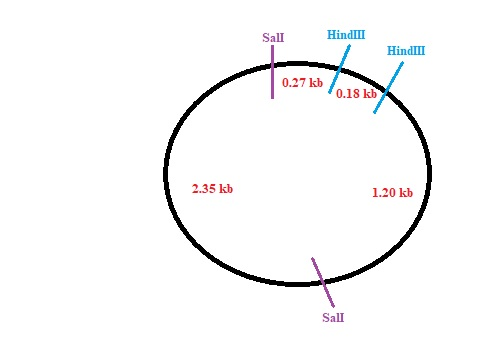
Next we compare the data of SalI with SalI + EcoRV. Only possibility is that 2.35 kb fragment due to digestion with only SalI is divided into two fragments of 1.60 kb & 0.75 kb when digested with SalI + EcoRV. Also, 1.65 kb fragment due to digestion with only SalI is divided into two fragments of 1.40 kb & 0.25 kb when digested with SalI + EcoRV. Now, to find the order of this fragments we compare the data with digestion of HindIII + EcoRV. As one 1.60 kb fragment is generated with digestion of SalI + EcoRV & one 1.87 kb fragment is generated with digestion of HindIII+ EcoRV, These two fragments must present side by side. Also, 0.18 kb fragment due to digestion with only HindIII stay intact when digestion with HindIII + EcoRV. Further, we can find a 1 kb fragment when digested with only EcoRV. Considering all of this final restriction map is shown in below.

Add Answer to:
When plasmid pD21 is digested with the following enzymes, these
bands are produced (all in kb):...
Calculate the restriction map of plasmid JLB51given the following restriction digest data. HindIII 3.82 0.18 kb...
 Calculate the restriction map of plasmid JLB51given the following restriction digest data. HindIII 3.82 0.18 kb BamHI 2.35, 1.65 kb EcoRI 3.00, 1.0 kb HindIII, BamHI 2.35, 1.2, 0.27, 0.18 kb HindIII, EcoRI 1.87, 1.00, 0.95, 0.18 kb BamHI, EcoRI 1.6, 1.4, 0.75, 0.25 kb draw the circular map
7. Show the restriction map for pOA102, which is a total of 4.35 kb. Sal: 2.30, 0.25, 1.80 Hhaill...
 7. Show the restriction map for pOA102, which is a total of 4.35 kb. Sal: 2.30, 0.25, 1.80 Hhaill: 210, 1.55, 0.70 Sall艹hall: 1.20. 1.10. 0.75 0.70, 0.35. 0.25 pDA102 5. Map the plasmid from the fragments shown below. Pstl: 4.36 kb EcoRI: 4.36 kb Sall: 4.36 kb EcoRI+Sall: 3.98 kb, 0.38 kb EcoRi +Pstl: 3.61 kb. 0.75 kb Psti Sall: 3.23 kb, 1.13 kb 6. Map pDA401 from the digests below (all given in kb units) Hindll: 3.82. 0.18...
A plasmid that is 3931 base pairs (bp) is digested with two restriction enzymes Nae I...
A plasmid that is 3931 base pairs (bp) is digested with two restriction enzymes Nae I and Nar I. The Nae I digestion produces two fragments. One is 3158 (bp) and the second is 773 bp. The NarI digestion produces two fragments. One is 3181 bp and the second is 750 bp. When the plasmid is digested with both enzymes four fragments are produced. They are 2656 bp, 525 bp, 502 bp, and 248 bp. Draw a circular map of...
The table below presents the results of different digests of a plasmid. All sizes are in...
The table below presents the results of different digests of a plasmid. All sizes are in base pairs. Digest Size of Fragments HindIII 4.00 kb BamHI 2.35 kb, 1.65 kb EcoRI 4.00 kb, 2.50 kb,1.50 kb HindIII + BamHI 1.65 kb, 1.50 kb, 0.85 kb HindIII + EcoRI 3.50 kb, 3.00 kb, 2.50kb, 1.00 kb, 0.50 kb BamHI + EcoRI 2.00kb, 1.85kb, 1.65kb, 1.5kb, 0.35kb, 0.50 kb One of the enzymes used only partially digested the DNA. Which enzyme is...
Can someone please help me answer these? Neat work is greatly appreciated. Explanation will also be...
 Can someone please help me answer these? Neat work is greatly
appreciated.
Explanation will also be appreciated (optional, if you have
time).
Thank you so much! I will give a big thumbs up :)
(1) You start with the pUC18 plasmid that is a -2.7 kb circular DNA molecule. The multiple cloning site (i.e., polylynker) has unique restriction sites in the following order: HindIII, BamHI, EcoRI. Recall that unique restriction site means that these sites are only found once on...
Can someone please help me answer these? Neat work is greatly
appreciated.
Explanation will also be appreciated (optional, if you have
time).
Thank you so much! I will give a big thumbs up :)
(1) You start with the pUC18 plasmid that is a -2.7 kb circular DNA molecule. The multiple cloning site (i.e., polylynker) has unique restriction sites in the following order: HindIII, BamHI, EcoRI. Recall that unique restriction site means that these sites are only found once on...
Restriction Mapping Below is a restriction map for the plasmid PGEN101 (total length - 20 kb)....
 Restriction Mapping Below is a restriction map for the plasmid PGEN101 (total length - 20 kb). Using this map as a guide, give the number of restriction fragments along with their associated lengths that would result from digesting PGEN101 with the restriction enzymes EcoRI, BamHII, anda combination of EcoRI + BamHI. BamHI BamHI BamHI / PGEN101 (20 kb) Mb EcoRI Digest Performed Size Emments Obtained EcoRI........ BamHI.. EcoRI + BamHI.... Two freshmen college students, interested in becoming gene jocks, performed...
Extra Credit (1 point all or nothing) A circular DNA plasmid was digested with the following...
Extra Credit (1 point all or nothing) A circular DNA plasmid was digested with the following results. Draw a map of the plasmid with all the restriction sites EcoRI: 7.0kb SalI: 7 kb HindIII: 4.0kb, 2.0kb, 1.0kbSalI + HindIII: 2.5kb, 2.0kb, 1.5kb, 1.0kb EcoRI + HindIII: 4.0kb, 2.0kb, 0.6kb, 0.4kb EcoRI + SalI: 2.9kb, 4.1kb
2) A linear phage chromosome is labelled at both ends with 32P and digested with restriction...
 2) A linear phage chromosome is labelled at both ends with 32P and digested with restriction enzymes. EcoRI produces fragments of sizes 2.9, 4.5. 6.2.7.4, and 8.0 kb. An autoradiogram developed from a Southern blot of this digest shows radioactivity associated with the 6.2 and 8.0 fragments. BamHI cleaves the same molecule into fragments of sizes 6.0, 10.1 and 12.9; the label is found to be associated with the 6.0 and 10.1 fragments. When EcoRI and BamHI are used together,...
Suppose 1000 coins are tossed. Use the normal curve approximation to the binomial distribution to find...
 Suppose 1000 coins are tossed. Use the normal curve approximation to the binomial distribution to find the probability of getting the following result. Exactly 495 heads Use the table of areas under the standard normal curve given below. Click here to view page 1. Click here to view page 2. Click here to view page 3. Click here to view page 4. Click here to view page 5. Click here to view page 6. The probability of getting exactly 495...
Suppose 16 coins are tossed. Use the normal curve approximation to the binomial distribution to find...
 Suppose 16 coins are tossed. Use the normal curve approximation to the binomial distribution to find the probability of getting the following result. More than 11 tails. Use the table of areas under the standard normal curve given below. Click here to view page 1. Click here to view page 2. Click here to view page 3. Click here to view page 4. Click here to view page 5. Click here to view page 6. Binomial probability = (Round to...
 Calculate the restriction map of plasmid JLB51given the following restriction digest data. HindIII 3.82 0.18 kb BamHI 2.35, 1.65 kb EcoRI 3.00, 1.0 kb HindIII, BamHI 2.35, 1.2, 0.27, 0.18 kb HindIII, EcoRI 1.87, 1.00, 0.95, 0.18 kb BamHI, EcoRI 1.6, 1.4, 0.75, 0.25 kb draw the circular map
 7. Show the restriction map for pOA102, which is a total of 4.35 kb. Sal: 2.30, 0.25, 1.80 Hhaill: 210, 1.55, 0.70 Sall艹hall: 1.20. 1.10. 0.75 0.70, 0.35. 0.25 pDA102 5. Map the plasmid from the fragments shown below. Pstl: 4.36 kb EcoRI: 4.36 kb Sall: 4.36 kb EcoRI+Sall: 3.98 kb, 0.38 kb EcoRi +Pstl: 3.61 kb. 0.75 kb Psti Sall: 3.23 kb, 1.13 kb 6. Map pDA401 from the digests below (all given in kb units) Hindll: 3.82. 0.18...
 Can someone please help me answer these? Neat work is greatly
appreciated.
Explanation will also be appreciated (optional, if you have
time).
Thank you so much! I will give a big thumbs up :)
(1) You start with the pUC18 plasmid that is a -2.7 kb circular DNA molecule. The multiple cloning site (i.e., polylynker) has unique restriction sites in the following order: HindIII, BamHI, EcoRI. Recall that unique restriction site means that these sites are only found once on...
Can someone please help me answer these? Neat work is greatly
appreciated.
Explanation will also be appreciated (optional, if you have
time).
Thank you so much! I will give a big thumbs up :)
(1) You start with the pUC18 plasmid that is a -2.7 kb circular DNA molecule. The multiple cloning site (i.e., polylynker) has unique restriction sites in the following order: HindIII, BamHI, EcoRI. Recall that unique restriction site means that these sites are only found once on...
 Restriction Mapping Below is a restriction map for the plasmid PGEN101 (total length - 20 kb). Using this map as a guide, give the number of restriction fragments along with their associated lengths that would result from digesting PGEN101 with the restriction enzymes EcoRI, BamHII, anda combination of EcoRI + BamHI. BamHI BamHI BamHI / PGEN101 (20 kb) Mb EcoRI Digest Performed Size Emments Obtained EcoRI........ BamHI.. EcoRI + BamHI.... Two freshmen college students, interested in becoming gene jocks, performed...
 2) A linear phage chromosome is labelled at both ends with 32P and digested with restriction enzymes. EcoRI produces fragments of sizes 2.9, 4.5. 6.2.7.4, and 8.0 kb. An autoradiogram developed from a Southern blot of this digest shows radioactivity associated with the 6.2 and 8.0 fragments. BamHI cleaves the same molecule into fragments of sizes 6.0, 10.1 and 12.9; the label is found to be associated with the 6.0 and 10.1 fragments. When EcoRI and BamHI are used together,...
 Suppose 1000 coins are tossed. Use the normal curve approximation to the binomial distribution to find the probability of getting the following result. Exactly 495 heads Use the table of areas under the standard normal curve given below. Click here to view page 1. Click here to view page 2. Click here to view page 3. Click here to view page 4. Click here to view page 5. Click here to view page 6. The probability of getting exactly 495...
 Suppose 16 coins are tossed. Use the normal curve approximation to the binomial distribution to find the probability of getting the following result. More than 11 tails. Use the table of areas under the standard normal curve given below. Click here to view page 1. Click here to view page 2. Click here to view page 3. Click here to view page 4. Click here to view page 5. Click here to view page 6. Binomial probability = (Round to...
Most questions answered within 3 hours.
-
Where is the error in this code sequence?
String s1 = "Hello";
String s2 = "ello";...
asked 10 months ago -
Financial data for Joel de Paris, Inc., for last year
follow:
Joel de Paris, Inc.
Balance...
asked 10 months ago -
Consider this reaction:
Al2(SO4)3 (aq)+ BaCl3
(aq) Al2Cl6 (aq)- +
3BaSO4(s) . What is the...
asked 10 months ago -
Suppose that Savneet is considering increasing her
recent random sample from 20 car rentals to 40...
asked 10 months ago -
Trucks arrive at an unloading terminal at an average rate of 120
per hour.
Trucks arrive...
asked 10 months ago -
Why are methanol and ethanol completely soluble in water while
octanol is not very little soluble....
asked 10 months ago -
A facilities manager at a university reads in a research report
that the mean amount of...
asked 10 months ago -
When the CuSO4 is rehydrated by adding water to the anhydrous
compound, is this an endothermic...
asked 10 months ago -
A ray of sunlight is passing from diamond into crown glass; the
angle of incidence is...
asked 10 months ago -
A block of mass 0.249 kg is placed on top of a light, vertical
spring of...
asked 10 months ago -
how do the kidneys compensate in the presences of acidosis
a) trigger hyperventilate
b) reserve acid...
asked 10 months ago -
Question 501 pts
The rental rate of capital to the firm increases. Which of the
following...
asked 10 months ago