&nb
Write a static method named sumOf that takes an array of int
values as an argument (you may safely assume that the array
contains at least 1 element). This method should return the sum of
all values in the array.
Examples:
Given the following array declaration and
definition.
int[] theArray = {0, 0,
0, 0, 0, 0};
sumOf(theArray) will
return 0
Given the following array declaration and
definition.
int[] theArray = {1, 1,
1, 1, 1, 1};
sumOf(theArray) will
return 6
Given the following array declaration and
definition.
int[] theArray = {1, 3,
5, 6, 4, 2};
sumOf(theArray) will
return 21
Homework Answers
Code:
class XYZ
{   // function you need
    public static int sumOf(int ar[])
    {
        int sum = 0;
        for(int i=0;i<ar.length;i++)
        {
            sum += ar[i];
        }
        return sum;
    }
    public static void main(String args[])
    {
        int[] theArray = {1,3,5,6,4,2};
        System.out.println(sumOf(theArray));

    }
}
Output:
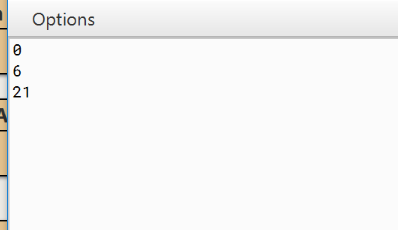
Write a static method named sumOf that takes an array of int values as an argument...
Write a static method named sumOf that takes an array of int values as an argument (you may safely assume that the array contains at least 1 element). This method should return the sum of all values in the array. Examples: Given the following array declaration and definition. int[] theArray = {0, 0, 0, 0, 0, 0}; sumOf(theArray) will return 0 Given the following array declaration and definition. int[] theArray = {1, 1, 1, 1, 1, 1}; sumOf(theArray) will return...
1) Write a public static method named printArray, that takes two arguments. The first argument is...
1) Write a public static method named printArray, that takes two arguments. The first argument is an Array of int and the second argument is a String. The method should print out a list of the values in the array, each separated by the value of the second argument. For example, given the following Array declaration and instantiation: int[] myArray = {1, 22, 333, 400, 5005, 9}; printArray(myArray, ", ") will print out 1, 22, 333, 400, 5005, 9 printArray(myArray,...
Assignment 06 – Ten Array Methods You must work in alone on this assignment. Do not...
Assignment 06 – Ten Array Methods You must work in alone on this assignment. Do not use any Java language features we have not cover so far in this course. Assignment Objectives After completing this assignment the student should be able to: Declare and instantiate arrays Access array elements by index Use loops and decisions to manipulate arrays and array elements Write methods that manipulate arrays Write methods that take array arguments Write methods...
You must create a Java class named TenArrayMethods in a file named TenArrayMethods.java. This class must...
You must create a Java class named TenArrayMethods in a file named TenArrayMethods.java. This class must include all the following described methods. Each of these methods should be public and static.Write a method named getFirst, that takes an Array of int as an argument and returns the value of the first element of the array. NO array lists. Write a method named getLast, that takes an Array of int as an argument and returns the value of the last element...
Write a public static method named getMaxOf2Ints that takes in 2 int arguments and returns the...
Write a public static method named getMaxOf2Ints that takes in 2 int arguments and returns the Maximum of the 2 values Write a public static method named getMinOf2Ints that takes in 2 int arguments and returns the Minimum of the 2 values Write apublic static method named getMaxOf3Ints that takes in 3 int arguments and returns the Maximum of the 3 values Write a public static method named getMedianOf3Ints that takes in 3 int arguments and returns the Median Value...
Programming 5_1: Create a Java class named <YourName>5_1 In this class create a main method...
Programming 5_1: Create a Java class named <YourName>5_1 In this class create a main method, but for now leave it empty. Then write a Java method getAverage which takes an array of integers as it’s argument. The method calculate the average of all the elements in the array, and returns that average. The method should work for an array of integers of any length greater than or equal to one. The method signature is shown below: public static double getAverage(...
Write a static method named middleValue that takes three int arguments, and returns an int. When...
Write a static method named middleValue that takes three int arguments, and returns an int. When given three different argument values, the method should return the value that is numerically between the other two values. When given three values where two or more argument values are the same, then the function should return that value. Examples: middleValue(1, 2, 3) will return 2 middleValue(5, 2, 7) will return 5 middleValue(8, 4, 6) will return 6 middleValue(1, 2, 1) will return 1...
JAVA~ 1. Write a static method named countOdd(my_array) that returns the number of odd integers in...
JAVA~ 1. Write a static method named countOdd(my_array) that returns the number of odd integers in a given array. If there are no odd numbers in the array, the method should return 0. If the array is empty, the method should also return 0. For example: Test Result System.out.println(countOdd(new int[]{2, 3, 5, 6})); 2 System.out.println(countOdd(new int[]{2})); 0 System.out.println(countOdd(new int[]{})); 0 System.out.println(countOdd(new int[]{-7, 2, 3, 8, 6, 6, 75, 38, 3, 2})); 4 public static int ----------------------------------------------------------------------------------------------------------- 2. Write a static...
1. Write a static method named mode that takes an array of integers as a parameter...
 1. Write a static method named mode that takes an array of integers as a parameter and that returns the value that occurs most frequently in the array. Assume that the integers in the array appear in sorted order. For example, if a variable called list stores the following values: ist -3, 1, 4, 4, 4, 6, 7,8, 8, 8, 8, 9, 11, 11, 11, 12, 14, int 141i Then the call of mode (li array, appearing four times. st,...
 1. Write a static method named mode that takes an array of integers as a parameter and that returns the value that occurs most frequently in the array. Assume that the integers in the array appear in sorted order. For example, if a variable called list stores the following values: ist -3, 1, 4, 4, 4, 6, 7,8, 8, 8, 8, 9, 11, 11, 11, 12, 14, int 141i Then the call of mode (li array, appearing four times. st,...
Most questions answered within 3 hours.
-
Where is the error in this code sequence?
String s1 = "Hello";
String s2 = "ello";...
asked 10 months ago -
Financial data for Joel de Paris, Inc., for last year
follow:
Joel de Paris, Inc.
Balance...
asked 10 months ago -
Consider this reaction:
Al2(SO4)3 (aq)+ BaCl3
(aq) Al2Cl6 (aq)- +
3BaSO4(s) . What is the...
asked 10 months ago -
Suppose that Savneet is considering increasing her
recent random sample from 20 car rentals to 40...
asked 10 months ago -
Trucks arrive at an unloading terminal at an average rate of 120
per hour.
Trucks arrive...
asked 10 months ago -
Why are methanol and ethanol completely soluble in water while
octanol is not very little soluble....
asked 10 months ago -
A facilities manager at a university reads in a research report
that the mean amount of...
asked 10 months ago -
When the CuSO4 is rehydrated by adding water to the anhydrous
compound, is this an endothermic...
asked 10 months ago -
A ray of sunlight is passing from diamond into crown glass; the
angle of incidence is...
asked 10 months ago -
A block of mass 0.249 kg is placed on top of a light, vertical
spring of...
asked 10 months ago -
how do the kidneys compensate in the presences of acidosis
a) trigger hyperventilate
b) reserve acid...
asked 10 months ago -
Question 501 pts
The rental rate of capital to the firm increases. Which of the
following...
asked 10 months ago