a) A given electrical circuit operating on "V" volts with "R" ohms of resistance draws 5.8...
a) A given electrical circuit operating on "V" volts with "R" ohms of resistance draws 5.8 amps of current. How much current will it draw if "V" is multiplied by 2.7?
b) How much current will the circuit above draw if it is connected to the original "V" but the resistance is multiplied by 5.0?
Homework Answers
Part A.
Using Ohm's law:
E = I*R
When E = V & R = R, then
I = E/R = V/R = 5.8 Amp
Now when E1 = 2.7*V, then
I1 = E1/R = 2.7*V/R
I1 = 2.7*I = 2.7*5.8 = 15.66 A
Part B.
Now when R1 = 5.0*R
then
I1 = E/R1 = V/(5.0*R) = (1/5.0)*(V/R)
I1 = (1/5.0)*5.8 = 5.8/5.0 = 1.16 Amp
Please Upvote.
Add Answer to:
a) A given electrical circuit operating on "V" volts with "R"
ohms of resistance draws 5.8...
In the following circuit, V = 55 volts, R1 = 3 Ohms, R2 = 5 Ohms,...
In the following circuit, V = 55 volts, R1 = 3 Ohms, R2 = 5 Ohms, R3 = 3 Ohms, R4 = 10 Ohms, and R5 = 6 Ohms. What is the current through R 3 in amps? Ri w 3 R2 + 4 mm R5
Given the following circuit with V = 36 Volts, R1 = 9 Ohms, R2 = 9...
 Given the following circuit with V = 36 Volts, R1 = 9
Ohms, R2 = 9 Ohms, R3 = 16 Ohms,
R4 = 3 Ohms, R5 = 6 Ohms, R6 = 11
Ohms, R7 = 3 Ohms, and R8 = 9 Ohms, what is
the equivalent resistance of the entire circuit in Ohms?
Given the following circuit with V = 36 Volts, R1 = 9 Ohms, R2 = 9 Ohms, R3 = 16 Ohms, R4 = 3 Ohms, R5 =...
Given the following circuit with V = 36 Volts, R1 = 9
Ohms, R2 = 9 Ohms, R3 = 16 Ohms,
R4 = 3 Ohms, R5 = 6 Ohms, R6 = 11
Ohms, R7 = 3 Ohms, and R8 = 9 Ohms, what is
the equivalent resistance of the entire circuit in Ohms?
Given the following circuit with V = 36 Volts, R1 = 9 Ohms, R2 = 9 Ohms, R3 = 16 Ohms, R4 = 3 Ohms, R5 =...
given the following circuit v= 66 volts R1= 5 ohms R2 = 14 ohms R3 =...
 given the following circuit
v= 66 volts
R1= 5 ohms
R2 = 14 ohms
R3 = 8 ohms
R4 =6 ohms
R5=8 ohms
R6= 9 ohms
R7= 7 ohms
R8= 8 ohms
what is the total power dissipated by all the resisitors
excluding 1,3, and 6 answer in watts.
Question 3 1.2 pts 3) Given the following circuit with V = 46 Volts, R2 = 5 Ohms, R2 = 14 Ohms, R3 = 8 Ohms, R = 6 Ohms, Rs...
given the following circuit
v= 66 volts
R1= 5 ohms
R2 = 14 ohms
R3 = 8 ohms
R4 =6 ohms
R5=8 ohms
R6= 9 ohms
R7= 7 ohms
R8= 8 ohms
what is the total power dissipated by all the resisitors
excluding 1,3, and 6 answer in watts.
Question 3 1.2 pts 3) Given the following circuit with V = 46 Volts, R2 = 5 Ohms, R2 = 14 Ohms, R3 = 8 Ohms, R = 6 Ohms, Rs...
15. Three components are connected in series; the total resistance is 200 a. If the combined...
 15. Three components are connected in series; the total resistance is 200 a. If the combined resistance of two of the components is 150, what is the resistance of the third component? 2. Given the c unknown val (a) 100 ohms () 25 ohms (c) 75 ohms (d) 50 ohms 16. What value of current will flow through the circuit in the diagram (Figure 5-26) on page 88 in the textbook? (a) 1 amp (b) 2 amps (c) 4 amps...
If an electrical circuit is set up to produce a current of 0.25 amps with a...
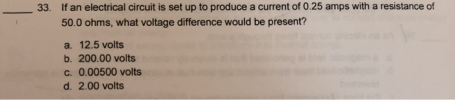 If an electrical circuit is set up to produce a current of 0.25 amps with a resistance of 50.0 ohms, what voltage difference would be present? 33. a. 12.5 volts b. 200.00 volts c. 0.00500 volts d. 2.00 volts
Problem 6: A 230-V shunt motor has an armature resistance of 0.05 Ohms and a field resistance of 75 Ohms. The motor draws 7 A of line current while running light at 1120 rpm. The line current at a...
 Problem 6: A 230-V shunt motor has an armature resistance of 0.05 Ohms and a field resistance of 75 Ohms. The motor draws 7 A of line current while running light at 1120 rpm. The line current at a certain load is 46 A. (a) What is the motor speed at this load? (b) At this load, if the field circuit resistance is increased to 100 Ohms, what is the new speed of the motor? Assume linearity between the flux...
Question 4 In Figure Q4, a resistance, R is connected in series with an iron-cored choke coil (r in series with L). The circuit draws a current of 5 A at 240 V, 60 Hz. The voltages across the res...
 Question 4 In Figure Q4, a resistance, R is connected in series with an iron-cored choke coil (r in series with L). The circuit draws a current of 5 A at 240 V, 60 Hz. The voltages across the resistance and the coil are 100 V and 200 V respectively. Analyze the circuit to determine the following (a) the resistance, reactance and impedance of the coil, (b) the power absorbed by the coil, and (c) the power factor (pf) of...
In a series resistance-capacitance DC circuit, the instantaneous charge Q on the capacitor as a... In...
In a series resistance-capacitance DC circuit, the instantaneous charge Q on the capacitor as a... In a series resistance-capacitance DC circuit, the instantaneous charge Q on the capacitor as a function of time (where t=0 is the moment the circuit is energized by closing a switch) is given by the equation Q(t)=CV(1-e-t/(RC), where C, V, and R are constants. Further, the instantaneous charging current Ic is the rate of change of charge on the capacitor, or Ic=dQ/dt a. Find the...
R1 R2 R 3 2 in the above circuit, V1 - 17 volts and v2 -...
 R1 R2 R 3 2 in the above circuit, V1 - 17 volts and v2 - 7 volts. If each of the 3 resistors was 1000 ohms, what is the current (in amps) through resistor R1?
4) Given the circuit below. The voltage is 5 volts and each resistor is 10 ohms....
 4) Given the circuit below. The voltage is 5 volts and each
resistor is 10 ohms. The current flowing through the circuit (when
measured by an ideal ammeter) is 1 amp.
a) Show current through the circuit is 1 A.
Next, assume you put a DMM (in ammeter mode) which has a
resistance of one ohm at point A. Recalculate the equivalent
resistance of the circuit.
b) What is the current flowing through the circuit now.
This is the current...
4) Given the circuit below. The voltage is 5 volts and each
resistor is 10 ohms. The current flowing through the circuit (when
measured by an ideal ammeter) is 1 amp.
a) Show current through the circuit is 1 A.
Next, assume you put a DMM (in ammeter mode) which has a
resistance of one ohm at point A. Recalculate the equivalent
resistance of the circuit.
b) What is the current flowing through the circuit now.
This is the current...
 Given the following circuit with V = 36 Volts, R1 = 9
Ohms, R2 = 9 Ohms, R3 = 16 Ohms,
R4 = 3 Ohms, R5 = 6 Ohms, R6 = 11
Ohms, R7 = 3 Ohms, and R8 = 9 Ohms, what is
the equivalent resistance of the entire circuit in Ohms?
Given the following circuit with V = 36 Volts, R1 = 9 Ohms, R2 = 9 Ohms, R3 = 16 Ohms, R4 = 3 Ohms, R5 =...
Given the following circuit with V = 36 Volts, R1 = 9
Ohms, R2 = 9 Ohms, R3 = 16 Ohms,
R4 = 3 Ohms, R5 = 6 Ohms, R6 = 11
Ohms, R7 = 3 Ohms, and R8 = 9 Ohms, what is
the equivalent resistance of the entire circuit in Ohms?
Given the following circuit with V = 36 Volts, R1 = 9 Ohms, R2 = 9 Ohms, R3 = 16 Ohms, R4 = 3 Ohms, R5 =...
 given the following circuit
v= 66 volts
R1= 5 ohms
R2 = 14 ohms
R3 = 8 ohms
R4 =6 ohms
R5=8 ohms
R6= 9 ohms
R7= 7 ohms
R8= 8 ohms
what is the total power dissipated by all the resisitors
excluding 1,3, and 6 answer in watts.
Question 3 1.2 pts 3) Given the following circuit with V = 46 Volts, R2 = 5 Ohms, R2 = 14 Ohms, R3 = 8 Ohms, R = 6 Ohms, Rs...
given the following circuit
v= 66 volts
R1= 5 ohms
R2 = 14 ohms
R3 = 8 ohms
R4 =6 ohms
R5=8 ohms
R6= 9 ohms
R7= 7 ohms
R8= 8 ohms
what is the total power dissipated by all the resisitors
excluding 1,3, and 6 answer in watts.
Question 3 1.2 pts 3) Given the following circuit with V = 46 Volts, R2 = 5 Ohms, R2 = 14 Ohms, R3 = 8 Ohms, R = 6 Ohms, Rs...
 15. Three components are connected in series; the total resistance is 200 a. If the combined resistance of two of the components is 150, what is the resistance of the third component? 2. Given the c unknown val (a) 100 ohms () 25 ohms (c) 75 ohms (d) 50 ohms 16. What value of current will flow through the circuit in the diagram (Figure 5-26) on page 88 in the textbook? (a) 1 amp (b) 2 amps (c) 4 amps...
 If an electrical circuit is set up to produce a current of 0.25 amps with a resistance of 50.0 ohms, what voltage difference would be present? 33. a. 12.5 volts b. 200.00 volts c. 0.00500 volts d. 2.00 volts
 Problem 6: A 230-V shunt motor has an armature resistance of 0.05 Ohms and a field resistance of 75 Ohms. The motor draws 7 A of line current while running light at 1120 rpm. The line current at a certain load is 46 A. (a) What is the motor speed at this load? (b) At this load, if the field circuit resistance is increased to 100 Ohms, what is the new speed of the motor? Assume linearity between the flux...
 Question 4 In Figure Q4, a resistance, R is connected in series with an iron-cored choke coil (r in series with L). The circuit draws a current of 5 A at 240 V, 60 Hz. The voltages across the resistance and the coil are 100 V and 200 V respectively. Analyze the circuit to determine the following (a) the resistance, reactance and impedance of the coil, (b) the power absorbed by the coil, and (c) the power factor (pf) of...
 R1 R2 R 3 2 in the above circuit, V1 - 17 volts and v2 - 7 volts. If each of the 3 resistors was 1000 ohms, what is the current (in amps) through resistor R1?
 4) Given the circuit below. The voltage is 5 volts and each
resistor is 10 ohms. The current flowing through the circuit (when
measured by an ideal ammeter) is 1 amp.
a) Show current through the circuit is 1 A.
Next, assume you put a DMM (in ammeter mode) which has a
resistance of one ohm at point A. Recalculate the equivalent
resistance of the circuit.
b) What is the current flowing through the circuit now.
This is the current...
4) Given the circuit below. The voltage is 5 volts and each
resistor is 10 ohms. The current flowing through the circuit (when
measured by an ideal ammeter) is 1 amp.
a) Show current through the circuit is 1 A.
Next, assume you put a DMM (in ammeter mode) which has a
resistance of one ohm at point A. Recalculate the equivalent
resistance of the circuit.
b) What is the current flowing through the circuit now.
This is the current...
Most questions answered within 3 hours.
-
Where is the error in this code sequence?
String s1 = "Hello";
String s2 = "ello";...
asked 10 months ago -
Financial data for Joel de Paris, Inc., for last year
follow:
Joel de Paris, Inc.
Balance...
asked 10 months ago -
Consider this reaction:
Al2(SO4)3 (aq)+ BaCl3
(aq) Al2Cl6 (aq)- +
3BaSO4(s) . What is the...
asked 10 months ago -
Suppose that Savneet is considering increasing her
recent random sample from 20 car rentals to 40...
asked 10 months ago -
Trucks arrive at an unloading terminal at an average rate of 120
per hour.
Trucks arrive...
asked 10 months ago -
Why are methanol and ethanol completely soluble in water while
octanol is not very little soluble....
asked 10 months ago -
A facilities manager at a university reads in a research report
that the mean amount of...
asked 10 months ago -
When the CuSO4 is rehydrated by adding water to the anhydrous
compound, is this an endothermic...
asked 10 months ago -
A ray of sunlight is passing from diamond into crown glass; the
angle of incidence is...
asked 10 months ago -
A block of mass 0.249 kg is placed on top of a light, vertical
spring of...
asked 10 months ago -
how do the kidneys compensate in the presences of acidosis
a) trigger hyperventilate
b) reserve acid...
asked 10 months ago -
Question 501 pts
The rental rate of capital to the firm increases. Which of the
following...
asked 10 months ago