Explain the process of formation for solutions that are produced by dissolving ionic and molecular compounds...
Explain the process of formation for solutions that are produced by dissolving ionic and
molecular compounds (e.g., salt, oxygen) in water, and for solutions that are produced by
dissolving non-polar solutes in non-polar solvents (e.g., grease in vegetable oil)
Homework Answers
Request Answer!
We need at least 10 more requests to produce the answer.
0 / 10 have requested this problem solution
The more requests, the faster the answer.
Add Answer to:
Explain the process of formation for solutions that are produced
by dissolving ionic and
molecular compounds...
REPORT SHEET LAB 14 Solutions, Electrolytes, and Concentration A. Polarity of Solutes and Solvents Solute 1....
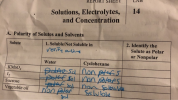 REPORT SHEET LAB 14 Solutions, Electrolytes, and Concentration A. Polarity of Solutes and Solvents Solute 1. Soluble/Not Soluble in verify orling 2. Identify the Solute as Polar or Nonpolar Water Cyclohexane KMnO4 12 Sucrose Vegetable oil Dolazsa non polars potaf sol non polars Thon plaf Salubk I non soloaleta Sol
Solubitity Depends on Bond Type and Molecular Struetwre L Solubilitity and Bond Type Ionic, Non-p...
 Solubitity Depends on Bond Type and Molecular Struetwre L Solubilitity and Bond Type Ionic, Non-polar Covalent, and rolar Covalent Compounds SolvemWater Substance Hexane Hexane Water Acetone Barium sulfate 3 Heptane Isopropandl Naphthalene Potassium Iodide Sodium bicarbonate Sucrose Xylene o Vegetable oil Analysis: Look at your data for heptane, naphthalene, and vegetable oil. Are they more soluble in water or in hexane? What is it about the structures of these compounds that explains this result? 1. Look at your data for...
SOLUTIONS 22. Non-polar compounds are soluble in ionic compounds b) electrolytes c) polar solvents d) non-polar...
 SOLUTIONS 22. Non-polar compounds are soluble in ionic compounds b) electrolytes c) polar solvents d) non-polar solvents 23. Which of the following would increase the solubility of gaseous O2 in water? (there is more than correct answer, mark them all!) Decreasing the temperature of the solution Increasing the temperature of the solution Decreasing the pressure of the solution Increasing the pressure of the solution 24. Which of the following describes an unsaturated solution? A solution that has less than the...
You are fixing your car and get grease all over your hands. Grease is a high molecular weight, non-polar substance. You...
You are fixing your car and get grease all over your hands. Grease is a high molecular weight, non-polar substance. You have the following substances at your disposal to clean your hands: water, alcohol (ethanol: C2H5OH), gasoline (octane: C8H18), ammonia, hydrochloric acid, and salt (sodium chloride). 1. Identify the ionic compounds. Give reasons. 2. Using your knowledge of solubility, liquid properties, and intermolecular forces, which substance would you use to clean your hands? Choose one substance only. Give reasons for...
write the equation that describes the dissolution process for the solutions of electrolytes. salt and water,...
write the equation that describes the dissolution process for the solutions of electrolytes. salt and water, baking soda and water, sugar and water, vinegar and water, rubbing alcohol and salt, rubbing alc and baking soda, alc and sugar, alc and vinegar, oil and salt, oil and baking soda, oil and vinegar, oil and sugar. classify each mixture as strong, weak or non electrolyte.
1.Is there a difference between the freezing temperature and the melting temperature? Explain your respect in...
1.Is there a difference between the freezing temperature and the melting temperature? Explain your respect in terms of numerical values, physical changes and changes in energy. 2.Suppose you have one mole of each of the following ionic solutes, NaNO3, CaCl2 and AIPO4, and that each of these dissolves in one kg of water. How many moles of particles will be in each of the solutions? Which of the solutions will have the lowest freezing point? and the lowest boiling point?...
1. Solubility in WATER Check solubility of four solutes in water (H2O). For each solute record...
1. Solubility in WATER Check solubility of four solutes in water (H2O). For each solute record how many teaspoons dissolved in 1/2 cup of water. NaCl: Start out with 4 small glasses (cups) and add 1/2 cup of water to each. Put 1/2 level teaspoon (tsp) of salt (NaCl) into the first cup and stir. If it dissolves within 1 minute; add another 1/2 tsp of salt and stir. Count the number of 1/2 tsps you are adding. Repeat until...
14. When are atoms most stable? A) when they have the fewest possible yale (B) when...
 14. When are atoms most stable? A) when they have the fewest possible yale (B) when they have the ma C) when all of the electron Orbit D) when all electrons are paired e the fewest possible valence electrons they have the maximum number of unpaired electrons in all of the electron orbitals in the valence shell are filled ods with 15. Water molecules can form hydrogen bonds with Acompounds that have polar covalent bonds B) compounds that have non-polar...
Balance the chemical equation for the important industrial process: C2H4 + O2 + HCl → C2H4Cl2...
Balance the chemical equation for the important industrial process: C2H4 + O2 + HCl → C2H4Cl2 + H2O. Given 760.0 kg of molecular oxygen, calculate how many kg of C2H4Cl2 can be produced. --- These are a mix (maybe) of ionic and covalent compounds: Name these compounds. Spell sulfide with the f not the ph. If the metal is a transition metal, you will need to use roman numerals in parentheses, no space between the metal and the parentheses, e.g....
please help me answer question 1 to 3, thank you Chapter 9, Solutions, Review & Extra Credit. 2 Points for each XC c...
 please help me answer question 1 to 3,
thank you
Chapter 9, Solutions, Review & Extra Credit. 2 Points for each XC correct answer; 6 points total, max. Partial Credit given. Suggestions...work in teams [it will improve the learning experience] 1. Solutions-A solution forms when a solute (the smaller quantity) dissolves in a solvent (the larger quantity). In a solution, the particles of solute are evenly distributed in the solvent. A solute may be a gas, liquid or solid. A...
please help me answer question 1 to 3,
thank you
Chapter 9, Solutions, Review & Extra Credit. 2 Points for each XC correct answer; 6 points total, max. Partial Credit given. Suggestions...work in teams [it will improve the learning experience] 1. Solutions-A solution forms when a solute (the smaller quantity) dissolves in a solvent (the larger quantity). In a solution, the particles of solute are evenly distributed in the solvent. A solute may be a gas, liquid or solid. A...
 REPORT SHEET LAB 14 Solutions, Electrolytes, and Concentration A. Polarity of Solutes and Solvents Solute 1. Soluble/Not Soluble in verify orling 2. Identify the Solute as Polar or Nonpolar Water Cyclohexane KMnO4 12 Sucrose Vegetable oil Dolazsa non polars potaf sol non polars Thon plaf Salubk I non soloaleta Sol
 Solubitity Depends on Bond Type and Molecular Struetwre L Solubilitity and Bond Type Ionic, Non-polar Covalent, and rolar Covalent Compounds SolvemWater Substance Hexane Hexane Water Acetone Barium sulfate 3 Heptane Isopropandl Naphthalene Potassium Iodide Sodium bicarbonate Sucrose Xylene o Vegetable oil Analysis: Look at your data for heptane, naphthalene, and vegetable oil. Are they more soluble in water or in hexane? What is it about the structures of these compounds that explains this result? 1. Look at your data for...
 SOLUTIONS 22. Non-polar compounds are soluble in ionic compounds b) electrolytes c) polar solvents d) non-polar solvents 23. Which of the following would increase the solubility of gaseous O2 in water? (there is more than correct answer, mark them all!) Decreasing the temperature of the solution Increasing the temperature of the solution Decreasing the pressure of the solution Increasing the pressure of the solution 24. Which of the following describes an unsaturated solution? A solution that has less than the...
 14. When are atoms most stable? A) when they have the fewest possible yale (B) when they have the ma C) when all of the electron Orbit D) when all electrons are paired e the fewest possible valence electrons they have the maximum number of unpaired electrons in all of the electron orbitals in the valence shell are filled ods with 15. Water molecules can form hydrogen bonds with Acompounds that have polar covalent bonds B) compounds that have non-polar...
 please help me answer question 1 to 3,
thank you
Chapter 9, Solutions, Review & Extra Credit. 2 Points for each XC correct answer; 6 points total, max. Partial Credit given. Suggestions...work in teams [it will improve the learning experience] 1. Solutions-A solution forms when a solute (the smaller quantity) dissolves in a solvent (the larger quantity). In a solution, the particles of solute are evenly distributed in the solvent. A solute may be a gas, liquid or solid. A...
please help me answer question 1 to 3,
thank you
Chapter 9, Solutions, Review & Extra Credit. 2 Points for each XC correct answer; 6 points total, max. Partial Credit given. Suggestions...work in teams [it will improve the learning experience] 1. Solutions-A solution forms when a solute (the smaller quantity) dissolves in a solvent (the larger quantity). In a solution, the particles of solute are evenly distributed in the solvent. A solute may be a gas, liquid or solid. A...
Most questions answered within 3 hours.
-
Where is the error in this code sequence?
String s1 = "Hello";
String s2 = "ello";...
asked 10 months ago -
Financial data for Joel de Paris, Inc., for last year
follow:
Joel de Paris, Inc.
Balance...
asked 10 months ago -
Consider this reaction:
Al2(SO4)3 (aq)+ BaCl3
(aq) Al2Cl6 (aq)- +
3BaSO4(s) . What is the...
asked 10 months ago -
Suppose that Savneet is considering increasing her
recent random sample from 20 car rentals to 40...
asked 10 months ago -
Trucks arrive at an unloading terminal at an average rate of 120
per hour.
Trucks arrive...
asked 10 months ago -
Why are methanol and ethanol completely soluble in water while
octanol is not very little soluble....
asked 10 months ago -
A facilities manager at a university reads in a research report
that the mean amount of...
asked 10 months ago -
When the CuSO4 is rehydrated by adding water to the anhydrous
compound, is this an endothermic...
asked 10 months ago -
A ray of sunlight is passing from diamond into crown glass; the
angle of incidence is...
asked 10 months ago -
A block of mass 0.249 kg is placed on top of a light, vertical
spring of...
asked 10 months ago -
how do the kidneys compensate in the presences of acidosis
a) trigger hyperventilate
b) reserve acid...
asked 10 months ago -
Question 501 pts
The rental rate of capital to the firm increases. Which of the
following...
asked 10 months ago