1. (Chapter 6, question E12) A trait in garden peas involves the curling of leaves. A...
Homework Answers
Recombinant frequency(RF) =78+80/390
=158/390
= 0.40
This seems like a case of linkage because the RF is less than 50% expected from independent assortment.
Total progeny is 390 , we would expect 390/4 = 97 in each class

A.) Chi square = 3.3+4.12+3.721+2.97
= 14.11
Degree of freedom(DF) = 4-1=3
In table at P = 0.05 and DF = 3, value = 7.815
Since our chi square value is greater than the table value genes are linked.
B.) Map distance = percentage recombination
= 78+80/390x100
= 40 mu
Add Answer to:
1. (Chapter 6, question E12) A trait in garden peas involves
the curling of leaves. A...
3. A trait in garden peas involves the curling of leaves. A dihydrid cross was made...
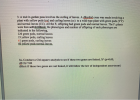 3. A trait in garden peas involves the curling of leaves. A dihydrid cross was made involving a plant with yellow pods (yy) and curling leaves (cc) to a wild-type plant with green pods (YY) and normal leaves (CC). All the F, offspring had green pods and normal leaves. The F, plants were then self-fertilized, the phenotypes and number of offspring of each phenotype are indicated in the following, 220 green pods, normal leaves 19 yellow pods, curling leaves 61...
A trait in garden peas involves the curling of leaves. A dihydrid cross was made involving...
A trait in garden peas involves the curling of leaves. A dihydrid cross was made involving a plant with yellow pods (yy) and curling leaves (cc) to a wild-type plant with green pods (YY) and normal leaves (CC). All F1 offspring had green pods and normal leaves. Suppose the Y(y) and C(c) alleles are not linked (the gene controlling pod color and the gene controlling leave characteristics inherit independently), The F1 plants were then crossed to plants with yellow pods...
QUESTION 1: Identify the parentals from the following testcross results: 117 green pods, normal leaves 78...
QUESTION 1: Identify the parentals from the following testcross results: 117 green pods, normal leaves 78 green pods, curling leaves 115 yellow pods, curling leaves 80 yellow pods, normal leaves b and d only a c and d a and b only d a and c QUESTION 2: In meiotic nondisjunction, meiotic products can be n+1, n-1, or n depending on when nondisjunction occurs. If non disjunction occurs in Meiosis I, what is the outcome? two trisomic and two monosomic...
1. In one experiment, Mendel crossed a pea plant that bred true for axial flowers with...
1. In one experiment, Mendel crossed a pea plant that bred true for axial flowers with a pea plant that bred true for terminal flowers. All the F1 plants had axial flowers. Which is the recessive trait? Explain your answer. 2. Green pod color is a dominant allele in pea plants (G). If two plants with green pods are crossed, some of the offspring have yellow pods. What are the possible genotypes of the parents? 3. In garden peas, one...
1) (3 pts) The following two recessive genes are known for corn: brittle endosperm (b) and...
 1) (3 pts) The following two recessive genes are known for corn: brittle endosperm (b) and glossy leaf (g). Two true-breeding plants with contrasting phenotypes are crossed (both plants are homozygous for both genes). The Fi offspring are all wild type. Then, an F1 plant is test-crossed with a brittle/glossy parent, and the following offspring are obtained: 16 238 wild type glossy brittle glossy, brittle 254 25 (a) Explain your reasoning as to why these data indicate that the two...
5. In Mendel's experiments, the pod color gene and the seed shape gene were located on...
 5. In Mendel's experiments, the pod color gene and the seed shape gene were located on different chromosomes (in other words, they were not linked. They assort independently). Green pods (G) are dominant over yellow pods (g) and tall stems (T) are dominant over dwarf stems (t). You are given two true breeding plants (homozygous at both genes). In the parental (P) generation, one parent has green pods and dwarf stems and the second parent has yellow pods and tall...
Please help me to answer these questions, thank you! 1-When Mendel crossed a plant with smooth...
Please help me to answer these questions, thank you! 1-When Mendel crossed a plant with smooth green peas and a plant with wrinkled yellow peas, what did he find? a- Color and shape of pea are linked (if you have a smooth pea it has to be green) b- Color and shape of pea are not linked (if you have a smooth pea, it can be green or yellow) c- Only yellow peas produce leaves d- Only smooth peas produce...
Two true breeding strains of peas, one with yellow and round seeds and the other with...
Two true breeding strains of peas, one with yellow and round seeds and the other with green and wrinkled seeds, were crossed. All the F1plants had yellow and round seeds. When these F1 plants were test crossed to the green and wrinkled parental strain, the following offspring were obtained: 30 yellow and round; 20 green and round; 26 yellow and wrinkled; 28 green and wrinkled. A) Please diagram the crosses described above, showing genotypes for each plant, using your own...
Part 2: Data Tables Table 1: Parent Genotypes: Monohybrid Crosses Generation Genotype of Individual #1 Genotype...
Part 2: Data Tables Table 1: Parent Genotypes: Monohybrid Crosses Generation Genotype of Individual #1 Genotype of Individual #2 P Yy SS P1 Sy Sy P2 yS yy P3 Sy Sy P4 Sy Sy Table 2: Generation Data Produced by Monohybrid Crosses Generation Possible Offspring Genotypes Possible Offspring Phenotypes Genotype Ratio Phenotype Ratio P YY Yy yy Yellow or Blue 1:2:1 3:1 P1 YY Yy yellow 1:1 1 P2 Yy yy Yellow or Blue 1:1 1:1 P3 Yy yy Yellow...
2. The lubber grasshopper is a very large grasshopper, and is black with red and yellow...
 2. The lubber grasshopper is a very large grasshopper, and is black with red and yellow stripes. Assume that red stripes are expressed from the homozygous RR genotype, yellow stripes from the homozygous rr genotype, and both from the heterozygous genotype. A. If two heterozygous grasshoppers were crossed, what would be the genotypic ratio of the F1 generation (RR:Rr:rr)? Fill in the Punnett square. B. What genotypes would be produced by crossing a grasshopper with both color stripes and one...
 3. A trait in garden peas involves the curling of leaves. A dihydrid cross was made involving a plant with yellow pods (yy) and curling leaves (cc) to a wild-type plant with green pods (YY) and normal leaves (CC). All the F, offspring had green pods and normal leaves. The F, plants were then self-fertilized, the phenotypes and number of offspring of each phenotype are indicated in the following, 220 green pods, normal leaves 19 yellow pods, curling leaves 61...
 1) (3 pts) The following two recessive genes are known for corn: brittle endosperm (b) and glossy leaf (g). Two true-breeding plants with contrasting phenotypes are crossed (both plants are homozygous for both genes). The Fi offspring are all wild type. Then, an F1 plant is test-crossed with a brittle/glossy parent, and the following offspring are obtained: 16 238 wild type glossy brittle glossy, brittle 254 25 (a) Explain your reasoning as to why these data indicate that the two...
 5. In Mendel's experiments, the pod color gene and the seed shape gene were located on different chromosomes (in other words, they were not linked. They assort independently). Green pods (G) are dominant over yellow pods (g) and tall stems (T) are dominant over dwarf stems (t). You are given two true breeding plants (homozygous at both genes). In the parental (P) generation, one parent has green pods and dwarf stems and the second parent has yellow pods and tall...
 2. The lubber grasshopper is a very large grasshopper, and is black with red and yellow stripes. Assume that red stripes are expressed from the homozygous RR genotype, yellow stripes from the homozygous rr genotype, and both from the heterozygous genotype. A. If two heterozygous grasshoppers were crossed, what would be the genotypic ratio of the F1 generation (RR:Rr:rr)? Fill in the Punnett square. B. What genotypes would be produced by crossing a grasshopper with both color stripes and one...
Most questions answered within 3 hours.
-
Where is the error in this code sequence?
String s1 = "Hello";
String s2 = "ello";...
asked 10 months ago -
Financial data for Joel de Paris, Inc., for last year
follow:
Joel de Paris, Inc.
Balance...
asked 10 months ago -
Consider this reaction:
Al2(SO4)3 (aq)+ BaCl3
(aq) Al2Cl6 (aq)- +
3BaSO4(s) . What is the...
asked 10 months ago -
Suppose that Savneet is considering increasing her
recent random sample from 20 car rentals to 40...
asked 10 months ago -
Trucks arrive at an unloading terminal at an average rate of 120
per hour.
Trucks arrive...
asked 10 months ago -
Why are methanol and ethanol completely soluble in water while
octanol is not very little soluble....
asked 10 months ago -
A facilities manager at a university reads in a research report
that the mean amount of...
asked 10 months ago -
When the CuSO4 is rehydrated by adding water to the anhydrous
compound, is this an endothermic...
asked 10 months ago -
A ray of sunlight is passing from diamond into crown glass; the
angle of incidence is...
asked 10 months ago -
A block of mass 0.249 kg is placed on top of a light, vertical
spring of...
asked 10 months ago -
how do the kidneys compensate in the presences of acidosis
a) trigger hyperventilate
b) reserve acid...
asked 10 months ago -
Question 501 pts
The rental rate of capital to the firm increases. Which of the
following...
asked 10 months ago