List the inputs/outputs and truth-table of Following Verilog codes module switch(A,B,X,Y,S); input[0:0] A,B,S; output[0:0] X,Y; alaways...
List the inputs/outputs and truth-table of Following Verilog codes
module switch(A,B,X,Y,S);
input[0:0] A,B,S;
output[0:0] X,Y;
alaways @(A,B,S) begin
if S == 0 begin
X <= A;
Y <= B;
end
else begin
X <= B;
Y <= A;
end
end
endmodule
Homework Answers
From the given verilog code,
Inputs are A,B and S.
Outputs are X and Y.
Now we can see the truth table for given logic .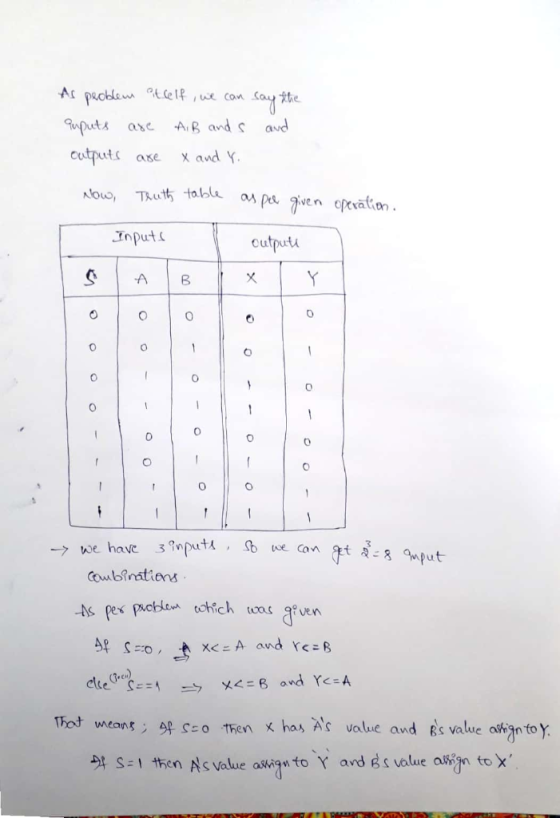
Add Answer to:
List the inputs/outputs and truth-table of Following Verilog
codes
module switch(A,B,X,Y,S);
input[0:0] A,B,S;
output[0:0] X,Y;
alaways...
module Lab5(Clock, Ex, Reset, W, S, L, Q); //Inputs input Clock, Ex, Reset; input [1:0] W;...
module Lab5(Clock, Ex, Reset, W, S, L, Q); //Inputs input Clock, Ex, Reset; input [1:0] W; input [2:0] S; input [3:0] L; //Outputs output reg [3:0] Q; // Inputs for FSM = Clock, Ex, Reset, W Outputs = S, L FSM U0 (.Clock(Clock), .Ex(Ex), .Reset(Reset), .W(W), .S(S), .L(L)); // Inputs for BUSR = Clock, Reset, L, S Outputs = Q Behavioral_Universal_Shift_Register U1 (.Clock(Clock), .Reset(Reset), .L(L), .S(S), .Q(Q)); endmodule How do you use the...
a Read the following codes in Verilog and the corresponding testbench file. Describe what the codes...
a Read the following codes in Verilog and the corresponding testbench file. Describe what the codes are doing by adding comments in the code. Then write down the simulation results of res1, res2, res3, and res4, respectively. Source code module vector_defn (num1, res1, res2, res3, res4); input [7:0] num1; output res1; output [3:0] res2; output [0:7] res3; output [15:0] res4; assign res1=num1[2]; assign res2=num1[7:4]; assign res3=num1; assign res4={2{num1}}; endmodule testbench: `timescale 1ns / 1ps module vector_defn_tb; reg [7:0] in1; wire...
A sequential circuit has one input (X), a clock input (CLK), and two outputs (S and...
 A sequential circuit has one input (X), a clock input (CLK), and
two outputs (S and V). X, S and V are all one-bit signals. X
represents a 4-bit binary number N, which is input least
significant bit first. S represents a 4-bit binary number equal to
N + 3, which is output least significant bit first. At the time the
fourth input occurs, V = 1 if N + 3 is too large to be represented
by 4 bits;...
A sequential circuit has one input (X), a clock input (CLK), and
two outputs (S and V). X, S and V are all one-bit signals. X
represents a 4-bit binary number N, which is input least
significant bit first. S represents a 4-bit binary number equal to
N + 3, which is output least significant bit first. At the time the
fourth input occurs, V = 1 if N + 3 is too large to be represented
by 4 bits;...
Question 3: Realize the circuit below using Verilog. Include a signal “reset_n” for asynchronously clearing the...
 Question 3: Realize the circuit below using Verilog. Include a signal “reset_n” for asynchronously clearing the flip-flop. What type of circuit is this? Complete the following Verilog code. Write a test bench to test it. clk sel module aff (clk, reset_n, sel, q); input clk ; // Declare the inputs and outputs of the module. input reset_n; input sel; output q; reg q; wire D; ; // model the combinational logic assign D= always @( begin if ( else end...
Q3. Draw the circuit represented by this Verilog code Module system(A,B.C.Y) Input A,B.C: Output Y Assign...
 Q3. Draw the circuit represented by this Verilog code Module system(A,B.C.Y) Input A,B.C: Output Y Assign Y (C1)?A: B Endmodule
Write a test bench to thoroughly test the Verilog module dff_fe_asyn_h. below is the module ddff_fe_asyn_h.code...
Write a test bench to thoroughly test the Verilog module dff_fe_asyn_h. below is the module ddff_fe_asyn_h.code Simulate the circuit using ISim and analyze the resulting waveform. Take full screenshots of all Verilog source codes and the resulting simulation waveform to be included in the lab report. Include explanation of the waveform and how you can conclude that the D flip flop implemented in step 9 is correct in the lab report. Verilog Code for dff_fe_asyn_h is mentioned below:- //DFF module...
Module halfadder(sum, cout, x, y); input x, y; output sum, cout; assign sumxy; assign cout-x&y; B...
 please fill in the wire, four gates and , calling the half
adders
module halfadder(sum, cout, x, y); input x, y; output sum, cout; assign sumxy; assign cout-x&y; Bo endmodule module multiplier(C, A, B); input [1:0] A, B; Cs C C1 Co output [3:0] C; //declare internal wires // four and gates // call halfadder twice Bo HA HA c, c2 Co endmodule
module halfadder(sum, cout, x, y); input x, y; output sum, cout; assign sumxy; assign cout-x&y; Bo endmodule...
please fill in the wire, four gates and , calling the half
adders
module halfadder(sum, cout, x, y); input x, y; output sum, cout; assign sumxy; assign cout-x&y; Bo endmodule module multiplier(C, A, B); input [1:0] A, B; Cs C C1 Co output [3:0] C; //declare internal wires // four and gates // call halfadder twice Bo HA HA c, c2 Co endmodule
module halfadder(sum, cout, x, y); input x, y; output sum, cout; assign sumxy; assign cout-x&y; Bo endmodule...
why its 4-to-1 mux behavioral? What does the logic circuit represented by the following Verilog module...
 why its 4-to-1 mux behavioral?
What does the logic circuit represented by the following Verilog module do, and what Verilog description style does it use? // My Verilog module #1 module mymodl ( x, d, q) input[1:0] x;input[3:0] d;output q; reg q; wire [1:0] x; wire [3:0] d; always ( x or d) begin case ( x ) 1 : q=d[1]; 2 : g=d[2]; 3 q d[3]; endcase end endmodule
why its 4-to-1 mux behavioral?
What does the logic circuit represented by the following Verilog module do, and what Verilog description style does it use? // My Verilog module #1 module mymodl ( x, d, q) input[1:0] x;input[3:0] d;output q; reg q; wire [1:0] x; wire [3:0] d; always ( x or d) begin case ( x ) 1 : q=d[1]; 2 : g=d[2]; 3 q d[3]; endcase end endmodule
I need a test bench code for this module in verilog. Verilog Code module part6 (А.В.us,G,E,L);...
 I need a test bench code for this module in
verilog.
Verilog Code module part6 (А.В.us,G,E,L); AlL ((Al --AI --op AIL (us) I-AIL input [2:0]A,B; input us; output G,E.I; reg G,E,L wire [2:0] A,B; always@(A or B) if (us 1)//unsigned mode begin しくーAB: //А is less G-A>B; //B is less 区-A-B; //logical (A equality end --oper AlL1 A[0] & -AIL E<-Ssigned(A) Ssigned(B); //logical equality opera AIL1I -AILI -operat else //signed mode begin しく=$signed(A)<$signed(B); //Ais less G-Ssigned(A)>Ssigned(B);: //B is less end...
I need a test bench code for this module in
verilog.
Verilog Code module part6 (А.В.us,G,E,L); AlL ((Al --AI --op AIL (us) I-AIL input [2:0]A,B; input us; output G,E.I; reg G,E,L wire [2:0] A,B; always@(A or B) if (us 1)//unsigned mode begin しくーAB: //А is less G-A>B; //B is less 区-A-B; //logical (A equality end --oper AlL1 A[0] & -AIL E<-Ssigned(A) Ssigned(B); //logical equality opera AIL1I -AILI -operat else //signed mode begin しく=$signed(A)<$signed(B); //Ais less G-Ssigned(A)>Ssigned(B);: //B is less end...
(15 pts) 1. Draw a logic diagram for the Verilog code. module Seq_Ckt ( CLK, PR,...
 (15 pts) 1. Draw a logic diagram for the Verilog code. module Seq_Ckt ( CLK, PR, sel, Q); input CLK, PR, sel; output reg [2:0] Q; reg [2:0] y; assign Q = y; always @ (posedge PR, posedge CLK) begin if (PR== 1) then y <= 3'b111; else if (sel) begin y[2] <= y[1] ^ y[0]; y[1] <= y[2]; y[1]; end else y[2] <= y[2] ; y[1] <= y[1]; y[0]; y[O] <= y[0] <= end endmodule
 A sequential circuit has one input (X), a clock input (CLK), and
two outputs (S and V). X, S and V are all one-bit signals. X
represents a 4-bit binary number N, which is input least
significant bit first. S represents a 4-bit binary number equal to
N + 3, which is output least significant bit first. At the time the
fourth input occurs, V = 1 if N + 3 is too large to be represented
by 4 bits;...
A sequential circuit has one input (X), a clock input (CLK), and
two outputs (S and V). X, S and V are all one-bit signals. X
represents a 4-bit binary number N, which is input least
significant bit first. S represents a 4-bit binary number equal to
N + 3, which is output least significant bit first. At the time the
fourth input occurs, V = 1 if N + 3 is too large to be represented
by 4 bits;...
 Question 3: Realize the circuit below using Verilog. Include a signal “reset_n” for asynchronously clearing the flip-flop. What type of circuit is this? Complete the following Verilog code. Write a test bench to test it. clk sel module aff (clk, reset_n, sel, q); input clk ; // Declare the inputs and outputs of the module. input reset_n; input sel; output q; reg q; wire D; ; // model the combinational logic assign D= always @( begin if ( else end...
 Q3. Draw the circuit represented by this Verilog code Module system(A,B.C.Y) Input A,B.C: Output Y Assign Y (C1)?A: B Endmodule
 please fill in the wire, four gates and , calling the half
adders
module halfadder(sum, cout, x, y); input x, y; output sum, cout; assign sumxy; assign cout-x&y; Bo endmodule module multiplier(C, A, B); input [1:0] A, B; Cs C C1 Co output [3:0] C; //declare internal wires // four and gates // call halfadder twice Bo HA HA c, c2 Co endmodule
module halfadder(sum, cout, x, y); input x, y; output sum, cout; assign sumxy; assign cout-x&y; Bo endmodule...
please fill in the wire, four gates and , calling the half
adders
module halfadder(sum, cout, x, y); input x, y; output sum, cout; assign sumxy; assign cout-x&y; Bo endmodule module multiplier(C, A, B); input [1:0] A, B; Cs C C1 Co output [3:0] C; //declare internal wires // four and gates // call halfadder twice Bo HA HA c, c2 Co endmodule
module halfadder(sum, cout, x, y); input x, y; output sum, cout; assign sumxy; assign cout-x&y; Bo endmodule...
 why its 4-to-1 mux behavioral?
What does the logic circuit represented by the following Verilog module do, and what Verilog description style does it use? // My Verilog module #1 module mymodl ( x, d, q) input[1:0] x;input[3:0] d;output q; reg q; wire [1:0] x; wire [3:0] d; always ( x or d) begin case ( x ) 1 : q=d[1]; 2 : g=d[2]; 3 q d[3]; endcase end endmodule
why its 4-to-1 mux behavioral?
What does the logic circuit represented by the following Verilog module do, and what Verilog description style does it use? // My Verilog module #1 module mymodl ( x, d, q) input[1:0] x;input[3:0] d;output q; reg q; wire [1:0] x; wire [3:0] d; always ( x or d) begin case ( x ) 1 : q=d[1]; 2 : g=d[2]; 3 q d[3]; endcase end endmodule
 I need a test bench code for this module in
verilog.
Verilog Code module part6 (А.В.us,G,E,L); AlL ((Al --AI --op AIL (us) I-AIL input [2:0]A,B; input us; output G,E.I; reg G,E,L wire [2:0] A,B; always@(A or B) if (us 1)//unsigned mode begin しくーAB: //А is less G-A>B; //B is less 区-A-B; //logical (A equality end --oper AlL1 A[0] & -AIL E<-Ssigned(A) Ssigned(B); //logical equality opera AIL1I -AILI -operat else //signed mode begin しく=$signed(A)<$signed(B); //Ais less G-Ssigned(A)>Ssigned(B);: //B is less end...
I need a test bench code for this module in
verilog.
Verilog Code module part6 (А.В.us,G,E,L); AlL ((Al --AI --op AIL (us) I-AIL input [2:0]A,B; input us; output G,E.I; reg G,E,L wire [2:0] A,B; always@(A or B) if (us 1)//unsigned mode begin しくーAB: //А is less G-A>B; //B is less 区-A-B; //logical (A equality end --oper AlL1 A[0] & -AIL E<-Ssigned(A) Ssigned(B); //logical equality opera AIL1I -AILI -operat else //signed mode begin しく=$signed(A)<$signed(B); //Ais less G-Ssigned(A)>Ssigned(B);: //B is less end...
 (15 pts) 1. Draw a logic diagram for the Verilog code. module Seq_Ckt ( CLK, PR, sel, Q); input CLK, PR, sel; output reg [2:0] Q; reg [2:0] y; assign Q = y; always @ (posedge PR, posedge CLK) begin if (PR== 1) then y <= 3'b111; else if (sel) begin y[2] <= y[1] ^ y[0]; y[1] <= y[2]; y[1]; end else y[2] <= y[2] ; y[1] <= y[1]; y[0]; y[O] <= y[0] <= end endmodule
Most questions answered within 3 hours.
-
Where is the error in this code sequence?
String s1 = "Hello";
String s2 = "ello";...
asked 10 months ago -
Financial data for Joel de Paris, Inc., for last year
follow:
Joel de Paris, Inc.
Balance...
asked 10 months ago -
Consider this reaction:
Al2(SO4)3 (aq)+ BaCl3
(aq) Al2Cl6 (aq)- +
3BaSO4(s) . What is the...
asked 10 months ago -
Suppose that Savneet is considering increasing her
recent random sample from 20 car rentals to 40...
asked 10 months ago -
Trucks arrive at an unloading terminal at an average rate of 120
per hour.
Trucks arrive...
asked 10 months ago -
Why are methanol and ethanol completely soluble in water while
octanol is not very little soluble....
asked 10 months ago -
A facilities manager at a university reads in a research report
that the mean amount of...
asked 10 months ago -
When the CuSO4 is rehydrated by adding water to the anhydrous
compound, is this an endothermic...
asked 10 months ago -
A ray of sunlight is passing from diamond into crown glass; the
angle of incidence is...
asked 10 months ago -
A block of mass 0.249 kg is placed on top of a light, vertical
spring of...
asked 10 months ago -
how do the kidneys compensate in the presences of acidosis
a) trigger hyperventilate
b) reserve acid...
asked 10 months ago -
Question 501 pts
The rental rate of capital to the firm increases. Which of the
following...
asked 10 months ago