For these three oxides, state whether each one is acidic, basic or amphoteric. Explain how cation...
- For these three oxides, state whether each one is acidic, basic
or amphoteric. Explain how cation oxidation state can be used to
help predict acid/base behavior.
- CrO
- CrO3
- Cr2O3
- (a) Briefly explain what amphoterism means; (b) Choose an amphoteric molecular compound and indicate its chemical reaction with an acid and with a base.
Homework Answers
The properties of oxides depends on the oxidation states and nature of element as metal forms basic oxides and non metals form acidic oxides.
But depending on the oxidation states the metal form the acidic and amphoteric oxides also .
Generally all these three properties are shown by transtion metals having variable oxidation states
As metal in low oxidation state iy form badic oxide due to low elecronegativity but at medium oxidation state it show amphoteric character (acidic and basic both) undergoes in either direction depending on the reactant nature
and if the oxdation state is to high then due to increase in elctronegaivity it show acidic nature.
So, 1. CrO is basic in nature as Cr in low (+2)oxidation state.
2. CrO3 is acidic in nature as Cr in high (+6) oxidation state
3. Cr2O3 is amphoteric in nature as Cr in medium (+3) oxidation state
**Amphoteric means having both acidic and basic properties
Vonsider an example ZnO amphoteric oxide
Acidic behaviour
ZnO + 2HCl -------> ZnCl2(salt)+ 2H2O
Basic behavior
ZnO +2 NaOH -----> Na2ZnO2(salt) + H2O
Add Answer to:
For these three oxides, state whether each one is acidic, basic
or amphoteric. Explain how cation...
Determine whether each of the following oxides is acidic, basic, or amphoteric. Use balanced chemical equations...
Determine whether each of the following oxides is acidic, basic, or amphoteric. Use balanced chemical equations to support your answer. (a) MgO (b) SO3 (c) Ga2O3 (d) Na2O (e) H2O (f) P4O10
9. State whether the following oxides are acidic, basic, neutral, or amphoteric: CO2, P2O5, SO3, MgO,...
9. State whether the following oxides are acidic, basic, neutral, or amphoteric: CO2, P2O5, SO3, MgO, K2O, Al2O3, CO. 10. Preferably without consulting reference material, write out the halogens as they appear in the periodic table, and indicate the trends in (a) physical state (s, l, or g) at room temperature and pressure, (b) electronegativity, (c) hardness of the halide ion, (d) colour.
Be sure to answer all parts. Specify whether the oxides BaO and So, are acidic, basic,...
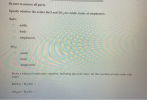 Be sure to answer all parts. Specify whether the oxides BaO and So, are acidic, basic, or amphoteric. Bao: acidic basic amphoteric D SO, acidic basic O amphoteric Write a balanced molecular equation, including physical states, for the reaction of each oxide with water. BaO(s) + H2O(1) - SO,() + H20(1) -
3) Metal oxides become less basic (more acidic) as the oxidation state increases. Explain w be...
 3) Metal oxides become less basic (more acidic) as the oxidation state increases. Explain w be specific! (2 marks)
Please explain each answer Predict whether aqueous solutions of the following compounds are acidic, basic, or...
 Please explain each answer
Predict whether aqueous solutions of the following compounds are acidic, basic, or neutral. compound Cr(NO) solution is...? acidic O basic O neutral NH,CI O acidic basic O neutral acidic Nal basic neutral x 6 ?
Please explain each answer
Predict whether aqueous solutions of the following compounds are acidic, basic, or neutral. compound Cr(NO) solution is...? acidic O basic O neutral NH,CI O acidic basic O neutral acidic Nal basic neutral x 6 ?
For each of the following species, indicate whether the resulting solution would be acidic, basic, or...
For each of the following species, indicate whether the resulting solution would be acidic, basic, or neutral, if 0.50 mole of each were dissolved in 1.0 liter of water. Provide the predominant acid-base reaction that would occur. Substance: A) NH4NO3 B) Potassium Iodide C) Sodium Fluoride. Determine if each of them is Acidic/Basic/Neutral and Predominant Reaction that occurs
Write correct chemical equations showing how each compound produces an acidic/basic solution. DO NOT include any...
 Write correct chemical equations showing how each compound produces an acidic/basic solution. DO NOT include any spectator ions in your equations Compound Acid or Base? Chemical Equation NaNO, Neutral NO Reaction-NaNO, is a "neutral salt aave NaHCO ese Nasco, ase NH NO CA Cu(NO) id NHs HiPO ci NaH PO NasPO4
Indicate whether each of the following compounds will give an acidic, basic or neutral solution when dissolved i...
 Indicate whether each of the following compounds will give an acidic, basic or neutral solution when dissolved in water. Clear All ammonium chloride The pH will be less than calcium nitrite The pH will be approximately equal to 7 potassium nitrate The pH will be greater than 7 ammonium nitrate For the following reaction, the reactants are favored at equilibrium. Classify each of the reactants and products based on their strength as Bronsted-Lowry acids or bases. CIO+CHINHCH N + HCIO...
1. For each of the following species, indicate whether the resulting solution would be acidic, basic,...
1. For each of the following species, indicate whether the resulting solution would be acidic, basic, or neutral, if 1.00 mole of each were dissolved in 1.0 liter of water. Provide the predominant acid-base reaction that occurs to explain your choice. (a) NH4NO3 (b) K2CO3 (c) NaF (d) Al2(SO4)2 (e) KClO4 2. Assuming that no equilibria other than dissolution are involved, calculate the molar solubility of each of the following from its solubility product: (a) Ag2SO4 (Ksp= 1.2 x 10⁻⁵) (b)...
explain ou are given us solutions of the following at 25°C. Predict whether each solution will...
 explain ou are given us solutions of the following at 25°C. Predict whether each solution will be acidic, basic, (a) posm at, KC,H,O, The cation, K", belongs to group 1 of the periodic table and will not affect the pH. The anion, C,H,O, solution of potassium acetate --Sec . weak acid and will act as a base, making a (b) barum chlorate, Balco), The cation Therefore, belongs to grove 2 of the periodic table and will not affect the p....
 Be sure to answer all parts. Specify whether the oxides BaO and So, are acidic, basic, or amphoteric. Bao: acidic basic amphoteric D SO, acidic basic O amphoteric Write a balanced molecular equation, including physical states, for the reaction of each oxide with water. BaO(s) + H2O(1) - SO,() + H20(1) -
 3) Metal oxides become less basic (more acidic) as the oxidation state increases. Explain w be specific! (2 marks)
 Please explain each answer
Predict whether aqueous solutions of the following compounds are acidic, basic, or neutral. compound Cr(NO) solution is...? acidic O basic O neutral NH,CI O acidic basic O neutral acidic Nal basic neutral x 6 ?
Please explain each answer
Predict whether aqueous solutions of the following compounds are acidic, basic, or neutral. compound Cr(NO) solution is...? acidic O basic O neutral NH,CI O acidic basic O neutral acidic Nal basic neutral x 6 ?
 Write correct chemical equations showing how each compound produces an acidic/basic solution. DO NOT include any spectator ions in your equations Compound Acid or Base? Chemical Equation NaNO, Neutral NO Reaction-NaNO, is a "neutral salt aave NaHCO ese Nasco, ase NH NO CA Cu(NO) id NHs HiPO ci NaH PO NasPO4
 Indicate whether each of the following compounds will give an acidic, basic or neutral solution when dissolved in water. Clear All ammonium chloride The pH will be less than calcium nitrite The pH will be approximately equal to 7 potassium nitrate The pH will be greater than 7 ammonium nitrate For the following reaction, the reactants are favored at equilibrium. Classify each of the reactants and products based on their strength as Bronsted-Lowry acids or bases. CIO+CHINHCH N + HCIO...
 explain ou are given us solutions of the following at 25°C. Predict whether each solution will be acidic, basic, (a) posm at, KC,H,O, The cation, K", belongs to group 1 of the periodic table and will not affect the pH. The anion, C,H,O, solution of potassium acetate --Sec . weak acid and will act as a base, making a (b) barum chlorate, Balco), The cation Therefore, belongs to grove 2 of the periodic table and will not affect the p....
Most questions answered within 3 hours.
-
Where is the error in this code sequence?
String s1 = "Hello";
String s2 = "ello";...
asked 10 months ago -
Financial data for Joel de Paris, Inc., for last year
follow:
Joel de Paris, Inc.
Balance...
asked 10 months ago -
Consider this reaction:
Al2(SO4)3 (aq)+ BaCl3
(aq) Al2Cl6 (aq)- +
3BaSO4(s) . What is the...
asked 10 months ago -
Suppose that Savneet is considering increasing her
recent random sample from 20 car rentals to 40...
asked 10 months ago -
Trucks arrive at an unloading terminal at an average rate of 120
per hour.
Trucks arrive...
asked 10 months ago -
Why are methanol and ethanol completely soluble in water while
octanol is not very little soluble....
asked 10 months ago -
A facilities manager at a university reads in a research report
that the mean amount of...
asked 10 months ago -
When the CuSO4 is rehydrated by adding water to the anhydrous
compound, is this an endothermic...
asked 10 months ago -
A ray of sunlight is passing from diamond into crown glass; the
angle of incidence is...
asked 10 months ago -
A block of mass 0.249 kg is placed on top of a light, vertical
spring of...
asked 10 months ago -
how do the kidneys compensate in the presences of acidosis
a) trigger hyperventilate
b) reserve acid...
asked 10 months ago -
Question 501 pts
The rental rate of capital to the firm increases. Which of the
following...
asked 10 months ago