Multiple Choice 26. Assuming the correlation coefficient between stocks in a portfolio is less than 1.0,...
Multiple Choice
26. Assuming the correlation coefficient between stocks in a portfolio is less than 1.0, the standard deviation of a portfolio’s returns will be:
A. greater than the weighted average standard deviation.
B. equal to the weighted average standard deviation.
C. less than the weighted average standard deviation.
Multiple Choice Problems (5 points each) Choose the best answer
27. The value of a common stock that just paid a $3.00 dividend will be ________________ if investors require a 12% return and dividends and earnings are expected to grow at 8% per year.
A. $66.67
B. $72.00
C. $81.00
D. $125.00
28. A speculator purchases a call option for a premium of $3, with an exercise price of $32. The stock is presently priced at $30, and falls to $28 before the expiration date. What is the net gain or loss to the purchaser?
A. loss $1
B. loss $3
C. gain $1
D. gain $3
29. You forecast that James Inc. will pay dividends of $4 one year from today, $4.50 the next and $5.00 at the end of the third year. You expect earnings per share to be $8 at the end of the third year and based on the industry average as well as your own forecasts relative to the firm, you are willing to pay 12 times earnings at that point (i.e. the P/E in year 3 is 12). How much are you willing to pay for the stock today if you require a 14% return on the investment? NOTE: this is a TVM problem combined with a relative valuation (to find the selling price) problem.
A. $75.14
B. $85.66
C. $109.50
D. none of the above
30. What is the duration of a 9% coupon bond, $1,000 par value that has 3 years left to maturity if the discount rate is 8%?
A. 3 years.
B. 2.76 years.
C. 2.82 years.
D. 3.24 years.
31. You are buying a callable bond, $1,000 par value that currently is priced at $1025, pays a 6% annual coupon and has 20 years to maturity. The bond is callable in 4 years at a call premium of 1 year’s interest. The yield to maturity and the yield to call are, respectively:
A. 5.78%, 6.63%
B. 5.78%, 5.78%
C. 6.63%, 6.00%
D. 6.00%, 5.78%.
32. What is the MONTHLY payment on a $260,000 mortgage loan that has a 12% annual interest rate if you pay it off in 30 years?
A. $1,028.61
B. $2,400.34
C. $2,674.39
D. $3,120.44
33. The risk free rate is 4%, Blackbeard Stock returned 11%. The stock’s beta is 1.2 and the standard deviation of returns is 14%. The stock’s Sharpe ratio is closest to:
A. 0.50
B. 0.79
B. 1.00
C. 5.83
34. The risk free rate is 4%, the market return is 11% and Blackbeard stock has a beta of 1.2. The required rate of return on Blackbeard’s stock is closest to:
A. 11%.
B. 12.4%.
C. 17.2%
D. none of the above
Homework Answers
26.
The standard deviation of a portfolio is given by
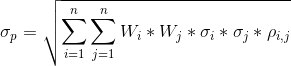
Where Wi is the weight of the security i,
 is the
standard deviation of returns of security i.
is the
standard deviation of returns of security i.
and  is the
correlation coefficient between returns of security i and security
j
is the
correlation coefficient between returns of security i and security
j
So, if the correlation coefficient between the stocks is less than 1, then the standard deviation is less than the weighted average standard deviation of the stocks. (option C)
27. From Gordon's Constant growth model
Price P0 = D1/(r-g)
where D1 is the expected dividend in the next year , r is the required rate and g is the constant growth rate
P0 = D0*(1+g)/(r-g)
=3*(1+0.08)/(0.12-0.08)
=$81 (option C)
28. Net payoff to the purchaser of a call option at maturity is equal to the intrinsic value of the option
Intrinsic value = max (S-K, 0) = max (28-32 , 0) = 0
As the intrinsic value is 0, payoff is 0 and the purchaser loses the premium paid ie.. $3 (option B)
29. Price of the stock at the end of 3rd year = Earnings in 3rd year * P/E ratio at the end of 3rd year
P3 =$8* 12 =$96
So, Price of stock today = D1/(1+r) + D2/(1+r)^2+ D3/(1+r)^3+ P3/(1+r)^3
= 4/1.14 + 4.5/1.14^2+ 5/1.14^3+96/1.14^3
=$75.1435 (option A)
Add Answer to:
Multiple Choice
26. Assuming the correlation coefficient between stocks in a
portfolio is less than 1.0,...
1. Bond A sells at a premium, so the YTM must be less than the coupon...
 1. Bond A sells at a premium, so the YTM must be less than the coupon rate. Assume the required rate of return remains constant when we're trying to determine the likelihood of a call being made. If the YTM stays less than the 9% coupon rate, then 5 years from now when the call protection ends, the bond issuer will call the bond, pay the call premium, and refinance with new bonds at lower market rates. Thus, the market...
For a discount bond, its coupon rate is_ than its yield to maturity and its price...
 For a discount bond, its coupon rate is_ than its yield to maturity and its price is expected to __over the years. A B. C. D. Greater; increase Greater; decrease Lower; increase Lower; decrease A corporate bond has a 30-year maturity and pays interest annually. The quoted coupon rate is 10% and the bond is priced at par. The boond is callable in 5 years at 120% of par. What is the bonds yield to call? (Choose the closest one)...
please show your work. This is the information for the problems l, 2,3, 4 and 5....
 please show your work.
This is the information for the problems l, 2,3, 4 and 5. Darby Inc.'s bonds currently sell for S 900 nve u par value of $1,000. They pay a S65 annual coupon and have a 1S-year maturity, but they can be called in 5 years at $1,020. 1. This bond is a discount bond. a. True b. False 2. What is their yield to maturity (YTM)? a. 5.78% b. 7.64% с 6.39% d. 6.71% e. 7.05%...
please show your work.
This is the information for the problems l, 2,3, 4 and 5. Darby Inc.'s bonds currently sell for S 900 nve u par value of $1,000. They pay a S65 annual coupon and have a 1S-year maturity, but they can be called in 5 years at $1,020. 1. This bond is a discount bond. a. True b. False 2. What is their yield to maturity (YTM)? a. 5.78% b. 7.64% с 6.39% d. 6.71% e. 7.05%...
10. What is their Expected Current Yield (CY)? 5.78% b. 6.09% c. 6.39% d. 7.50% e....
 10. What is their Expected Current Yield (CY)? 5.78% b. 6.09% c. 6.39% d. 7.50% e. 6.25% 11. What is their Capital Gain Yield (CGY)? a. 0.54% b. 6.09% c. 0.42% d. 0.65% e. 0.62% 12. This bond is a discount bond. a. True b. False 13. What is their yield to Call (YTC)? a. 5.78% b. 14.93% e. 6.39% d. 9.43% e. 13.84% 14. Kimberly Motors has a beta of 1.40, the T-bill rate is 3.00%, and the T-bond...
e none of the above 6. A corporate bond matures in years. The value of 51000....
 e none of the above 6. A corporate bond matures in years. The value of 51000. The bond is callable in two year today is $1075. What are the bond' yield to call? .3.16 6.4.5% as an 8% semiannual coupon and a par "price of S1050. The price of the bond lave a yield to maturity of 8.5%. The par value ate and pay interest on semiannual basis. 7. Mides cooperation bonds mature in 3 years and have a yield...
A coupon bond which pays interest of $60 annually, has a par value of $1,000, matures...
 A coupon bond which pays interest of $60 annually, has a par value of $1,000, matures in 5 years, and is selling today at a 584.52 discount from par value. The approximate yield to maturity on this bond is A6% B. 7% C. 8% D. 9% For a discount bond, its coupon rate is_than its yield to maturity and its price is expected to ___over the years. A B. C. D. Greater; increase Greater; decrease Lower; increase Lower; decrease A...
1. a corperate bond matures in 3 years. the bond has an 8% semiannual coupon and...
1. a corperate bond matures in 3 years. the bond has an 8% semiannual coupon and the par value is 1000. the bond is callable in 2 years at a call price of $1050. the price of the bond today is $1075. what is the bonds yield to call? 2. midea cooperation bonds mature in 3 years and have a yield to maturity of 8.5%. the par value is 1000. the bond has a 10% coupon rate and pay interest...
A 20-year, 8% semiannual coupon bond with a par value of $1,000 may be called in...
A 20-year, 8% semiannual coupon bond with a par value of $1,000 may be called in 5 years at a call price of $1,040. The bond sells for $1,100. (Assume that the bond has just been issued.) Basic Input Data: Years to maturity: 20 Periods per year: 2 Periods to maturity: Coupon rate: 8% Par value: $1,000 Periodic payment: Current price $1,100 Call price: $1,040 Years till callable: 5 Periods till callable: a. What is the bond's yield to maturity?...
MULTIPLE CHOICE: 1. What is the long-run objective of financial management? A. Maximize earnings per share B. Maximize...
MULTIPLE CHOICE: 1. What is the long-run objective of financial management? A. Maximize earnings per share B. Maximize the value of the firm's common stock C. Maximize return on investment D. Maximize market share 2. Which of the following statement (in general) is correct? A. A low receivables turnover is desirable B. The lower the total debt-to-equity ratio, the lower the financial risk for a firm C. An increase in net profit margin with no change in sales or assets means a weaker ROI...
Calculation and Interpretation of traditional yield measures for fixed-rate bonds. Their assumptions and limitations. 1. Consider...
 Calculation and Interpretation of traditional yield measures for fixed-rate bonds. Their assumptions and limitations. 1. Consider a 20-year, $1,000 par value, 6% semiannual-pay bond that is currently trading at $802.07. Calculate the current yield, the YTM, and the BEY 2. A bond with 5 years remaining until maturity is currently trading for 101 per 100 of par value. The bond offers a 6% coupon rate with interest paid semiannually. The bond is first callable in 3 years, and is callable...
 1. Bond A sells at a premium, so the YTM must be less than the coupon rate. Assume the required rate of return remains constant when we're trying to determine the likelihood of a call being made. If the YTM stays less than the 9% coupon rate, then 5 years from now when the call protection ends, the bond issuer will call the bond, pay the call premium, and refinance with new bonds at lower market rates. Thus, the market...
 For a discount bond, its coupon rate is_ than its yield to maturity and its price is expected to __over the years. A B. C. D. Greater; increase Greater; decrease Lower; increase Lower; decrease A corporate bond has a 30-year maturity and pays interest annually. The quoted coupon rate is 10% and the bond is priced at par. The boond is callable in 5 years at 120% of par. What is the bonds yield to call? (Choose the closest one)...
 please show your work.
This is the information for the problems l, 2,3, 4 and 5. Darby Inc.'s bonds currently sell for S 900 nve u par value of $1,000. They pay a S65 annual coupon and have a 1S-year maturity, but they can be called in 5 years at $1,020. 1. This bond is a discount bond. a. True b. False 2. What is their yield to maturity (YTM)? a. 5.78% b. 7.64% с 6.39% d. 6.71% e. 7.05%...
please show your work.
This is the information for the problems l, 2,3, 4 and 5. Darby Inc.'s bonds currently sell for S 900 nve u par value of $1,000. They pay a S65 annual coupon and have a 1S-year maturity, but they can be called in 5 years at $1,020. 1. This bond is a discount bond. a. True b. False 2. What is their yield to maturity (YTM)? a. 5.78% b. 7.64% с 6.39% d. 6.71% e. 7.05%...
 10. What is their Expected Current Yield (CY)? 5.78% b. 6.09% c. 6.39% d. 7.50% e. 6.25% 11. What is their Capital Gain Yield (CGY)? a. 0.54% b. 6.09% c. 0.42% d. 0.65% e. 0.62% 12. This bond is a discount bond. a. True b. False 13. What is their yield to Call (YTC)? a. 5.78% b. 14.93% e. 6.39% d. 9.43% e. 13.84% 14. Kimberly Motors has a beta of 1.40, the T-bill rate is 3.00%, and the T-bond...
 e none of the above 6. A corporate bond matures in years. The value of 51000. The bond is callable in two year today is $1075. What are the bond' yield to call? .3.16 6.4.5% as an 8% semiannual coupon and a par "price of S1050. The price of the bond lave a yield to maturity of 8.5%. The par value ate and pay interest on semiannual basis. 7. Mides cooperation bonds mature in 3 years and have a yield...
 A coupon bond which pays interest of $60 annually, has a par value of $1,000, matures in 5 years, and is selling today at a 584.52 discount from par value. The approximate yield to maturity on this bond is A6% B. 7% C. 8% D. 9% For a discount bond, its coupon rate is_than its yield to maturity and its price is expected to ___over the years. A B. C. D. Greater; increase Greater; decrease Lower; increase Lower; decrease A...
 Calculation and Interpretation of traditional yield measures for fixed-rate bonds. Their assumptions and limitations. 1. Consider a 20-year, $1,000 par value, 6% semiannual-pay bond that is currently trading at $802.07. Calculate the current yield, the YTM, and the BEY 2. A bond with 5 years remaining until maturity is currently trading for 101 per 100 of par value. The bond offers a 6% coupon rate with interest paid semiannually. The bond is first callable in 3 years, and is callable...
Most questions answered within 3 hours.
-
Where is the error in this code sequence?
String s1 = "Hello";
String s2 = "ello";...
asked 10 months ago -
Financial data for Joel de Paris, Inc., for last year
follow:
Joel de Paris, Inc.
Balance...
asked 10 months ago -
Consider this reaction:
Al2(SO4)3 (aq)+ BaCl3
(aq) Al2Cl6 (aq)- +
3BaSO4(s) . What is the...
asked 10 months ago -
Suppose that Savneet is considering increasing her
recent random sample from 20 car rentals to 40...
asked 10 months ago -
Trucks arrive at an unloading terminal at an average rate of 120
per hour.
Trucks arrive...
asked 10 months ago -
Why are methanol and ethanol completely soluble in water while
octanol is not very little soluble....
asked 10 months ago -
A facilities manager at a university reads in a research report
that the mean amount of...
asked 10 months ago -
When the CuSO4 is rehydrated by adding water to the anhydrous
compound, is this an endothermic...
asked 10 months ago -
A ray of sunlight is passing from diamond into crown glass; the
angle of incidence is...
asked 10 months ago -
A block of mass 0.249 kg is placed on top of a light, vertical
spring of...
asked 10 months ago -
how do the kidneys compensate in the presences of acidosis
a) trigger hyperventilate
b) reserve acid...
asked 10 months ago -
Question 501 pts
The rental rate of capital to the firm increases. Which of the
following...
asked 10 months ago