In PROLOG, write a binary predicate fof, short for 'full of full', which will precede each...
In PROLOG, write a binary predicate fof, short for 'full of
full', which
will precede each atom in a list by the atom full.
E.g. ?- fof([a,b,c]),L).
L = [full,a,full,b,full,c]
NOTE: only atoms, not numbers or lists or trees.
Homework Answers
The required problem can be solved as follows
%to assign one list to another
set(X,X).
%%Leave the empty list as it is
fof([],[]).
%H is first element of old list
%if it is atom find T2 from T1 and append it in front of
full,H
%other wise append it in front of H only
fof([H|T1] , L) :-
( atom(H)
-> fof(T1,T2) , set([full,H|T2],L)
; fof(T1,T2) , set([H|T2],L)
).
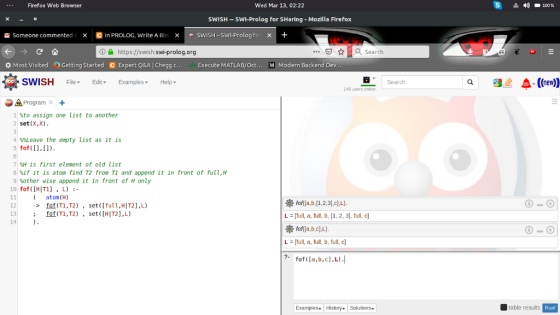
In case of any doubt please comment. Happy Learning :)
Add Answer to:
In PROLOG, write a binary predicate fof, short for 'full of
full', which
will precede each...
SWI-Prolog a) Write a predicate called lastEle(Atom,List) to find the last element of a list. You...
SWI-Prolog a) Write a predicate called lastEle(Atom,List) to find the last element of a list. You may not use the built-in last predicate in your answer. E.g., ?- lastEle(X,[how,are,you,today]). X=today. b) Write a predicate gradeMap(L,R), where L is a list of percentage grade values (integers from 0 to 100), and R is a list of corresponding grade letters (a-f, no +/-'s). You may assume the grade list contains the correct types. E.g., ?-gradeMap([0, 16, 49, 55, 63, 78, 92], R)....
Prolog questions. Thanks! Write a predicate that removes consecutive duplicate elements from a list. ?- remove_consecutive_duplicates...
 Prolog questions. Thanks!
Write a predicate that removes consecutive duplicate elements from a list. ?- remove_consecutive_duplicates ([a, a, b, c, c, a, a, a, e, d, d, a, c], L). L = [a, b, c,,a, e, d, a, c].
Prolog questions. Thanks!
Write a predicate that removes consecutive duplicate elements from a list. ?- remove_consecutive_duplicates ([a, a, b, c, c, a, a, a, e, d, d, a, c], L). L = [a, b, c,,a, e, d, a, c].
///Program needs to write in prolog/// 6. A binary tree is either empty or it is...
 ///Program needs to write in prolog///
6. A binary tree is either empty or it is composed of a root element and two successors, which are binary trees themselves. In Prolog we represent the empty tree by the atom 'nil' and the non-empty tree by the term t(X,L,R), where X denotes the root node and L and R denote the left and right subtree, respectively. The following Prolog term represents the given binary tree below. T1 = t(a,t(b,t(d,nil,nil),t(e,nil,nil)),t(c,nil,t(f,t(g,nil, nil),nil))) d...
///Program needs to write in prolog///
6. A binary tree is either empty or it is composed of a root element and two successors, which are binary trees themselves. In Prolog we represent the empty tree by the atom 'nil' and the non-empty tree by the term t(X,L,R), where X denotes the root node and L and R denote the left and right subtree, respectively. The following Prolog term represents the given binary tree below. T1 = t(a,t(b,t(d,nil,nil),t(e,nil,nil)),t(c,nil,t(f,t(g,nil, nil),nil))) d...
Question 3 (13] (a) Write a procedure filter (L,PredName, L1,L2) that accepts a list L and...
 Question 3 (13] (a) Write a procedure filter (L,PredName, L1,L2) that accepts a list L and returns two lists Li and L2, where Li contains all elements in L for which PredName (x) fails, and L2 contains all elements in L for which PredName (x) succeeds. The predicate PredName/1 should be defined when calling the procedure filter. For example: let test be defined as test(N).- N > 0. 7- filter((-6,7,-1,0),test,L1,L2). L1 - (-6.-1) L2 - [7, 0] NB Use the...
THIS IS A PROLOG QUESTION: Write a Prolog rule to repeat each element of the list...
THIS IS A PROLOG QUESTION: Write a Prolog rule to repeat each element of the list TWO times. Hint: You should use recursion. For example, repeat_elements([a,b,c], Result) should return Result as [a,a,b,b,c,c] The result of repeating an empty list [] is an empty list [] so your base case should be the following: repeat_elements([], []). % This is the base case Once you complete your rule by adding recursion rule to the base case, you should test it by a...
Write a C# program to generate 2 Lists of random 5 elements each containing only binary...
Write a C# program to generate 2 Lists of random 5 elements each containing only binary numbers like 1 or 0 only such that there is only one 1 in the list in any random position and the rest four elements are zeroes. Create another list of 3 elements and such that there are random 1s or 0s. And concatenate these 3 Lists together to produce "one List" named "datablock".
Write a C# program to generate Lists of random 5 elements each containing only binary numbers...
Write a C# program to generate Lists of random 5 elements each containing only binary numbers like 1 or 0 only such that there is only one 1 in the list in any random position and the rest four elements are zeroes. . For eg: (10000) or (01000) or (00100) or (00010) or (00001).
1. An integer is said to be perfect if the sum of its factors, including 1,...
1. An integer is said to be perfect if the sum of its factors, including 1, is equal to the number itself. Write a Prolog predicate perfect(N, F), which determines if integer N is perfect and if so, return it’s list of factors F. If N is not perfect, the predicate fails. You may find the arithmetic operation M mod N to be useful. Test your predicate on the following. • perfect(6, Factors) ⇒ Factors = [1, 2, 3] •...
(10 points) Recall that the set of full binary trees is defined as follows: Basis: A...
 (10 points) Recall that the set of full binary trees is defined as follows: Basis: A single vertex with no edges is a full binary tree. The root is the only vertex in the tree. Recursive rule: If T1 and T2 are full binary trees, then a new tree T' can be constructed by first placing T1 to the left of T2, adding a new vertex v at the top and then adding an edge between v and the root...
3. Write a full set of quantum numbers for each of the following: a. The outermost...
 3. Write a full set of quantum numbers for each of the following: a. The outermost electron in an Li atom b. The electron gained when a Br atom becomes a Brion. C. The electron lost when a Cs atom ionizes (Cs) d. The highest energy electron in the ground-state B aton 3. Write a full set of quantum numbers for each of the following: a. The outermost electron in an Li atom b. The electron gained when a Br...
 Prolog questions. Thanks!
Write a predicate that removes consecutive duplicate elements from a list. ?- remove_consecutive_duplicates ([a, a, b, c, c, a, a, a, e, d, d, a, c], L). L = [a, b, c,,a, e, d, a, c].
Prolog questions. Thanks!
Write a predicate that removes consecutive duplicate elements from a list. ?- remove_consecutive_duplicates ([a, a, b, c, c, a, a, a, e, d, d, a, c], L). L = [a, b, c,,a, e, d, a, c].
 ///Program needs to write in prolog///
6. A binary tree is either empty or it is composed of a root element and two successors, which are binary trees themselves. In Prolog we represent the empty tree by the atom 'nil' and the non-empty tree by the term t(X,L,R), where X denotes the root node and L and R denote the left and right subtree, respectively. The following Prolog term represents the given binary tree below. T1 = t(a,t(b,t(d,nil,nil),t(e,nil,nil)),t(c,nil,t(f,t(g,nil, nil),nil))) d...
///Program needs to write in prolog///
6. A binary tree is either empty or it is composed of a root element and two successors, which are binary trees themselves. In Prolog we represent the empty tree by the atom 'nil' and the non-empty tree by the term t(X,L,R), where X denotes the root node and L and R denote the left and right subtree, respectively. The following Prolog term represents the given binary tree below. T1 = t(a,t(b,t(d,nil,nil),t(e,nil,nil)),t(c,nil,t(f,t(g,nil, nil),nil))) d...
 Question 3 (13] (a) Write a procedure filter (L,PredName, L1,L2) that accepts a list L and returns two lists Li and L2, where Li contains all elements in L for which PredName (x) fails, and L2 contains all elements in L for which PredName (x) succeeds. The predicate PredName/1 should be defined when calling the procedure filter. For example: let test be defined as test(N).- N > 0. 7- filter((-6,7,-1,0),test,L1,L2). L1 - (-6.-1) L2 - [7, 0] NB Use the...
 (10 points) Recall that the set of full binary trees is defined as follows: Basis: A single vertex with no edges is a full binary tree. The root is the only vertex in the tree. Recursive rule: If T1 and T2 are full binary trees, then a new tree T' can be constructed by first placing T1 to the left of T2, adding a new vertex v at the top and then adding an edge between v and the root...
 3. Write a full set of quantum numbers for each of the following: a. The outermost electron in an Li atom b. The electron gained when a Br atom becomes a Brion. C. The electron lost when a Cs atom ionizes (Cs) d. The highest energy electron in the ground-state B aton 3. Write a full set of quantum numbers for each of the following: a. The outermost electron in an Li atom b. The electron gained when a Br...
Most questions answered within 3 hours.
-
Where is the error in this code sequence?
String s1 = "Hello";
String s2 = "ello";...
asked 10 months ago -
Financial data for Joel de Paris, Inc., for last year
follow:
Joel de Paris, Inc.
Balance...
asked 10 months ago -
Consider this reaction:
Al2(SO4)3 (aq)+ BaCl3
(aq) Al2Cl6 (aq)- +
3BaSO4(s) . What is the...
asked 10 months ago -
Suppose that Savneet is considering increasing her
recent random sample from 20 car rentals to 40...
asked 10 months ago -
Trucks arrive at an unloading terminal at an average rate of 120
per hour.
Trucks arrive...
asked 10 months ago -
Why are methanol and ethanol completely soluble in water while
octanol is not very little soluble....
asked 10 months ago -
A facilities manager at a university reads in a research report
that the mean amount of...
asked 10 months ago -
When the CuSO4 is rehydrated by adding water to the anhydrous
compound, is this an endothermic...
asked 10 months ago -
A ray of sunlight is passing from diamond into crown glass; the
angle of incidence is...
asked 10 months ago -
A block of mass 0.249 kg is placed on top of a light, vertical
spring of...
asked 10 months ago -
how do the kidneys compensate in the presences of acidosis
a) trigger hyperventilate
b) reserve acid...
asked 10 months ago -
Question 501 pts
The rental rate of capital to the firm increases. Which of the
following...
asked 10 months ago