Under what condition does a liquidity trap occur? Illustrate a liquidity trap using IS-LM. b) What...
Under what condition does a liquidity trap occur?
Illustrate a liquidity trap using IS-LM.
b) What policy measure would you suggest to help get an economy out of a liquidity trap? Show
how this policy works using IS-LM.
Homework Answers
a) Usually interest rate falls when money
supply is increased in long run. Liquidity trap is an economic
situation when interest rate do not fall in case of rise in
monetary policy or expansionary monetary policy. From M0 to M1,
increase in money supply cause interest rate to fall and output
level to rise while from M1 to M2 to M3, there is no reduction in
rate of interest but only rise in output level. In Liquidity trap,
interest rate have fallen almost to zero causing people to save
their money in the form of cash rather than in stocks and
bonds.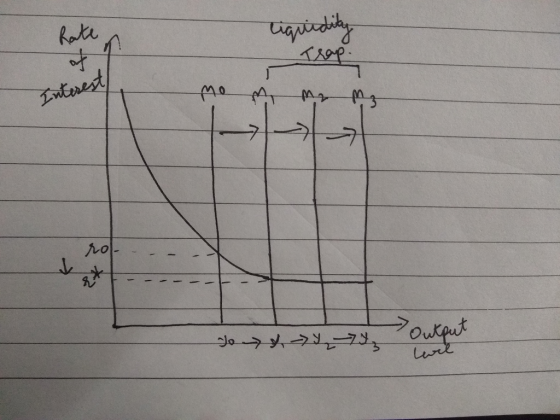
b) There are many ways to raise preference of saving in banks or raise confidence in the public that interest rate would rise soon which will induce them to invest in banks. Keynesian argues that it can be settled with expansionary fiscal policy with borrowing of government. Increase in government spending will encourage private investors to start spending. Modern monetary theory suggest that expansionary fiscal policy can be increased by money supply rather than government borrowing.
Add Answer to:
Under what condition does a liquidity trap occur?
Illustrate a liquidity trap using IS-LM.
b) What...
Given the normal IS-LM and AD-AS DescriptionA liquidity trap is a situation, described in Keynesian economics,...
 Given the normal IS-LM and AD-AS
DescriptionA liquidity trap is a situation, described in Keynesian
economics, in which, "after the rate of interest has fallen to a
certain level, liquidity preference may become virtually absolute
in the sense that almost everyone prefers holding cash rather than
holding a debt which yields so low a rate of interest."
(1) Show the effect of the increase of M by the government using graphs. (Be careful about intersection points in the graphs.) (2)...
Given the normal IS-LM and AD-AS
DescriptionA liquidity trap is a situation, described in Keynesian
economics, in which, "after the rate of interest has fallen to a
certain level, liquidity preference may become virtually absolute
in the sense that almost everyone prefers holding cash rather than
holding a debt which yields so low a rate of interest."
(1) Show the effect of the increase of M by the government using graphs. (Be careful about intersection points in the graphs.) (2)...
Liquidity Trap in the IS-LM Model (50 points) Consider a closed economy in which output is...
Liquidity Trap in the IS-LM Model (50 points) Consider a closed economy in which output is the sum of consumption, investment and government purchases Y = C + I + G, and where C, I and G are respectively given by C = 5000 – 2000 r + 0.8(Y– T), I = 1500 – 3000 r, and G = 2500. Note also that lump-sum taxes T are given by 1250. (a) (5 points) Recalling that national savings equals S =...
1. Consider an economy with zero interest rate and aggregate output less than its natural output...
 1. Consider an economy with zero interest rate and aggregate output less than its natural output (liquidity trap). a. Draw IS-LM curves representing this economy. b. Draw AD-AS curves representing this economy. c. Explain why the price adjustment mechanism (wage and price changes) does not work in this condition. d. What type of policy (fiscal/monetary) is needed to reduce unemployment rate and increase output? Show on the graphs. f. Do you think that the policy packages in response to the...
B3. Open Economy IS-LM-FE model: The behaviour of households and firms in an open economy is...
 B3. Open Economy IS-LM-FE model: The behaviour of households and firms in an open economy is represented by the following equations: Full-employment outputY-1200 red consumption Cd = 350 + 0.5Y-200r : Desired investmentd 250-300r Government purchasesG 95 Net exports : NX = 100-01-05e Real exchange rate : 90. Assume that the real interest rate, r, does not deviate from the foreign interest rate and that the economy is initially in general equilibrium. ve the open-economy IS curve writing the real...
5) What would best be considered the ultimate consequences of a liquidity trap as described in Keynesian theory? a)...
 5) What would best be considered the ultimate consequences of a liquidity trap as described in Keynesian theory? a) Bonds would be hoarded instead of money leading to ever higher interest rates b) There would be a massive shortage of money and tremendous demand for bonds, regardless of how high interest rates are. o) There would be universal refusal of money leading to a reversion back to the barter system. d) Money would be hoarded instead of bonds regardless of...
Suppose you are given IS: Y = 1250-50r and LM: Y = 450 + 30r ,...
 Suppose you are given IS: Y = 1250-50r and LM: Y = 450 + 30r , α = 2.5 M = 700 and P-2, Md (1/3) Y + 200-10r, Initial equilibrium Y 750, r-10 and 1=0 a) Evaluate numerically only the impact of fiscal policy on the income level (Y) when government expenditure is increased by $5 billions, under the conditions when: i Seitivity of investment demand to the interest rate is 0.001 and 100 Less sensitivity of Investment to...
I really need help with these two I do not understand the theory and how to illustrate these on d...
 I really need help with these two I do not understand the
theory and how to illustrate these on diagrams
Suppose you were a member of the Federal Reserve Board of Governors: a. What three policies would you suggest to combat inflation? Why? Explain carefully. b. Using money market diagrams illustrate and briefly explain the effects of your suggested open market operations. Suppose that the Fed's policy objective is to keep the nominal interest rate constant. How would a Fed...
I really need help with these two I do not understand the
theory and how to illustrate these on diagrams
Suppose you were a member of the Federal Reserve Board of Governors: a. What three policies would you suggest to combat inflation? Why? Explain carefully. b. Using money market diagrams illustrate and briefly explain the effects of your suggested open market operations. Suppose that the Fed's policy objective is to keep the nominal interest rate constant. How would a Fed...
1. A. Suppose in an economy, there is an exogenous fall in investment spending due to the burst of a housing bubble. Answer the following questions using the IS-LM-FX model. Which schedule shifts...
 1. A. Suppose in an economy, there is an exogenous fall in investment spending due to the burst of a housing bubble. Answer the following questions using the IS-LM-FX model. Which schedule shifts in the IS-LM model on impact? ii. i. What happens to the equilibrium output, interest rate, and exchange rate after this change? B. Suppose that following the decline in investment spending, the central bank decides to pursue an output stabilization policy. Answer the following questions comparing the...
Question 2: [50 marks] The COVID-19 pandemic is causing tremendous hardship around the world. A recession,...
 Question 2: [50 marks] The COVID-19 pandemic is causing tremendous hardship around the world. A recession, likely a severe one, is inevitable. A. Show the short run effects of a decrease in the demand for goods and services caused by the pandemic. Suppose the economy is an open economy that is on a flexible exchange rate. To answer this question, draw the following five diagrams: 1. The goods market, [3 marks] 2. The money market, [3 marks] 3. The IS-LM...
IS-LM What combination of policies would best reduce inflation? a) Increase taxes, sell government bonds b)...
 IS-LM What combination of policies would best reduce inflation? a) Increase taxes, sell government bonds b) Decrease taxes, buy government bonds c) Decrease taxes, lower the reserve ratio d) Decrease government spending, lower the discount rate e) Increase government spending, raise the discount rate Use the IS-LM model. Your policy instruments are: Taxes, Government Spending, and the Money Supply. Describe a policy or set of policies that achieve the following objectives. Your answer should include a diagram to show how...
 Given the normal IS-LM and AD-AS
DescriptionA liquidity trap is a situation, described in Keynesian
economics, in which, "after the rate of interest has fallen to a
certain level, liquidity preference may become virtually absolute
in the sense that almost everyone prefers holding cash rather than
holding a debt which yields so low a rate of interest."
(1) Show the effect of the increase of M by the government using graphs. (Be careful about intersection points in the graphs.) (2)...
Given the normal IS-LM and AD-AS
DescriptionA liquidity trap is a situation, described in Keynesian
economics, in which, "after the rate of interest has fallen to a
certain level, liquidity preference may become virtually absolute
in the sense that almost everyone prefers holding cash rather than
holding a debt which yields so low a rate of interest."
(1) Show the effect of the increase of M by the government using graphs. (Be careful about intersection points in the graphs.) (2)...
 1. Consider an economy with zero interest rate and aggregate output less than its natural output (liquidity trap). a. Draw IS-LM curves representing this economy. b. Draw AD-AS curves representing this economy. c. Explain why the price adjustment mechanism (wage and price changes) does not work in this condition. d. What type of policy (fiscal/monetary) is needed to reduce unemployment rate and increase output? Show on the graphs. f. Do you think that the policy packages in response to the...
 B3. Open Economy IS-LM-FE model: The behaviour of households and firms in an open economy is represented by the following equations: Full-employment outputY-1200 red consumption Cd = 350 + 0.5Y-200r : Desired investmentd 250-300r Government purchasesG 95 Net exports : NX = 100-01-05e Real exchange rate : 90. Assume that the real interest rate, r, does not deviate from the foreign interest rate and that the economy is initially in general equilibrium. ve the open-economy IS curve writing the real...
 5) What would best be considered the ultimate consequences of a liquidity trap as described in Keynesian theory? a) Bonds would be hoarded instead of money leading to ever higher interest rates b) There would be a massive shortage of money and tremendous demand for bonds, regardless of how high interest rates are. o) There would be universal refusal of money leading to a reversion back to the barter system. d) Money would be hoarded instead of bonds regardless of...
 Suppose you are given IS: Y = 1250-50r and LM: Y = 450 + 30r , α = 2.5 M = 700 and P-2, Md (1/3) Y + 200-10r, Initial equilibrium Y 750, r-10 and 1=0 a) Evaluate numerically only the impact of fiscal policy on the income level (Y) when government expenditure is increased by $5 billions, under the conditions when: i Seitivity of investment demand to the interest rate is 0.001 and 100 Less sensitivity of Investment to...
 I really need help with these two I do not understand the
theory and how to illustrate these on diagrams
Suppose you were a member of the Federal Reserve Board of Governors: a. What three policies would you suggest to combat inflation? Why? Explain carefully. b. Using money market diagrams illustrate and briefly explain the effects of your suggested open market operations. Suppose that the Fed's policy objective is to keep the nominal interest rate constant. How would a Fed...
I really need help with these two I do not understand the
theory and how to illustrate these on diagrams
Suppose you were a member of the Federal Reserve Board of Governors: a. What three policies would you suggest to combat inflation? Why? Explain carefully. b. Using money market diagrams illustrate and briefly explain the effects of your suggested open market operations. Suppose that the Fed's policy objective is to keep the nominal interest rate constant. How would a Fed...
 1. A. Suppose in an economy, there is an exogenous fall in investment spending due to the burst of a housing bubble. Answer the following questions using the IS-LM-FX model. Which schedule shifts in the IS-LM model on impact? ii. i. What happens to the equilibrium output, interest rate, and exchange rate after this change? B. Suppose that following the decline in investment spending, the central bank decides to pursue an output stabilization policy. Answer the following questions comparing the...
 Question 2: [50 marks] The COVID-19 pandemic is causing tremendous hardship around the world. A recession, likely a severe one, is inevitable. A. Show the short run effects of a decrease in the demand for goods and services caused by the pandemic. Suppose the economy is an open economy that is on a flexible exchange rate. To answer this question, draw the following five diagrams: 1. The goods market, [3 marks] 2. The money market, [3 marks] 3. The IS-LM...
 IS-LM What combination of policies would best reduce inflation? a) Increase taxes, sell government bonds b) Decrease taxes, buy government bonds c) Decrease taxes, lower the reserve ratio d) Decrease government spending, lower the discount rate e) Increase government spending, raise the discount rate Use the IS-LM model. Your policy instruments are: Taxes, Government Spending, and the Money Supply. Describe a policy or set of policies that achieve the following objectives. Your answer should include a diagram to show how...
Most questions answered within 3 hours.
-
Where is the error in this code sequence?
String s1 = "Hello";
String s2 = "ello";...
asked 10 months ago -
Financial data for Joel de Paris, Inc., for last year
follow:
Joel de Paris, Inc.
Balance...
asked 10 months ago -
Consider this reaction:
Al2(SO4)3 (aq)+ BaCl3
(aq) Al2Cl6 (aq)- +
3BaSO4(s) . What is the...
asked 10 months ago -
Suppose that Savneet is considering increasing her
recent random sample from 20 car rentals to 40...
asked 10 months ago -
Trucks arrive at an unloading terminal at an average rate of 120
per hour.
Trucks arrive...
asked 10 months ago -
Why are methanol and ethanol completely soluble in water while
octanol is not very little soluble....
asked 10 months ago -
A facilities manager at a university reads in a research report
that the mean amount of...
asked 10 months ago -
When the CuSO4 is rehydrated by adding water to the anhydrous
compound, is this an endothermic...
asked 10 months ago -
A ray of sunlight is passing from diamond into crown glass; the
angle of incidence is...
asked 10 months ago -
A block of mass 0.249 kg is placed on top of a light, vertical
spring of...
asked 10 months ago -
how do the kidneys compensate in the presences of acidosis
a) trigger hyperventilate
b) reserve acid...
asked 10 months ago -
Question 501 pts
The rental rate of capital to the firm increases. Which of the
following...
asked 10 months ago