Problem 6-11. Consider an electron in a "box" which is 1.00 cm long. Using Eq. (6-27),...
Problem 6-11. Consider an electron in a "box" which is 1.00 cm long. Using Eq. (6-27), find the smallest velocity the electron can have.
(6-27) k = n ( pi / L )
Homework Answers

Add Answer to:
Problem 6-11. Consider an electron in a "box" which is 1.00 cm
long. Using Eq. (6-27),...
7. π electron is an electron which resides in the pi bond(s) of a double bond or a triple bond, o...
 7. π electron is an electron which resides in the pi bond(s) of a double bond or a triple bond, or in a conjugated p orbital. The 1,3,5-hexatriene molecule is a conjugated molecule with 6 t electrons. Consider the Tt electrons free to move back and forth along the molecule through the delocalized pi system. Using the particle in a box approximation, treat the carbon chain as a linear one-dimensional "box". Allow each energy level in the box to hold...
Problem 10 (Problem 2.24 in textbook) The wavefunction for the electron in a hydrogen atom in its...
 Problem 10 (Problem 2.24 in textbook) The wavefunction for the electron in a hydrogen atom in its ground state (the 1s state for which n 0, l-0, and m-0) is spherically symmetric as shown in Fig. 2.14. For this state the wavefunction is real and is given by exp-r/ao h2Eo 5.29 x 10⁻¹¹ m. This quantity is the radius of the first Bohr orbit for hydrogen (see next chapter). Because of the spherical symmetry of ịpo, dV in Eq. (2.56)...
Consider an electron in a one-dimensional box as a model of a quantum dot. Suppose the...
 Consider an electron in a one-dimensional box as a model of a quantum dot. Suppose the box has width 0.7 nm. For this problem, absorption of light and subsequent relaxation connect two states (i andj) with a difference in energy, AEi E - E. (a) Calculate AEsi and AE2I for luminescence from excited energy levels to the ground state. Convert the energies to the corresponding wavelengths of light, λ31 and λ21. (b) Find the wavelength of light that corresponds to...
Problem 1 Using what we have leamed in chapter 1, derive, for a semiconductor, the expressions of...
 Problem 1 Using what we have leamed in chapter 1, derive, for a semiconductor, the expressions of The total current density Conductivity - Problem 2 Consider Germanium sample with the following characteristics the electron and hole mobility for Ge is 0.39 and 0.19 m2N.s The electron and hole effectives masses are 0.56me and 0.4 me The energy gap is 0.67 eV at T-27°C 1) 2) Find the intrinsic carrier concentration for Ge What is the resistivity of the Ge sample...
Question 11 6 pts The electric field 52.0 cm from a very long uniform line of...
 Question 11 6 pts The electric field 52.0 cm from a very long uniform line of charge is 785 N/C. How much charge is contained in a 1.00 cm section of the line? Please give your answer in units of pC. w
(Chapters 24 and 16 in the book) Problem 6. Consider a competitive industry in the long...
 (Chapters 24 and 16 in the book) Problem 6. Consider a competitive industry in the long run with many firms, all of which have identical costs functions c(y) - y2 when y> 0, and c(0) 0 when y 0. The marginal cost of each firm is MCy) 2y. Suppose that the initial market demand is D(p) 52 -p Note: The number of firms is always an integer. The output of a firm does not have to be an integer. (a)...
Tipler6 28.P.036. 1 2 3 A rod 27 cm long moves at 8 m/s in a...
 Tipler6 28.P.036. 1 2 3 A rod 27 cm long moves at 8 m/s in a plane perpendicular to a magnetic field of 100 G. The velocity of the rod is perpendicular to its length. 1) Find the magnetic force on an electron in the rod. N Submit You currently have 0 submissions for this question. Only 10 submission are allowed. You can make 10 more submissions for this question. 2) Find the electrostatic field in the rod. V/m Submit...
2. Electron overlap with nucleus (very important for electron capture): Since the possible positi...
 2. Electron overlap with nucleus (very important for electron capture): Since the possible position of the electron is smudged out, it even may overlap with the nucleus. a) What is the probability of an electron in the (1,0,0) state being between r-0 and ao? b) What is the probability of an electron in the (1,0,0) state being between r-0 and 1.25 fm? (remember how to solve integrals for a very small interval, see example 5.3) Example 5.3 Consider again an...
Chapter 22, Problem 040 An electron with a speed of 3.53 x 108 cm/s in the...
 Chapter 22, Problem 040 An electron with a speed of 3.53 x 108 cm/s in the positive direction of an x axis enters an electric field of magnitude 2.25 × 10³ N/C, traveling along a field line in the direction that retards its motion. (a) How far will the electron travel in the field before stopping momentarily, and (b) how much time l have elapsed? (c) If the region containing the electric field is 5.82 mm long (too short for...
Problem 3: A. To construct a moving electron we have to consider two wavelengths, one very...
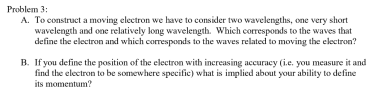 Problem 3: A. To construct a moving electron we have to consider two wavelengths, one very short wavelength and one relatively long wavelength. Which corresponds to the waves that define the electron and which corresponds to the waves related to moving the electron? B. If you define the position of the electron with increasing accuracy (i.e. you measure it and find the electron to be somewhere specific) what is implied about your ability to define its momentum?
 7. π electron is an electron which resides in the pi bond(s) of a double bond or a triple bond, or in a conjugated p orbital. The 1,3,5-hexatriene molecule is a conjugated molecule with 6 t electrons. Consider the Tt electrons free to move back and forth along the molecule through the delocalized pi system. Using the particle in a box approximation, treat the carbon chain as a linear one-dimensional "box". Allow each energy level in the box to hold...
 Problem 10 (Problem 2.24 in textbook) The wavefunction for the electron in a hydrogen atom in its ground state (the 1s state for which n 0, l-0, and m-0) is spherically symmetric as shown in Fig. 2.14. For this state the wavefunction is real and is given by exp-r/ao h2Eo 5.29 x 10⁻¹¹ m. This quantity is the radius of the first Bohr orbit for hydrogen (see next chapter). Because of the spherical symmetry of ịpo, dV in Eq. (2.56)...
 Consider an electron in a one-dimensional box as a model of a quantum dot. Suppose the box has width 0.7 nm. For this problem, absorption of light and subsequent relaxation connect two states (i andj) with a difference in energy, AEi E - E. (a) Calculate AEsi and AE2I for luminescence from excited energy levels to the ground state. Convert the energies to the corresponding wavelengths of light, λ31 and λ21. (b) Find the wavelength of light that corresponds to...
 Problem 1 Using what we have leamed in chapter 1, derive, for a semiconductor, the expressions of The total current density Conductivity - Problem 2 Consider Germanium sample with the following characteristics the electron and hole mobility for Ge is 0.39 and 0.19 m2N.s The electron and hole effectives masses are 0.56me and 0.4 me The energy gap is 0.67 eV at T-27°C 1) 2) Find the intrinsic carrier concentration for Ge What is the resistivity of the Ge sample...
 Question 11 6 pts The electric field 52.0 cm from a very long uniform line of charge is 785 N/C. How much charge is contained in a 1.00 cm section of the line? Please give your answer in units of pC. w
 (Chapters 24 and 16 in the book) Problem 6. Consider a competitive industry in the long run with many firms, all of which have identical costs functions c(y) - y2 when y> 0, and c(0) 0 when y 0. The marginal cost of each firm is MCy) 2y. Suppose that the initial market demand is D(p) 52 -p Note: The number of firms is always an integer. The output of a firm does not have to be an integer. (a)...
 Tipler6 28.P.036. 1 2 3 A rod 27 cm long moves at 8 m/s in a plane perpendicular to a magnetic field of 100 G. The velocity of the rod is perpendicular to its length. 1) Find the magnetic force on an electron in the rod. N Submit You currently have 0 submissions for this question. Only 10 submission are allowed. You can make 10 more submissions for this question. 2) Find the electrostatic field in the rod. V/m Submit...
 2. Electron overlap with nucleus (very important for electron capture): Since the possible position of the electron is smudged out, it even may overlap with the nucleus. a) What is the probability of an electron in the (1,0,0) state being between r-0 and ao? b) What is the probability of an electron in the (1,0,0) state being between r-0 and 1.25 fm? (remember how to solve integrals for a very small interval, see example 5.3) Example 5.3 Consider again an...
 Chapter 22, Problem 040 An electron with a speed of 3.53 x 108 cm/s in the positive direction of an x axis enters an electric field of magnitude 2.25 × 10³ N/C, traveling along a field line in the direction that retards its motion. (a) How far will the electron travel in the field before stopping momentarily, and (b) how much time l have elapsed? (c) If the region containing the electric field is 5.82 mm long (too short for...
 Problem 3: A. To construct a moving electron we have to consider two wavelengths, one very short wavelength and one relatively long wavelength. Which corresponds to the waves that define the electron and which corresponds to the waves related to moving the electron? B. If you define the position of the electron with increasing accuracy (i.e. you measure it and find the electron to be somewhere specific) what is implied about your ability to define its momentum?
Most questions answered within 3 hours.
-
Where is the error in this code sequence?
String s1 = "Hello";
String s2 = "ello";...
asked 10 months ago -
Financial data for Joel de Paris, Inc., for last year
follow:
Joel de Paris, Inc.
Balance...
asked 10 months ago -
Consider this reaction:
Al2(SO4)3 (aq)+ BaCl3
(aq) Al2Cl6 (aq)- +
3BaSO4(s) . What is the...
asked 10 months ago -
Suppose that Savneet is considering increasing her
recent random sample from 20 car rentals to 40...
asked 10 months ago -
Trucks arrive at an unloading terminal at an average rate of 120
per hour.
Trucks arrive...
asked 10 months ago -
Why are methanol and ethanol completely soluble in water while
octanol is not very little soluble....
asked 10 months ago -
A facilities manager at a university reads in a research report
that the mean amount of...
asked 10 months ago -
When the CuSO4 is rehydrated by adding water to the anhydrous
compound, is this an endothermic...
asked 10 months ago -
A ray of sunlight is passing from diamond into crown glass; the
angle of incidence is...
asked 10 months ago -
A block of mass 0.249 kg is placed on top of a light, vertical
spring of...
asked 10 months ago -
how do the kidneys compensate in the presences of acidosis
a) trigger hyperventilate
b) reserve acid...
asked 10 months ago -
Question 501 pts
The rental rate of capital to the firm increases. Which of the
following...
asked 10 months ago