The multiplier effect a. intensifies the effect of an increase in spending but not a decrease....
The multiplier effect
a. intensifies the effect of an increase in spending but not a decrease.
b. intensifies the effect of a decrease in spending but not an increase.
c. diminishes the effect of a spending change, whether it is an increase or decrease.
d. intensifies the effect of a spending change, whether it is an increase or decrease.
Homework Answers
Multiplier effect implies that amplification of initial change.
In other words, if initial change leads to greater final change then this process is termed as multiplier process as initial change has multiplied to create a much greater final change.
So,
The multiplier effect intensifies the effect of a spending change, whether it is an increase or decrease.
Hence, the correct answer is the option (d).
Add Answer to:
The multiplier effect
a. intensifies the effect of an increase in spending but not a
decrease....
Why is the multiplier for a change in taxes smaller than for a change in spending?...
 Why is the multiplier for a change in taxes smaller than for a change in spending? a. A change in taxes has no effect on aggregate demand, only on aggregate supply. b. A change in taxes directly affects government spending as well, lowering the multiplier. c. A change in taxes affects spending directly, but at a slower rate than spending does. d. A change in taxes affects disposable income and then consumption rather than spending directly. e. All of the...
The multiplier effect applies a. Only to changes in government spending b. To a change in...
The multiplier effect applies a. Only to changes in government spending b. To a change in spending of any component of GDP c. Only to change in the money supply d. Only when the crowding-out effect is sufficiently strong
(1) Calculate the government spending multiplier if, an increase in government spending by $5 million increases...
(1) Calculate the government spending multiplier if, an increase in government spending by $5 million increases real GDP by $20 million. Group of answer choices 0.20 0.25 2 5 4 (2) A major benefit of automatic stabilizers is that they: Group of answer choices guarantee a balanced budget over the course of the business cycle. have a tendency to reduce the national debt. moderate the effect of fluctuations in the business cycle. require legislative review by Congress before they can...
If the government spending multiplier is 5 and government spending decreases by $200 billion
 If the government spending multiplier is 5 and government spending decreases by $200 billion, output will _______ by $_______ billion.Select one:a. decrease; 200b. increase; 200c. decrease; 40d. decrease; 1,000
1. Which is not an effect of increases in gov. deficit spending? a) Capital inflow increase...
1. Which is not an effect of increases in gov. deficit spending? a) Capital inflow increase b)Increase in imports c)Increase in interest rates d)Decrease in exports e)Decrease in the trade deficit 2. The twin deficits effects is used to describe simultaneous deficits in the USA gov. budget and: a)International trade b)Monetary policy c)Gov. expenditures d)unemployment e)None of these 3. If an expansionary monetary policy increases the supply of US dollars, what effect will this have on the US dollar value...
1. Explain whether each of the following events will increase, decrease, or have no effect on...
1. Explain whether each of the following events will increase, decrease, or have no effect on aggregate demand. a) The stock market crashes. b) People feel pessimistic with the outlook of economy, and start to save for a rainy day. c) The city cuts the budget and hence the spending on schools. d) Inflation increases workers expectation on the nominal wage.
19) Fiscal stimulus is: a) An increase or decrease in government spending. b) An increase in...
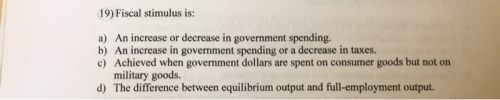 19) Fiscal stimulus is: a) An increase or decrease in government spending. b) An increase in government spending or a decrease in taxes. c) Achieved when government dollars are spent on consumer goods but not on military goods. d) The difference between equilibrium output and full-employment output.
22. Why is the multiplier for a change in taxes smaller than for a change in spendi...
22. Why is the multiplier for a change in taxes smaller than for a change in spending? a. A change in taxes has no effect on aggregate demand, only on aggregate supply. b. A change in taxes directly affects government spending as well, lowering the multiplier. c. A change in taxes affects spending directly, but at a slower rate than spending does. d. A change in taxes affects disposable income and then consumption rather than spending directly....
list the factors that determine the amount of investment spending by firms spending multiplier effect will...
 list the factors that determine the amount of investment spending
by firms
spending multiplier effect will go up or down? down List the factors that determine the amount of investment spending by firms What kind of curves the followings are?
list the factors that determine the amount of investment spending
by firms
spending multiplier effect will go up or down? down List the factors that determine the amount of investment spending by firms What kind of curves the followings are?
1 Will making each of the following changes increase, decrease, or have no effect on the...
1 Will making each of the following changes increase, decrease, or have no effect on the size of a t-value? In each case, circle the appropriate response. a. Increasing the difference between the means. Increase Decrease No Change b. Decreasing the variance of both groups. Increase Decrease No Change c. Increasing the sample size of both groups. Increase Decrease No Change d. Decreasing the population size Increase Decrease No Change
 Why is the multiplier for a change in taxes smaller than for a change in spending? a. A change in taxes has no effect on aggregate demand, only on aggregate supply. b. A change in taxes directly affects government spending as well, lowering the multiplier. c. A change in taxes affects spending directly, but at a slower rate than spending does. d. A change in taxes affects disposable income and then consumption rather than spending directly. e. All of the...
 19) Fiscal stimulus is: a) An increase or decrease in government spending. b) An increase in government spending or a decrease in taxes. c) Achieved when government dollars are spent on consumer goods but not on military goods. d) The difference between equilibrium output and full-employment output.
 list the factors that determine the amount of investment spending
by firms
spending multiplier effect will go up or down? down List the factors that determine the amount of investment spending by firms What kind of curves the followings are?
list the factors that determine the amount of investment spending
by firms
spending multiplier effect will go up or down? down List the factors that determine the amount of investment spending by firms What kind of curves the followings are?
Most questions answered within 3 hours.
-
Where is the error in this code sequence?
String s1 = "Hello";
String s2 = "ello";...
asked 10 months ago -
Financial data for Joel de Paris, Inc., for last year
follow:
Joel de Paris, Inc.
Balance...
asked 10 months ago -
Consider this reaction:
Al2(SO4)3 (aq)+ BaCl3
(aq) Al2Cl6 (aq)- +
3BaSO4(s) . What is the...
asked 10 months ago -
Suppose that Savneet is considering increasing her
recent random sample from 20 car rentals to 40...
asked 10 months ago -
Trucks arrive at an unloading terminal at an average rate of 120
per hour.
Trucks arrive...
asked 10 months ago -
Why are methanol and ethanol completely soluble in water while
octanol is not very little soluble....
asked 10 months ago -
A facilities manager at a university reads in a research report
that the mean amount of...
asked 10 months ago -
When the CuSO4 is rehydrated by adding water to the anhydrous
compound, is this an endothermic...
asked 10 months ago -
A ray of sunlight is passing from diamond into crown glass; the
angle of incidence is...
asked 10 months ago -
A block of mass 0.249 kg is placed on top of a light, vertical
spring of...
asked 10 months ago -
how do the kidneys compensate in the presences of acidosis
a) trigger hyperventilate
b) reserve acid...
asked 10 months ago -
Question 501 pts
The rental rate of capital to the firm increases. Which of the
following...
asked 10 months ago