Explain how the ΔG value relates to changes in redox species concentration.
Explain how the ΔG value relates to changes in redox species concentration.
Homework Answers


Add Answer to:
Explain how the ΔG value relates to changes in redox species
concentration.
Use two of the given redox couples to create a complete, balanced redox reaction for which ΔG'° i...
Use two of the given redox couples to create a complete, balanced redox reaction for which ΔG'° is the most exergonic it can be (for the forward reaction). (A) Fe3+ / Fe2+ = + 0.771 V (C) NAD+ / NADH =-.032 V Calculate the ΔE'° value for the redox reaction you've just created. How does this calculated delta E reflect a hihgly exergonic reaction, in terms of electron affinities
Species richness changes with latitude. Using an example explain what the pattern looks like and how...
Species richness changes with latitude. Using an example explain what the pattern looks like and how many species groups we see it in.
Species extinction and habitat loss! Explain how Climate Change impads vulnerable species results in the spread...
 Species extinction and habitat loss! Explain how Climate Change impads vulnerable species results in the spread of invasive Species food webs. 2. Explain how these changes will affect
Define in a paragraph the term mole, and explain how this metric unit relates to the...
 Define in a paragraph the term mole, and explain how this metric unit relates to the molor Concentration of a Solution
CH6Q17 The value of ΔG°'ΔG°′ for the conversion of dihydroxyacetone phosphate to glyceraldehyde-3-phosphate (GAP) is +7.53...
CH6Q17 The value of ΔG°'ΔG°′ for the conversion of dihydroxyacetone phosphate to glyceraldehyde-3-phosphate (GAP) is +7.53 kJ/mol+7.53 kJ/mol. If the concentration of dihydroxyacetone phosphate at equilibrium is 2.25 mM2.25 mM, what is the concentration of glyceraldehyde-3-phosphate? Assume a temperature of 25.0°C25.0°C. [GAP]= _________ mM
What is the value equation? Identify its various components and explain how the equation relates to...
What is the value equation? Identify its various components and explain how the equation relates to a company's pursuit of competitive advantage.
Use two of the given redox couples to create a complete, balanced redox reaction for which...
Use two of the given redox couples to create a complete, balanced redox reaction for which ΔG'° is the most exergonic it can be (for the forward reaction). (A) Fe3+ / Fe2+ = + 0.771 V (C) NAD+ / NADH =-.032 V Calculate the ΔE'° value for the redox reaction you've just created. How does this calculated delta E reflect a hihgly exergonic reaction, in terms of electron affinities
Which of the following are redox reactions? Explain your answer on the basis of changes in...
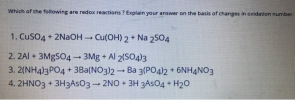 Which of the following are redox reactions? Explain your answer on the basis of changes in oxidation number 1. CuSO4 + 2NaOH → Cu(OH) 2 + Na 2504 2. 2A1 + 3MgSO4 → 3Mg + Al 2(SO4)3 3. 2(NH4)3PO4 + 3Ba(NO3)2 - Ba 3(PO4)2 + 6NH4NO3 4.2HNO3 + 3H3ASO3 2NO + 3H 3ASO4+H2O
Explain the theory of endosymbiosis and explain how it relates to the evolution of Eukaryotes and...
Explain the theory of endosymbiosis and explain how it relates to the evolution of Eukaryotes and their mitochondria and chloroplasts.
how did the optical rotation of sucrose changes atls the concentration increased and was there a...
how did the optical rotation of sucrose changes atls the concentration increased and was there a trend in the optical rotation values for the spefic rotation (calculated) how did your specific rotation compare to the referance value
 Species extinction and habitat loss! Explain how Climate Change impads vulnerable species results in the spread of invasive Species food webs. 2. Explain how these changes will affect
 Define in a paragraph the term mole, and explain how this metric unit relates to the molor Concentration of a Solution
 Which of the following are redox reactions? Explain your answer on the basis of changes in oxidation number 1. CuSO4 + 2NaOH → Cu(OH) 2 + Na 2504 2. 2A1 + 3MgSO4 → 3Mg + Al 2(SO4)3 3. 2(NH4)3PO4 + 3Ba(NO3)2 - Ba 3(PO4)2 + 6NH4NO3 4.2HNO3 + 3H3ASO3 2NO + 3H 3ASO4+H2O
Most questions answered within 3 hours.
-
Where is the error in this code sequence?
String s1 = "Hello";
String s2 = "ello";...
asked 10 months ago -
Financial data for Joel de Paris, Inc., for last year
follow:
Joel de Paris, Inc.
Balance...
asked 10 months ago -
Consider this reaction:
Al2(SO4)3 (aq)+ BaCl3
(aq) Al2Cl6 (aq)- +
3BaSO4(s) . What is the...
asked 10 months ago -
Suppose that Savneet is considering increasing her
recent random sample from 20 car rentals to 40...
asked 10 months ago -
Trucks arrive at an unloading terminal at an average rate of 120
per hour.
Trucks arrive...
asked 10 months ago -
Why are methanol and ethanol completely soluble in water while
octanol is not very little soluble....
asked 10 months ago -
A facilities manager at a university reads in a research report
that the mean amount of...
asked 10 months ago -
When the CuSO4 is rehydrated by adding water to the anhydrous
compound, is this an endothermic...
asked 10 months ago -
A ray of sunlight is passing from diamond into crown glass; the
angle of incidence is...
asked 10 months ago -
A block of mass 0.249 kg is placed on top of a light, vertical
spring of...
asked 10 months ago -
how do the kidneys compensate in the presences of acidosis
a) trigger hyperventilate
b) reserve acid...
asked 10 months ago -
Question 501 pts
The rental rate of capital to the firm increases. Which of the
following...
asked 10 months ago