define a struct containing 4 data fields of the following types of data 1.) char, 2.)...
define a struct containing 4 data fields of the following types of data 1.) char, 2.) int or 3.) float.
Homework Answers
Add Answer to:
define a struct containing 4 data fields of the following types
of data 1.) char, 2.)...
2. Give the minimum size of each of the following C++ types, assuming that char values occupy one...
 2. Give the minimum size of each of the following C++ types, assuming that char values occupy one byte, short values occupy two bytes, int and float values occupy four bytes, double and long values occupy eight bytes, and pointers occupy four bytes. a) union u type ( double a[3]; int *b; char c[10] b) struct s1type float *d [2]; long e[4] char f[6] short *gi c) struct s2 type ( s1_type s; u type u [2]; int *h[3]; short...
Give the minimum size of each of the following C data structures, assuming that char values...
 Give the minimum size of each of the following C data structures, assuming that char values occupy byte, int and float values occupy four bytes, double values occupy eight bytes, and pointers occupy bytes. (a) char str[] = "Curly": (b) double *a[4][4]: (c) char *str[3] = {"Moe", "Larry", "Curly"}: (Include the space occupied by the string literals in your answer.) (d) union { int a: char b: float c[4]: }u: (e) struct { int a: char b: float c[4]: }s:...
A linked list is constructed of nodes described by the following structure: struct node{ char data;...
A linked list is constructed of nodes described by the following structure: struct node{ char data; struct node *next; }; Assume a linked list containing a sentinel node is constructed from the above nodes. Write a function named "count"-prototyped as int count(struct node*sent)- that accepts a pointer to the sentinel node; counts the number of data (non-sentinel) nodes containing the character 'A'; and returns that count as the function value.
PLease explain output of these two programs: 1. #include <stdio.h> typedef struct { char *name; int...
PLease explain output of these two programs: 1. #include <stdio.h> typedef struct { char *name; int x, y; int h, w; } box; typedef struct { unsigned int baud : 5; unsigned int div2 : 1; unsigned int use_external_clock : 1; } flags; int main(int argc, char** argv){ printf("The size of box is %d bytes\n", sizeof(box)); printf("The size of flags is %d bytes\n", sizeof(flags)); return 0; } 2. #include <stdio.h> #include <string.h> /* define simple structure */ struct { unsigned...
C program help 2. For the following code: #include "stdafx.h" struct State char out struct State...
 C program help
2. For the following code: #include "stdafx.h" struct State char out struct State *next[2]; b; typedef struct State States; #define STe &FSM[8] #define ST1 &FSM[1] #define ST2 &FSM[2] States FSM[3] { {"L', {STe, ST1)), {'1', {STe, sT2)), {ST1, = {.2', ST2))); int main() States "ptr &FSM[e]; int in; while (1) printf("cIn", ptr->out); printf("Enter a e or 1 to operate this machine: "); scanf s("Xd", &in); ptr ptr->next[in]; return e; Draw the finite state machine diagram for this...
C program help
2. For the following code: #include "stdafx.h" struct State char out struct State *next[2]; b; typedef struct State States; #define STe &FSM[8] #define ST1 &FSM[1] #define ST2 &FSM[2] States FSM[3] { {"L', {STe, ST1)), {'1', {STe, sT2)), {ST1, = {.2', ST2))); int main() States "ptr &FSM[e]; int in; while (1) printf("cIn", ptr->out); printf("Enter a e or 1 to operate this machine: "); scanf s("Xd", &in); ptr ptr->next[in]; return e; Draw the finite state machine diagram for this...
C language not C++ 1. Write the statements to do the following: (2 pts) a. Define...
 C language not C++
1. Write the statements to do the following: (2 pts) a. Define a struct with member variables width, height, topleft x, topleft y all floats). Use a tag to call it Rectangle. b. Declare a variable struct type Rectangle 2. Consider the following variables: struct int x; float y; char zi var1; union nt x; float y; char[20] z;) var2 f float and int are stored using 4 bytes each, what is the size (in bytes)...
C language not C++
1. Write the statements to do the following: (2 pts) a. Define a struct with member variables width, height, topleft x, topleft y all floats). Use a tag to call it Rectangle. b. Declare a variable struct type Rectangle 2. Consider the following variables: struct int x; float y; char zi var1; union nt x; float y; char[20] z;) var2 f float and int are stored using 4 bytes each, what is the size (in bytes)...
Given the following structure: 4. struct int x; float y[10]; bool z; char w } s;...
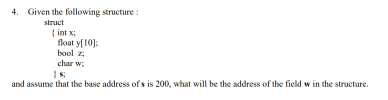 Given the following structure: 4. struct int x; float y[10]; bool z; char w } s; and assume that the base address of s is 200, what will be the address of the field w in the structure
Modify the below code to fit the above requirements: struct node { char data; struct node...
 Modify the below code to fit the above requirements:
struct node
{
char data;
struct node *next;
struct node *previous;
} *front, *MyNode, *rear, *MyPointer, *anchor *Valuenode ;
typedef struct node node;
int Push(char input)
{
if(IsFull()==1)
{
printf("The queue is full. Enter the ‘^’ character to
stop.\n");
return -1;
}
else if (IsFull()==-1)
{
node *MyNode=(node*)malloc(sizeof(node));
MyNode->data=input;
rear->next=MyNode;
MyNode->previous=rear;
MyPointer=rear=MyNode;
return 1;
}
else
{
node *MyNode=(node*)malloc(sizeof(node));
node *anchor=(node*)malloc(sizeof(node));
MyNode->data=input;
MyPointer=rear=front=MyNode;
MyNode->previous=NULL;
MyNode->next=NULL;
anchor->next=MyNode;
return 0;
}
}
char...
Modify the below code to fit the above requirements:
struct node
{
char data;
struct node *next;
struct node *previous;
} *front, *MyNode, *rear, *MyPointer, *anchor *Valuenode ;
typedef struct node node;
int Push(char input)
{
if(IsFull()==1)
{
printf("The queue is full. Enter the ‘^’ character to
stop.\n");
return -1;
}
else if (IsFull()==-1)
{
node *MyNode=(node*)malloc(sizeof(node));
MyNode->data=input;
rear->next=MyNode;
MyNode->previous=rear;
MyPointer=rear=MyNode;
return 1;
}
else
{
node *MyNode=(node*)malloc(sizeof(node));
node *anchor=(node*)malloc(sizeof(node));
MyNode->data=input;
MyPointer=rear=front=MyNode;
MyNode->previous=NULL;
MyNode->next=NULL;
anchor->next=MyNode;
return 0;
}
}
char...
Activities Define a struct called Unit containing the following fields I Unit code Unit credit hours...
 Activities Define a struct called Unit containing the following fields I Unit code Unit credit hours Unit semester of study List of prerequisites Number of prerequisites List of post requisites Number of post requisites Inside your main function declare an array of type Unit called units with size 20 elements. This array will contain the information related to all the units in our diploma program. Each of the elements of this array correspond with one our diploma units. II III...
In the following code, A and B are constants defined with #define: 1 typedef struct {...
In the following code, A and B are constants defined with #define: 1 typedef struct { 2 int x[A][B]; /* Unknown constants A and B */ 3 long y; 4 } str1; 5 6 typedef struct { 7 char array[B]; 8 int t; 9 short s[A]; 10 long u; 11 } str2; 12 13 void setVal(str1 *p, str2 *q) { 14 long v1 = q-<t; 15 long v2 = q-<u; 16 p-<y = v1+v2; 17 } gcc generates the following...
 2. Give the minimum size of each of the following C++ types, assuming that char values occupy one byte, short values occupy two bytes, int and float values occupy four bytes, double and long values occupy eight bytes, and pointers occupy four bytes. a) union u type ( double a[3]; int *b; char c[10] b) struct s1type float *d [2]; long e[4] char f[6] short *gi c) struct s2 type ( s1_type s; u type u [2]; int *h[3]; short...
 Give the minimum size of each of the following C data structures, assuming that char values occupy byte, int and float values occupy four bytes, double values occupy eight bytes, and pointers occupy bytes. (a) char str[] = "Curly": (b) double *a[4][4]: (c) char *str[3] = {"Moe", "Larry", "Curly"}: (Include the space occupied by the string literals in your answer.) (d) union { int a: char b: float c[4]: }u: (e) struct { int a: char b: float c[4]: }s:...
 C program help
2. For the following code: #include "stdafx.h" struct State char out struct State *next[2]; b; typedef struct State States; #define STe &FSM[8] #define ST1 &FSM[1] #define ST2 &FSM[2] States FSM[3] { {"L', {STe, ST1)), {'1', {STe, sT2)), {ST1, = {.2', ST2))); int main() States "ptr &FSM[e]; int in; while (1) printf("cIn", ptr->out); printf("Enter a e or 1 to operate this machine: "); scanf s("Xd", &in); ptr ptr->next[in]; return e; Draw the finite state machine diagram for this...
C program help
2. For the following code: #include "stdafx.h" struct State char out struct State *next[2]; b; typedef struct State States; #define STe &FSM[8] #define ST1 &FSM[1] #define ST2 &FSM[2] States FSM[3] { {"L', {STe, ST1)), {'1', {STe, sT2)), {ST1, = {.2', ST2))); int main() States "ptr &FSM[e]; int in; while (1) printf("cIn", ptr->out); printf("Enter a e or 1 to operate this machine: "); scanf s("Xd", &in); ptr ptr->next[in]; return e; Draw the finite state machine diagram for this...
 C language not C++
1. Write the statements to do the following: (2 pts) a. Define a struct with member variables width, height, topleft x, topleft y all floats). Use a tag to call it Rectangle. b. Declare a variable struct type Rectangle 2. Consider the following variables: struct int x; float y; char zi var1; union nt x; float y; char[20] z;) var2 f float and int are stored using 4 bytes each, what is the size (in bytes)...
C language not C++
1. Write the statements to do the following: (2 pts) a. Define a struct with member variables width, height, topleft x, topleft y all floats). Use a tag to call it Rectangle. b. Declare a variable struct type Rectangle 2. Consider the following variables: struct int x; float y; char zi var1; union nt x; float y; char[20] z;) var2 f float and int are stored using 4 bytes each, what is the size (in bytes)...
 Given the following structure: 4. struct int x; float y[10]; bool z; char w } s; and assume that the base address of s is 200, what will be the address of the field w in the structure
 Modify the below code to fit the above requirements:
struct node
{
char data;
struct node *next;
struct node *previous;
} *front, *MyNode, *rear, *MyPointer, *anchor *Valuenode ;
typedef struct node node;
int Push(char input)
{
if(IsFull()==1)
{
printf("The queue is full. Enter the ‘^’ character to
stop.\n");
return -1;
}
else if (IsFull()==-1)
{
node *MyNode=(node*)malloc(sizeof(node));
MyNode->data=input;
rear->next=MyNode;
MyNode->previous=rear;
MyPointer=rear=MyNode;
return 1;
}
else
{
node *MyNode=(node*)malloc(sizeof(node));
node *anchor=(node*)malloc(sizeof(node));
MyNode->data=input;
MyPointer=rear=front=MyNode;
MyNode->previous=NULL;
MyNode->next=NULL;
anchor->next=MyNode;
return 0;
}
}
char...
Modify the below code to fit the above requirements:
struct node
{
char data;
struct node *next;
struct node *previous;
} *front, *MyNode, *rear, *MyPointer, *anchor *Valuenode ;
typedef struct node node;
int Push(char input)
{
if(IsFull()==1)
{
printf("The queue is full. Enter the ‘^’ character to
stop.\n");
return -1;
}
else if (IsFull()==-1)
{
node *MyNode=(node*)malloc(sizeof(node));
MyNode->data=input;
rear->next=MyNode;
MyNode->previous=rear;
MyPointer=rear=MyNode;
return 1;
}
else
{
node *MyNode=(node*)malloc(sizeof(node));
node *anchor=(node*)malloc(sizeof(node));
MyNode->data=input;
MyPointer=rear=front=MyNode;
MyNode->previous=NULL;
MyNode->next=NULL;
anchor->next=MyNode;
return 0;
}
}
char...
 Activities Define a struct called Unit containing the following fields I Unit code Unit credit hours Unit semester of study List of prerequisites Number of prerequisites List of post requisites Number of post requisites Inside your main function declare an array of type Unit called units with size 20 elements. This array will contain the information related to all the units in our diploma program. Each of the elements of this array correspond with one our diploma units. II III...
Most questions answered within 3 hours.
-
Where is the error in this code sequence?
String s1 = "Hello";
String s2 = "ello";...
asked 10 months ago -
Financial data for Joel de Paris, Inc., for last year
follow:
Joel de Paris, Inc.
Balance...
asked 10 months ago -
Consider this reaction:
Al2(SO4)3 (aq)+ BaCl3
(aq) Al2Cl6 (aq)- +
3BaSO4(s) . What is the...
asked 10 months ago -
Suppose that Savneet is considering increasing her
recent random sample from 20 car rentals to 40...
asked 10 months ago -
Trucks arrive at an unloading terminal at an average rate of 120
per hour.
Trucks arrive...
asked 10 months ago -
Why are methanol and ethanol completely soluble in water while
octanol is not very little soluble....
asked 10 months ago -
A facilities manager at a university reads in a research report
that the mean amount of...
asked 10 months ago -
When the CuSO4 is rehydrated by adding water to the anhydrous
compound, is this an endothermic...
asked 10 months ago -
A ray of sunlight is passing from diamond into crown glass; the
angle of incidence is...
asked 10 months ago -
A block of mass 0.249 kg is placed on top of a light, vertical
spring of...
asked 10 months ago -
how do the kidneys compensate in the presences of acidosis
a) trigger hyperventilate
b) reserve acid...
asked 10 months ago -
Question 501 pts
The rental rate of capital to the firm increases. Which of the
following...
asked 10 months ago