
Homework Answers
Add Answer to:
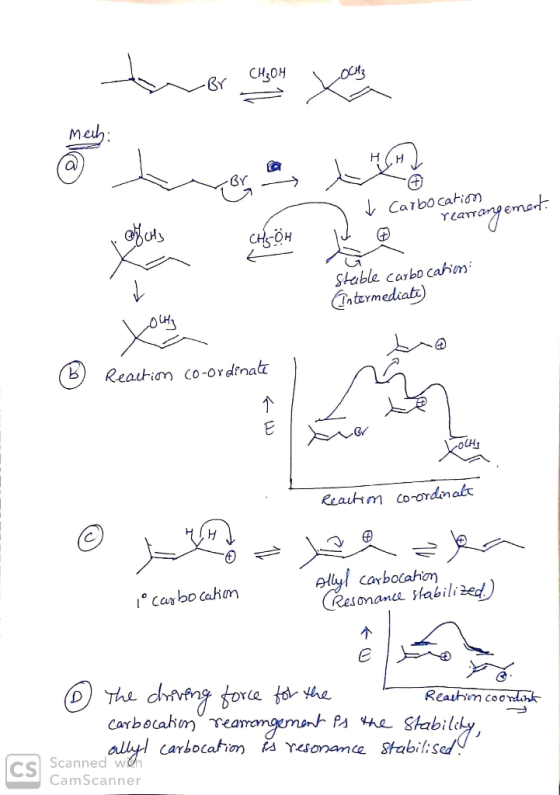
Press Esc to exit full screen Consider the reaction below. 6. CH3OH Br a. Give a complete curved-arrow reaction mechanism b. Draw the reaction-coordinate diagram for this reaction Draw the transition...
Give the product of the following reaction, indicate the mechanism type(s), state whether a solution of...
 Give the product of the following reaction, indicate the mechanism type(s), state whether a solution of the product would be optically active or not, give a BRIEF explanation Br: MeOH boil Give a full curved-arrow pushing mechanism fro the following reaction, label the Lewis and Bronsted acids/bases for all bimolecular reactions as appropriate. CHO: CH3OH heat Give a full curved arrow mechanism for the following reaction, indicate LB/LA/BB/BA for each bimolecular as appropriate, and give a reaction energy diagram. State...
13.6% Resources [ Give Up? Feedback Press esc to exit full screen Identify the products formed...
 13.6% Resources [ Give Up? Feedback Press esc to exit full screen Identify the products formed in this Brønsted-Lowry reaction. HSO, +F acid + base acid: F base: HSO4 Incorrect Incorrect
a) Give a full curved-arrow pushing mechanism, indicate the Lewis and Bronsted acids/bases for each intermoelcular...
 a) Give a full curved-arrow pushing mechanism, indicate the Lewis and Bronsted acids/bases for each intermoelcular step as appropriate, indicate the rate determining step. Give the number of sets of intermediates and the number of transition states included in your mechanism. HO: H20 HCI (catalytic) # of sets of intermediates # of transition states b) Draw a reaction energy diagram, do not draw the transition states for each step but indicate their positions on the diagram and also the positions...
9. Give the curved arrow mechanism for each reaction. H2SO4 b. H,o OH c. H20 H2SO...
 9. Give the curved arrow mechanism for each reaction. H2SO4 b. H,o OH c. H20 H2SO d. OH H2o 10. For the following reaction, H,so, H,O он a. Give the curved arrow mechanism for the reaction, showing formation of both products b. Identify the major product and explain why it is favored. c. Draw the energy diagram for the formation of the major product. 11. Give the major organic product for the following reactions. If a racemic mixture is expected,...
Draw the major product of this reaction & a complete curved arrow mechanism and explain why...
 Draw the major product of this reaction & a complete curved
arrow mechanism and explain why the observed product is formed.
H-Br
Draw the major product of this reaction & a complete curved
arrow mechanism and explain why the observed product is formed.
H-Br
4. (22 points) "Fun in acid" question: Draw a reasonable mechanism using the curved-arrow formalism (include...
 4. (22 points) "Fun in acid" question: Draw a reasonable mechanism using the curved-arrow formalism (include lone pair electrons) for the following rearrangement reaction of an arene oxide in the presence of dilute aqueous sulfuric acid to give the corresponding phenol. What is the thermodynamic driving force for the conversion of the arene oxide into the phenol? Hint: 4-steps H2SO4 HO in excess: used as solvent) "Fun in acid" question: Draw a reasonable mechanism using the curved-arrow formalism (include lone...
The reaction below proceeds through an exothermic E2 mechanism. Draw the reaction coordinate diagram for this...
 The reaction below proceeds through an exothermic E2
mechanism. Draw the reaction coordinate diagram for this reaction,
and label all activation energies, delta Gs, and transition states.
Draw the structures of the starting materials, products, and any
interediates onto your chart where they belong
NaH Br
The reaction below proceeds through an exothermic E2
mechanism. Draw the reaction coordinate diagram for this reaction,
and label all activation energies, delta Gs, and transition states.
Draw the structures of the starting materials, products, and any
interediates onto your chart where they belong
NaH Br
Below is the SN1 reaction of (S)-2-iodopentane and bromide (Br–). Complete the mechanism by providing the missing curved...
 Below is the SN1 reaction of
(S)-2-iodopentane and bromide (Br–). Complete
the mechanism by providing the missing curved arrow notation, lone
pairs of electrons, and nonzero formal charges. Be sure to draw the
two organic products that will be produced in the third
box.
Below is the SN1 reaction of (S)-2-iodopentane and bromide (Br). Complete the mechanism by providing the missing curved arrow notation, lone pairs of electrons, and nonzero formal charges. Be sure to draw the two organic products...
Below is the SN1 reaction of
(S)-2-iodopentane and bromide (Br–). Complete
the mechanism by providing the missing curved arrow notation, lone
pairs of electrons, and nonzero formal charges. Be sure to draw the
two organic products that will be produced in the third
box.
Below is the SN1 reaction of (S)-2-iodopentane and bromide (Br). Complete the mechanism by providing the missing curved arrow notation, lone pairs of electrons, and nonzero formal charges. Be sure to draw the two organic products...
Show the curved arrow mechanism for the reaction...
 1.2.3.4.5.6.7.8.Show the curved arrow mechanism for the reaction between ethoxide and methanol to give ethanol and the methoxide ion. 1st attempt Jual See Periodic Table See Hint OH-Ö: Add the missing curved arrow notation.The carbon-metal bond in organometallic Grignard reagents exhibits significant covalent character. However, we can treat these compounds as electron-rich carbanions because of the large difference in electronegativity between carbon and magnesium. These reagents are great to form carbon-carbon bonds but must be kept in an anhydrous environment...
B. Using curved arrow notation, draw the reaction mechanism and predict the product the reaction below....
 B. Using curved arrow notation, draw the reaction mechanism and predict the product the reaction below. Show all reaction intermediates and account for stereochemical requirements. [6 MARKS) EtOna / EtOH ? OTS Heat
 Give the product of the following reaction, indicate the mechanism type(s), state whether a solution of the product would be optically active or not, give a BRIEF explanation Br: MeOH boil Give a full curved-arrow pushing mechanism fro the following reaction, label the Lewis and Bronsted acids/bases for all bimolecular reactions as appropriate. CHO: CH3OH heat Give a full curved arrow mechanism for the following reaction, indicate LB/LA/BB/BA for each bimolecular as appropriate, and give a reaction energy diagram. State...
 13.6% Resources [ Give Up? Feedback Press esc to exit full screen Identify the products formed in this Brønsted-Lowry reaction. HSO, +F acid + base acid: F base: HSO4 Incorrect Incorrect
 a) Give a full curved-arrow pushing mechanism, indicate the Lewis and Bronsted acids/bases for each intermoelcular step as appropriate, indicate the rate determining step. Give the number of sets of intermediates and the number of transition states included in your mechanism. HO: H20 HCI (catalytic) # of sets of intermediates # of transition states b) Draw a reaction energy diagram, do not draw the transition states for each step but indicate their positions on the diagram and also the positions...
 9. Give the curved arrow mechanism for each reaction. H2SO4 b. H,o OH c. H20 H2SO d. OH H2o 10. For the following reaction, H,so, H,O он a. Give the curved arrow mechanism for the reaction, showing formation of both products b. Identify the major product and explain why it is favored. c. Draw the energy diagram for the formation of the major product. 11. Give the major organic product for the following reactions. If a racemic mixture is expected,...
 Draw the major product of this reaction & a complete curved
arrow mechanism and explain why the observed product is formed.
H-Br
Draw the major product of this reaction & a complete curved
arrow mechanism and explain why the observed product is formed.
H-Br
 4. (22 points) "Fun in acid" question: Draw a reasonable mechanism using the curved-arrow formalism (include lone pair electrons) for the following rearrangement reaction of an arene oxide in the presence of dilute aqueous sulfuric acid to give the corresponding phenol. What is the thermodynamic driving force for the conversion of the arene oxide into the phenol? Hint: 4-steps H2SO4 HO in excess: used as solvent) "Fun in acid" question: Draw a reasonable mechanism using the curved-arrow formalism (include lone...
 The reaction below proceeds through an exothermic E2
mechanism. Draw the reaction coordinate diagram for this reaction,
and label all activation energies, delta Gs, and transition states.
Draw the structures of the starting materials, products, and any
interediates onto your chart where they belong
NaH Br
The reaction below proceeds through an exothermic E2
mechanism. Draw the reaction coordinate diagram for this reaction,
and label all activation energies, delta Gs, and transition states.
Draw the structures of the starting materials, products, and any
interediates onto your chart where they belong
NaH Br
 Below is the SN1 reaction of
(S)-2-iodopentane and bromide (Br–). Complete
the mechanism by providing the missing curved arrow notation, lone
pairs of electrons, and nonzero formal charges. Be sure to draw the
two organic products that will be produced in the third
box.
Below is the SN1 reaction of (S)-2-iodopentane and bromide (Br). Complete the mechanism by providing the missing curved arrow notation, lone pairs of electrons, and nonzero formal charges. Be sure to draw the two organic products...
Below is the SN1 reaction of
(S)-2-iodopentane and bromide (Br–). Complete
the mechanism by providing the missing curved arrow notation, lone
pairs of electrons, and nonzero formal charges. Be sure to draw the
two organic products that will be produced in the third
box.
Below is the SN1 reaction of (S)-2-iodopentane and bromide (Br). Complete the mechanism by providing the missing curved arrow notation, lone pairs of electrons, and nonzero formal charges. Be sure to draw the two organic products...
 1.2.3.4.5.6.7.8.Show the curved arrow mechanism for the reaction between ethoxide and methanol to give ethanol and the methoxide ion. 1st attempt Jual See Periodic Table See Hint OH-Ö: Add the missing curved arrow notation.The carbon-metal bond in organometallic Grignard reagents exhibits significant covalent character. However, we can treat these compounds as electron-rich carbanions because of the large difference in electronegativity between carbon and magnesium. These reagents are great to form carbon-carbon bonds but must be kept in an anhydrous environment...
 B. Using curved arrow notation, draw the reaction mechanism and predict the product the reaction below. Show all reaction intermediates and account for stereochemical requirements. [6 MARKS) EtOna / EtOH ? OTS Heat
Most questions answered within 3 hours.
-
Where is the error in this code sequence?
String s1 = "Hello";
String s2 = "ello";...
asked 10 months ago -
Financial data for Joel de Paris, Inc., for last year
follow:
Joel de Paris, Inc.
Balance...
asked 10 months ago -
Consider this reaction:
Al2(SO4)3 (aq)+ BaCl3
(aq) Al2Cl6 (aq)- +
3BaSO4(s) . What is the...
asked 10 months ago -
Suppose that Savneet is considering increasing her
recent random sample from 20 car rentals to 40...
asked 10 months ago -
Trucks arrive at an unloading terminal at an average rate of 120
per hour.
Trucks arrive...
asked 10 months ago -
Why are methanol and ethanol completely soluble in water while
octanol is not very little soluble....
asked 10 months ago -
A facilities manager at a university reads in a research report
that the mean amount of...
asked 10 months ago -
When the CuSO4 is rehydrated by adding water to the anhydrous
compound, is this an endothermic...
asked 10 months ago -
A ray of sunlight is passing from diamond into crown glass; the
angle of incidence is...
asked 10 months ago -
A block of mass 0.249 kg is placed on top of a light, vertical
spring of...
asked 10 months ago -
how do the kidneys compensate in the presences of acidosis
a) trigger hyperventilate
b) reserve acid...
asked 10 months ago -
Question 501 pts
The rental rate of capital to the firm increases. Which of the
following...
asked 10 months ago