

Write a function to move r to the left n nodes from any given position (l, (b)
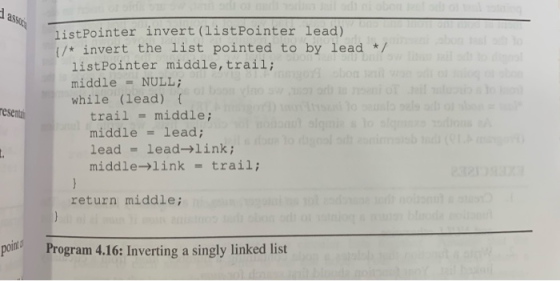
as listPointer invert (listPointer lead) /invert the list pointed to by lead / listPointer middle,trail; middle-NULL while (lead) t resent trail = middle; middle lead; lead lead-ilink; middle-link trail; return middle; poit Program 4.16: Inverting a singly linked list
Homework Answers
#include<stdio.h>
#include<stdlib.h>
/* Link list node */
struct Node
{
int data;
struct Node* next;
};
// This function rotates a linked list counter-clockwise and
// updates the head. The function assumes that k is smaller
// than size of linked list. It doesn't modify the list if
// k is greater than or equal to size
void rotate(struct Node **head_ref, int k)
{
if (k == 0)
return;
// Let us understand the below code for example k = 4 and
// list = 10->20->30->40->50->60.
struct Node* current = *head_ref;
// current will either point to kth or NULL after this loop.
// current will point to node 40 in the above example
int count = 1;
while (count < k && current != NULL)
{
current = current->next;
count++;
}
// If current is NULL, k is greater than or equal to count
// of nodes in linked list. Don't change the list in this
case
if (current == NULL)
return;
// current points to kth node. Store it in a variable.
// kthNode points to node 40 in the above example
struct Node *kthNode = current;
// current will point to last node after this loop
// current will point to node 60 in the above example
while (current->next != NULL)
current = current->next;
// Change next of last node to previous head
// Next of 60 is now changed to node 10
current->next = *head_ref;
// Change head to (k+1)th node
// head is now changed to node 50
*head_ref = kthNode->next;
// change next of kth node to NULL
// next of 40 is now NULL
kthNode->next = NULL;
}
/* UTILITY FUNCTIONS */
/* Function to push a node */
void push (struct Node** head_ref, int new_data)
{
/* allocate node */
struct Node* new_node =
(struct Node*) malloc(sizeof(struct Node));
/* put in the data */
new_node->data = new_data;
/* link the old list off the new node */
new_node->next = (*head_ref);
/* move the head to point to the new node */
(*head_ref) = new_node;
}
/* Function to print linked list */
void printList(struct Node *node)
{
while (node != NULL)
{
printf("%d ", node->data);
node = node->next;
}
}
/* Drier program to test above function*/
int main(void)
{
/* Start with the empty list */
struct Node* head = NULL;
// create a list 10->20->30->40->50->60
for (int i = 60; i > 0; i -= 10)
push(&head, i);
printf("Given linked list \n");
printList(head);
rotate(&head, 4);
printf("\nRotated Linked list \n");
printList(head);
return (0);
}
Add Answer to:
Pull out question 8 on Exercises. See also: Program 4.16 invert (), Program 4.4 printList () Configuring -main () 1. Create a linked list 2. Function call of 8 (a) and (b) 3. Check the accuracy of th...
CSCI 2010 Lab11 Link-Lists Lab 11A Linked-Lists Preparation Create a Visual Studio C++ Project C...
 CSCI 2010 Lab11 Link-Lists
Lab 11A Linked-Lists
Preparation
Create a Visual Studio C++ Project C2010Lab11A
Add the following to the project.
//LinkedList.cpp
#include <cstdlib>
#include "LinkedList.h"
using namespace std;
//---------------------------------------------------
//List Element Members
//---------------------------------------------------
ListElement::ListElement(int d, ListElement * n)
{
datum=d;
next=n;
}
int ListElement::getDatum () const
{
return datum;
}
ListElement const* ListElement::getNext () const
{
return next;
}
//---------------------------------------------------
//LinkedList Members
//---------------------------------------------------
LinkedList::LinkedList ()
{
head=NULL;
}
void LinkedList::insertItem(int item)
{
ListElement *currPtr = head;
ListElement *prevPtr =...
CSCI 2010 Lab11 Link-Lists
Lab 11A Linked-Lists
Preparation
Create a Visual Studio C++ Project C2010Lab11A
Add the following to the project.
//LinkedList.cpp
#include <cstdlib>
#include "LinkedList.h"
using namespace std;
//---------------------------------------------------
//List Element Members
//---------------------------------------------------
ListElement::ListElement(int d, ListElement * n)
{
datum=d;
next=n;
}
int ListElement::getDatum () const
{
return datum;
}
ListElement const* ListElement::getNext () const
{
return next;
}
//---------------------------------------------------
//LinkedList Members
//---------------------------------------------------
LinkedList::LinkedList ()
{
head=NULL;
}
void LinkedList::insertItem(int item)
{
ListElement *currPtr = head;
ListElement *prevPtr =...
Major Homework #2 Implement a C program major_hw2.c to solve the 15-puzzle problem using the A*...
Major Homework #2 Implement a C program major_hw2.c to solve the 15-puzzle problem using the A* search algorithm. 1. Objectives • To gain more experience on using pointers and linked lists in C programs. • To learn how to solve problems using state space search and A* search algorithm. 2. Background A* search and 15-puzzle problem have been introduced in the class. For more information, please read the wiki page of 15-puzzle problem at https://en.wikipedia.org/wiki/15_puzzle, and the wiki page of...
Major Homework #2 Implement a C program major_hw2.c to solve the 15-puzzle problem using the A* s...
Major Homework #2 Implement a C program major_hw2.c to solve the 15-puzzle problem using the A* search algorithm. Please include pictures that the code runs and shows the different states as it reaches goal state please. 1. Objectives • To gain more experience on using pointers and linked lists in C programs. • To learn how to solve problems using state space search and A* search algorithm. 2. Background A* search and 15-puzzle problem have been introduced in the class....
 CSCI 2010 Lab11 Link-Lists
Lab 11A Linked-Lists
Preparation
Create a Visual Studio C++ Project C2010Lab11A
Add the following to the project.
//LinkedList.cpp
#include <cstdlib>
#include "LinkedList.h"
using namespace std;
//---------------------------------------------------
//List Element Members
//---------------------------------------------------
ListElement::ListElement(int d, ListElement * n)
{
datum=d;
next=n;
}
int ListElement::getDatum () const
{
return datum;
}
ListElement const* ListElement::getNext () const
{
return next;
}
//---------------------------------------------------
//LinkedList Members
//---------------------------------------------------
LinkedList::LinkedList ()
{
head=NULL;
}
void LinkedList::insertItem(int item)
{
ListElement *currPtr = head;
ListElement *prevPtr =...
CSCI 2010 Lab11 Link-Lists
Lab 11A Linked-Lists
Preparation
Create a Visual Studio C++ Project C2010Lab11A
Add the following to the project.
//LinkedList.cpp
#include <cstdlib>
#include "LinkedList.h"
using namespace std;
//---------------------------------------------------
//List Element Members
//---------------------------------------------------
ListElement::ListElement(int d, ListElement * n)
{
datum=d;
next=n;
}
int ListElement::getDatum () const
{
return datum;
}
ListElement const* ListElement::getNext () const
{
return next;
}
//---------------------------------------------------
//LinkedList Members
//---------------------------------------------------
LinkedList::LinkedList ()
{
head=NULL;
}
void LinkedList::insertItem(int item)
{
ListElement *currPtr = head;
ListElement *prevPtr =...
Most questions answered within 3 hours.
-
Where is the error in this code sequence?
String s1 = "Hello";
String s2 = "ello";...
asked 10 months ago -
Financial data for Joel de Paris, Inc., for last year
follow:
Joel de Paris, Inc.
Balance...
asked 10 months ago -
Consider this reaction:
Al2(SO4)3 (aq)+ BaCl3
(aq) Al2Cl6 (aq)- +
3BaSO4(s) . What is the...
asked 10 months ago -
Suppose that Savneet is considering increasing her
recent random sample from 20 car rentals to 40...
asked 10 months ago -
Trucks arrive at an unloading terminal at an average rate of 120
per hour.
Trucks arrive...
asked 10 months ago -
Why are methanol and ethanol completely soluble in water while
octanol is not very little soluble....
asked 10 months ago -
A facilities manager at a university reads in a research report
that the mean amount of...
asked 10 months ago -
When the CuSO4 is rehydrated by adding water to the anhydrous
compound, is this an endothermic...
asked 10 months ago -
A ray of sunlight is passing from diamond into crown glass; the
angle of incidence is...
asked 10 months ago -
A block of mass 0.249 kg is placed on top of a light, vertical
spring of...
asked 10 months ago -
how do the kidneys compensate in the presences of acidosis
a) trigger hyperventilate
b) reserve acid...
asked 10 months ago -
Question 501 pts
The rental rate of capital to the firm increases. Which of the
following...
asked 10 months ago