Determine the yield limiting reagent and the theoretical yield for the following multistep synthesis from the reaction of ethyl acetoacetate. Draw the chemical complete chemical reaction and mechanism...
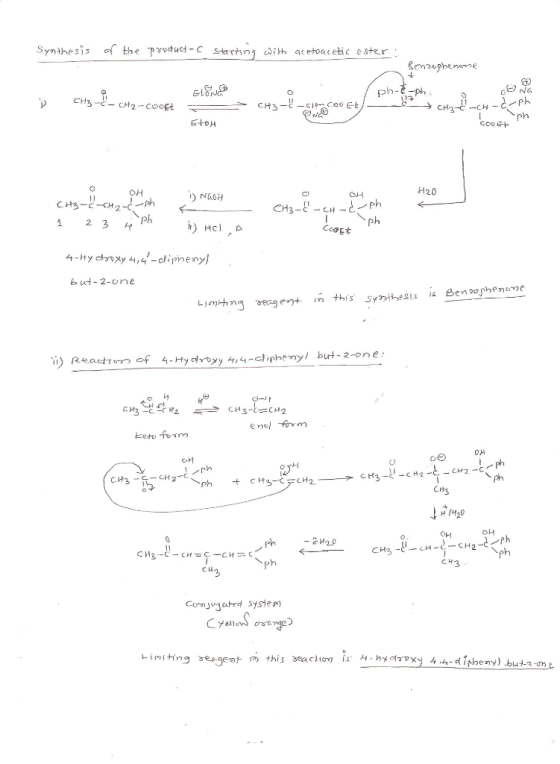
Determine the yield limiting reagent and the theoretical yield for the following multistep synthesis from the reaction of ethyl acetoacetate. Draw the chemical complete chemical reaction and mechanism of Product C (determined to be 4-hydroxy-4 4-diphenylbutan-2-one) to Product E provided the procedure below.
Procedure
Step 4B [Product C to Product E]
Place product [C] (0.5 g) in a 50 mL round bottomed
flask, add acetone (15 mL), and concentrated HCl (2.5 mL). Boil
under reflux on a water bath for 30 minutes. The solution should
become pinkish-orange. Add water (30 mL), with swirling, then
extract with ether (2 x 10 mL). Wash the combined ether layers with
saturated sodium bicarbonate (3 x 10 mL), then water (2 x 10 mL).
Dry the ether solution with anhydrous sodium sulfate, filter, and
evaporate the ether to yield a yellow oil. This crude product [E]
may be purified by rapid column chromatography.
Obtain a column with stopcock. If it does not have a sintered glass disc at the bottom, place a plug of cotton wool in the constriction. Clamp the column vertically, add 15 g of silica gel to the column, tap with rubber tubing to settle the packing, then place a 1 cm layer of sand on the top of the silica gel. Prepare 100 mL of 50/50 diethyl ether/petroleum ether (b.p. 40-60 °C). This mixture is referred to as “eluent” below. Keep the prepared mixture in a covered Erlenmeyer flask until needed. The successive steps must follow each other quickly, so prepare everything in advance.
1. Prewashing of column: Add eluent to the column, without disturbing the top of the packing. Open the stopcock, adding more eluent until the packing is saturated and liquid drips from the bottom. Tapping the column with rubber tubing will displace large bubbles, but if you delay here, more bubbles will form, especially on a warm day. When the column is prepared, allow it to run until liquid is just above the sand, then close the tap. Proceed immediately to the next step.
2. Application of the sample: Dissolve your crude product [E] in about 1 mL of eluent, transfer this solution by Pasteur pipette to the top of the packing. Rinse the flask with a further 2 mL of eluent, and transfer the rinsings to the column. As with all types of chromatography, your aim is to apply the sample in a narrow, concentrated band.
3. Elution of the product: Open the stopcock to allow the sample to flow on to the packing. Add more eluent to avoid the column drying out. The product will travel rapidly as a yellow band. Collect this band in a clean, dry, pre-weighed 100 mL round bottomed flask. When the yellow band has eluted, allow the column to run dry. Dispose of the used silica gel as instructed.
Evaporate the solvent to leave the pure product [E] as a yellow oil. Leave the flask on the rotary evaporator in the hot water for several minutes after all solvent appears to have gone, to make sure the last traces of solvent are removed. Measure the yield, and record the IR and 1H and 13C NMR spectra. The product may discolor on standing, so show an Instructor the fresh material for checking.
Homework Answers
Add Answer to:
Determine the yield limiting reagent and the theoretical yield for the following multistep synthesis from the reaction of ethyl acetoacetate. Draw the chemical complete chemical reaction and mechanism...
Determine the yield limiting reagent and the theoretical yield for the following multistep synthesis from the...
Determine the yield limiting reagent and the theoretical yield for the following multistep synthesis from the reaction of ethyl acetoacetate. Draw the chemical complete chemical reaction and mechanism of Product B (4,4-diphenyl-3-buten-2-one) to Product C provided the procedure below. Procedure Step 3 [Product B to Product C] Place the product [B] (4,4-diphenyl-3-buten-2-one) from the previous step (3 g) in a 250 ml round bottomed flask, add acetone (40 ml) and 1 M HCl (6 ml). Reflux on a water...
Evaluate and investigate the following IR Spectrum, 13C NMR Spectrum and 1H NMR Spectrum. Identify the most important peaks and correlate the results as much as you can from the obtained product in th...
 Evaluate and investigate the
following IR Spectrum, 13C NMR Spectrum
and 1H NMR Spectrum. Identify
the most important peaks and correlate the
results as much as you can from the obtained product in
the multi-step synthesis of ethyl acetoacetate.
This is Product E from this multi-step synthesis
where Product C was identified as in the figure
below and as such, identify what product can be obtained
after the synthesis from the spectra provided. Use the template
below in analysing the...
Evaluate and investigate the
following IR Spectrum, 13C NMR Spectrum
and 1H NMR Spectrum. Identify
the most important peaks and correlate the
results as much as you can from the obtained product in
the multi-step synthesis of ethyl acetoacetate.
This is Product E from this multi-step synthesis
where Product C was identified as in the figure
below and as such, identify what product can be obtained
after the synthesis from the spectra provided. Use the template
below in analysing the...
This procedure was conducted for diethyl n-butylmalonate. The question is: What is the purpose of the...
 This procedure was conducted for diethyl n-butylmalonate. The
question is: What is the purpose of the tricaprylmethylammonium
chloride and why is it used in a nomstoichiometric?
Chapter 42 Malonic Ester of a Barbiturate 541 Into a 5-mL long-necked, round-bottomed flask, weigh 40 mg of tricaprylmethylammonium chloride, 400 mg of diethyl malonate, 350 mg of 1-bromobutane, and 415 mg of anhydrous potassium carbonate. Attach the empty distillation column as an air condenser and reflux the mixture for 1.5 hours (Fig. 42.1)....
This procedure was conducted for diethyl n-butylmalonate. The
question is: What is the purpose of the tricaprylmethylammonium
chloride and why is it used in a nomstoichiometric?
Chapter 42 Malonic Ester of a Barbiturate 541 Into a 5-mL long-necked, round-bottomed flask, weigh 40 mg of tricaprylmethylammonium chloride, 400 mg of diethyl malonate, 350 mg of 1-bromobutane, and 415 mg of anhydrous potassium carbonate. Attach the empty distillation column as an air condenser and reflux the mixture for 1.5 hours (Fig. 42.1)....
how do I determine %yield and theoretical yield from Fisher esterification reaction? Glacial acetic acid M.W=...
how do I determine %yield and theoretical yield from Fisher esterification reaction? Glacial acetic acid M.W= 60.052 g/mol density=1.05 g/cm used 4.0mL, 70 mmol 3-methyl-1-butanol m.w= 88.148 g/mol density=810 kg/m. used 2.5mL, 23mmol Dowlex-50 used 0.3mL Silica Gel used 0.4mL procedure • Glacial acetic acid (4.0 mL, 70 mmol, 3-methyl-1 butanol (2.5 mL, 23mmol), Dowex-50 (0.3 and silica gel (0.4 g) are added to a microwave vessel • A stir bar is added • The vessel is filled with a...
1 - Provide a balanced equation for this reaction 2 - Provide a mechanism for the...
 1 - Provide a balanced equation for this reaction
2 - Provide a mechanism for the transformation of cyclohexanol
into cyclohexanone
3 - Provide a flow chart for the workup procedure for isolating
cyclohexane from all the by-products, making sure to note in which
layer you expect to find your product in each extraction.
4 - Provide the theoretical yield of cyclohexane in this
experiment.
PROCEDURE OXIDATION OF CYCLOHEXANOL TO CYCLOHEXANONE Set up a water bath as the heat source...
1 - Provide a balanced equation for this reaction
2 - Provide a mechanism for the transformation of cyclohexanol
into cyclohexanone
3 - Provide a flow chart for the workup procedure for isolating
cyclohexane from all the by-products, making sure to note in which
layer you expect to find your product in each extraction.
4 - Provide the theoretical yield of cyclohexane in this
experiment.
PROCEDURE OXIDATION OF CYCLOHEXANOL TO CYCLOHEXANONE Set up a water bath as the heat source...
Why did you wash the ether solution with sodium bicarbonate? Write chemical equations for the rea...
 Why did you wash the ether solution with sodium bicarbonate? Write chemical equations for the reactions that took place. b. At which purification steps was the unreacted methanol removed in the reaction? Some of it may have been removed in more than one place. c. Three-Step Synthesis of Methyl Anisate (Step 3) 0 CHOH. Н.so, cat.) Wear gloves. Methanol is poisonous. Ether is an anesthetic, so don't breathe it. Sulfuric acid is a strong corrosive acid. Wash any you spill...
2416F19 Exp. 7 Report Discussion 1. Explicitly show your calculation for the theoretical yield from the...
 2416F19 Exp. 7 Report Discussion 1. Explicitly show your calculation for the theoretical yield from the reaction you performed, including the moles of both reactants. HCI (CH)sCCl H20 (CH)COH+ Yield Actua theore hica 1007. This experiment In this experiment you will prepare t-butyl chloride from t-butyl alcohol using concentrated hydrochloric acid. You will perform qualitative tests on the product to characterize the t-butyl chloride. The first qualitative test will be to hydrolyze the t-butyl chloride in water, and observe the...
Hydroboration-Oxidation (Organic Chemistry Laboratory) 1.Explain the mechanism of the reaction. 2.What was the most important piece...
Hydroboration-Oxidation (Organic Chemistry Laboratory) 1.Explain the mechanism of the reaction. 2.What was the most important piece of equipment for the success of the reaction? 3.Was there a rate determining step in the reaction? 4.Explain the purpose of the key reagent(s) in the reaction. Experiment Procedure Flame dry a 5.0 mL conical vial and a Claisen head at the start of the lab period. Place a dry spin vane in the dried conical vial. Assemble these pieces with a calcium chloride...
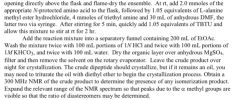
write a mechanism for the following procedure opening directly above the flask and flame-dry the ensemble. At rt, ad...
 write a mechanism for the following procedure
opening directly above the flask and flame-dry the ensemble. At rt, add 2.0 mmoles of the appropriate N-protected amino acid to the flask, followed by 1.05 equivalents of L-alanine methyl ester hydrochloride, 4 mmoles of triethyl amine and 30 mL of anhydrous DMF, the latter two via syringe. After stirring for 5 min, quickly add 1.05 equivalents of TBTU and allow this mixture to stir at rt for 2 hr Add the reaction...
write a mechanism for the following procedure
opening directly above the flask and flame-dry the ensemble. At rt, add 2.0 mmoles of the appropriate N-protected amino acid to the flask, followed by 1.05 equivalents of L-alanine methyl ester hydrochloride, 4 mmoles of triethyl amine and 30 mL of anhydrous DMF, the latter two via syringe. After stirring for 5 min, quickly add 1.05 equivalents of TBTU and allow this mixture to stir at rt for 2 hr Add the reaction...
R1= OCH2C6H5, R2= OCH3 Identify the limiting reagent and calculate the theoretical yield? NaOH H3C -H20...
 R1= OCH2C6H5, R2= OCH3
Identify the limiting reagent and calculate the theoretical
yield?
NaOH H3C -H20 R2 R1 Procedure: 1. Prepare a water bath for use later in the experiment by filling a pyrex dish -half full of water and heating it to 70 °C on a stirrer/hot plate. 2. Combine 3.5 mmol of your aldehyde and 3.5 mmol of your ketone with 2 mL of 95% ethanol in a 25- mL round-bottom flask and swirl the mixture briefly. 3....
R1= OCH2C6H5, R2= OCH3
Identify the limiting reagent and calculate the theoretical
yield?
NaOH H3C -H20 R2 R1 Procedure: 1. Prepare a water bath for use later in the experiment by filling a pyrex dish -half full of water and heating it to 70 °C on a stirrer/hot plate. 2. Combine 3.5 mmol of your aldehyde and 3.5 mmol of your ketone with 2 mL of 95% ethanol in a 25- mL round-bottom flask and swirl the mixture briefly. 3....
 Evaluate and investigate the
following IR Spectrum, 13C NMR Spectrum
and 1H NMR Spectrum. Identify
the most important peaks and correlate the
results as much as you can from the obtained product in
the multi-step synthesis of ethyl acetoacetate.
This is Product E from this multi-step synthesis
where Product C was identified as in the figure
below and as such, identify what product can be obtained
after the synthesis from the spectra provided. Use the template
below in analysing the...
Evaluate and investigate the
following IR Spectrum, 13C NMR Spectrum
and 1H NMR Spectrum. Identify
the most important peaks and correlate the
results as much as you can from the obtained product in
the multi-step synthesis of ethyl acetoacetate.
This is Product E from this multi-step synthesis
where Product C was identified as in the figure
below and as such, identify what product can be obtained
after the synthesis from the spectra provided. Use the template
below in analysing the...
 This procedure was conducted for diethyl n-butylmalonate. The
question is: What is the purpose of the tricaprylmethylammonium
chloride and why is it used in a nomstoichiometric?
Chapter 42 Malonic Ester of a Barbiturate 541 Into a 5-mL long-necked, round-bottomed flask, weigh 40 mg of tricaprylmethylammonium chloride, 400 mg of diethyl malonate, 350 mg of 1-bromobutane, and 415 mg of anhydrous potassium carbonate. Attach the empty distillation column as an air condenser and reflux the mixture for 1.5 hours (Fig. 42.1)....
This procedure was conducted for diethyl n-butylmalonate. The
question is: What is the purpose of the tricaprylmethylammonium
chloride and why is it used in a nomstoichiometric?
Chapter 42 Malonic Ester of a Barbiturate 541 Into a 5-mL long-necked, round-bottomed flask, weigh 40 mg of tricaprylmethylammonium chloride, 400 mg of diethyl malonate, 350 mg of 1-bromobutane, and 415 mg of anhydrous potassium carbonate. Attach the empty distillation column as an air condenser and reflux the mixture for 1.5 hours (Fig. 42.1)....
 1 - Provide a balanced equation for this reaction
2 - Provide a mechanism for the transformation of cyclohexanol
into cyclohexanone
3 - Provide a flow chart for the workup procedure for isolating
cyclohexane from all the by-products, making sure to note in which
layer you expect to find your product in each extraction.
4 - Provide the theoretical yield of cyclohexane in this
experiment.
PROCEDURE OXIDATION OF CYCLOHEXANOL TO CYCLOHEXANONE Set up a water bath as the heat source...
1 - Provide a balanced equation for this reaction
2 - Provide a mechanism for the transformation of cyclohexanol
into cyclohexanone
3 - Provide a flow chart for the workup procedure for isolating
cyclohexane from all the by-products, making sure to note in which
layer you expect to find your product in each extraction.
4 - Provide the theoretical yield of cyclohexane in this
experiment.
PROCEDURE OXIDATION OF CYCLOHEXANOL TO CYCLOHEXANONE Set up a water bath as the heat source...
 Why did you wash the ether solution with sodium bicarbonate? Write chemical equations for the reactions that took place. b. At which purification steps was the unreacted methanol removed in the reaction? Some of it may have been removed in more than one place. c. Three-Step Synthesis of Methyl Anisate (Step 3) 0 CHOH. Н.so, cat.) Wear gloves. Methanol is poisonous. Ether is an anesthetic, so don't breathe it. Sulfuric acid is a strong corrosive acid. Wash any you spill...
 2416F19 Exp. 7 Report Discussion 1. Explicitly show your calculation for the theoretical yield from the reaction you performed, including the moles of both reactants. HCI (CH)sCCl H20 (CH)COH+ Yield Actua theore hica 1007. This experiment In this experiment you will prepare t-butyl chloride from t-butyl alcohol using concentrated hydrochloric acid. You will perform qualitative tests on the product to characterize the t-butyl chloride. The first qualitative test will be to hydrolyze the t-butyl chloride in water, and observe the...
 write a mechanism for the following procedure
opening directly above the flask and flame-dry the ensemble. At rt, add 2.0 mmoles of the appropriate N-protected amino acid to the flask, followed by 1.05 equivalents of L-alanine methyl ester hydrochloride, 4 mmoles of triethyl amine and 30 mL of anhydrous DMF, the latter two via syringe. After stirring for 5 min, quickly add 1.05 equivalents of TBTU and allow this mixture to stir at rt for 2 hr Add the reaction...
write a mechanism for the following procedure
opening directly above the flask and flame-dry the ensemble. At rt, add 2.0 mmoles of the appropriate N-protected amino acid to the flask, followed by 1.05 equivalents of L-alanine methyl ester hydrochloride, 4 mmoles of triethyl amine and 30 mL of anhydrous DMF, the latter two via syringe. After stirring for 5 min, quickly add 1.05 equivalents of TBTU and allow this mixture to stir at rt for 2 hr Add the reaction...
 R1= OCH2C6H5, R2= OCH3
Identify the limiting reagent and calculate the theoretical
yield?
NaOH H3C -H20 R2 R1 Procedure: 1. Prepare a water bath for use later in the experiment by filling a pyrex dish -half full of water and heating it to 70 °C on a stirrer/hot plate. 2. Combine 3.5 mmol of your aldehyde and 3.5 mmol of your ketone with 2 mL of 95% ethanol in a 25- mL round-bottom flask and swirl the mixture briefly. 3....
R1= OCH2C6H5, R2= OCH3
Identify the limiting reagent and calculate the theoretical
yield?
NaOH H3C -H20 R2 R1 Procedure: 1. Prepare a water bath for use later in the experiment by filling a pyrex dish -half full of water and heating it to 70 °C on a stirrer/hot plate. 2. Combine 3.5 mmol of your aldehyde and 3.5 mmol of your ketone with 2 mL of 95% ethanol in a 25- mL round-bottom flask and swirl the mixture briefly. 3....
Most questions answered within 3 hours.
-
Where is the error in this code sequence?
String s1 = "Hello";
String s2 = "ello";...
asked 10 months ago -
Financial data for Joel de Paris, Inc., for last year
follow:
Joel de Paris, Inc.
Balance...
asked 10 months ago -
Consider this reaction:
Al2(SO4)3 (aq)+ BaCl3
(aq) Al2Cl6 (aq)- +
3BaSO4(s) . What is the...
asked 10 months ago -
Suppose that Savneet is considering increasing her
recent random sample from 20 car rentals to 40...
asked 10 months ago -
Trucks arrive at an unloading terminal at an average rate of 120
per hour.
Trucks arrive...
asked 10 months ago -
Why are methanol and ethanol completely soluble in water while
octanol is not very little soluble....
asked 10 months ago -
A facilities manager at a university reads in a research report
that the mean amount of...
asked 10 months ago -
When the CuSO4 is rehydrated by adding water to the anhydrous
compound, is this an endothermic...
asked 10 months ago -
A ray of sunlight is passing from diamond into crown glass; the
angle of incidence is...
asked 10 months ago -
A block of mass 0.249 kg is placed on top of a light, vertical
spring of...
asked 10 months ago -
how do the kidneys compensate in the presences of acidosis
a) trigger hyperventilate
b) reserve acid...
asked 10 months ago -
Question 501 pts
The rental rate of capital to the firm increases. Which of the
following...
asked 10 months ago