
Homework Answers
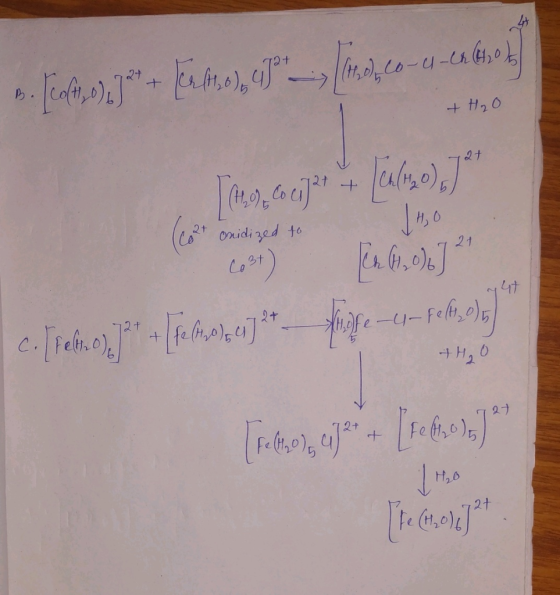
Ans:- The inner sphere electron transfer reaction occurs via formation of a bridged complex. It is explained in the picture below.
![9 001 Rubuh), cije , [ie sel, 4) **+Ku 61,0)) 26.01 + [6,5),c]> [06,07,41)*** Tar (4,0)) c. del, 6) ] 24 + Fe (or of ejer](http://img.homeworklib.com/questions/d472ec30-074e-11ea-9fed-2bb098c460ec.png?x-oss-process=image/resize,w_560)
Add Answer to:
4. Predict all possible six-coordinate products for the following inner-sphere electron transfer reactions. Assume that...
(i) Name the two mechanisms by which electron transfer reactions can occur and explain how they differ. (ii)Explain how the following reaction was used to deduce the mechanism of inner sphere electron...
(i) Name the two mechanisms by which electron transfer reactions can occur and explain how they differ. (ii)Explain how the following reaction was used to deduce the mechanism of inner sphere electron transfer. [Co(NH3)5Cl]2+ + [Cr(H2O)6]2+ + 5H2O = [Co(H2O)6]2+ + [Cr(H2O)5Cl]2+ + 5NH3
(i) Name the two mechanisms by which electron transfer reactions can occur and explain how they...
(i) Name the two mechanisms by which electron transfer reactions can occur and explain how they differ. (ii)Explain how the following reaction was used to deduce the mechanism of inner sphere electron transfer. [Co(NH3)5Cl]2+ + [Cr(H2O)6]2+ + 5H2O = [Co(H2O)6]2+ + [Cr(H2O)5Cl]2+ + 5NH3
a) Explain how electron transfer takes place between the complexes in oxidation-reduction reactions related to inner-sphere...
a) Explain how electron transfer takes place between the complexes in oxidation-reduction reactions related to inner-sphere and outer-sphere mechanisms, respectively. b) You are told that the oxidation-reduction reaction between [Co(NH3)6]^3+ and Ru(NH3)6^2+ takes place via outer sphere electron transfer and the rate constant is 1.1 x 10^–2. However, if instead of Ru(NH3)6^2+, [Cr(bipy)3]^2+ is the reductant then rate constant is much higher, 6.9 x 10^2. Explain the reason.
Which of the following is most likely not an outer-sphere electron transfer process? A.[Cu(NH3)5Cl] + [Co(NH3)6]3+...
Which of the following is most likely not an outer-sphere electron transfer process? A.[Cu(NH3)5Cl] + [Co(NH3)6]3+ --> [Cu(NH3)5Cl]+ + [Co(NH3)6]2+ B.[Cu(NH3)5Cl] + [Co(NH3)5Cl]2+ --> [Cu(NH3)4Cl2] + [Co(NH3)6]3+ C.[Fe(CN)6]4- + [RhCl6]2- --> [Fe(CN)6]3- + [RhCl6]3- D.[Ni(NH3)5Cl]+ + [Co(NH3)5Cl]2+ --> [Ni(NH3)5Cl]2+ + [Co(NH3)5Cl]+
7. Write balance chemical equations that illustrate the following types of reactions. For reactants choose only from the...
 7. Write balance chemical
equations that illustrate the following types of reactions. For
reactants choose only from the following lists of reactants. Please
limit yourselves to only reactants in the following lists. Use each
reactant in only one of the reactions you write. You must identify
the appropriate products. List of reactants: Ir(CO)Cl(PPh3)2, C2H6,
CN-, [NiBr4]2-, CH3I, [Cr(H2O)6]2+, CH3CH2Re(CO)5, [Fe(CN)6]3-,
PPh3, [PtBr6]2-, [(C2H4)PtCl3]-,[Co(NH3)5N3]2+, a) Migratory
Insertion.b) Ligand Substitution. c) Oxidative Addition. d)
Inner-Sphere Electron Transfer.
7. Write balance chemical equations...
7. Write balance chemical
equations that illustrate the following types of reactions. For
reactants choose only from the following lists of reactants. Please
limit yourselves to only reactants in the following lists. Use each
reactant in only one of the reactions you write. You must identify
the appropriate products. List of reactants: Ir(CO)Cl(PPh3)2, C2H6,
CN-, [NiBr4]2-, CH3I, [Cr(H2O)6]2+, CH3CH2Re(CO)5, [Fe(CN)6]3-,
PPh3, [PtBr6]2-, [(C2H4)PtCl3]-,[Co(NH3)5N3]2+, a) Migratory
Insertion.b) Ligand Substitution. c) Oxidative Addition. d)
Inner-Sphere Electron Transfer.
7. Write balance chemical equations...
(i) explain how they differ. b. (ii) Explain how the following reaction was used to deduce the mechanism of inner sphere electron transfer. [Co(NH,),Cl]Cr(Hd+SH,OCo(H,O)+ [Cr(HO),ci+5NH 8 marks]...
 (i) explain how they differ. b. (ii) Explain how the following reaction was used to deduce the mechanism of inner sphere electron transfer. [Co(NH,),Cl]Cr(Hd+SH,OCo(H,O)+ [Cr(HO),ci+5NH 8 marks] (i) Given the following ligands, suggest which one you would use as a chelating agent to treat an excess of Fe(III). Explain your choice. c. HS SH он HS NH2 Ci) Assuming an octahedral geometry, draw the strueture (inecluding any possible isomers) of the neutral Fe(III) complex that would be formed if it...
predict the products of the following reactions and balance the resulting equations Predict the products of...
 predict the products of the following reactions and balance
the resulting equations
Predict the products of the following reactions and balance the resulting equations: C2H2 + _ _02 → CO 2 + H2O 9. LiOH +_ Fe(NO3)3 → 10. 6 AgF+ | Fe2(CO3)3 – 3A7 a 00315) + 2 feF3 11. _ NaOH + H3PO4 → 12. _ Ba(CN)2 + (NH4)2SO4 – 13.___ H2CO3 – HaO + coa 14. ___ KOH + __ MgCl2 → 15. FeCl3 -
predict the products of the following reactions and balance
the resulting equations
Predict the products of the following reactions and balance the resulting equations: C2H2 + _ _02 → CO 2 + H2O 9. LiOH +_ Fe(NO3)3 → 10. 6 AgF+ | Fe2(CO3)3 – 3A7 a 00315) + 2 feF3 11. _ NaOH + H3PO4 → 12. _ Ba(CN)2 + (NH4)2SO4 – 13.___ H2CO3 – HaO + coa 14. ___ KOH + __ MgCl2 → 15. FeCl3 -
3. According to the textbook (p. 115). the electron transfer reaction rate between [Co(NH3)]** and (Co(NH3).]?(eq....
 3. According to the textbook (p. 115). the electron transfer reaction rate between [Co(NH3)]** and (Co(NH3).]?(eq. 5.41) is extremely slow whereas that between [Fe(CN).74 and [Fe(CN).]" (eq. 5.42) is very fast. By using the established facts in the box in answering the following questions. 1. According to the molecular orbital theory, the eg orbitals of an MLO octahedral complex are, in fact, M-L anti-bonding orbitals and the tza orbitals are non-bonding orbitals. 2. According to the spectrochemical series, CN is...
Please answer all of the following: a) Give the correct IUPAC name and sketch the structure...
Please answer all of the following: a) Give the correct IUPAC name and sketch the structure of the transition metal complex for each of the following compounds. If multiple stereoisomers are possible, give both names and structures: 1) [Pt(NH3)2Cl2] 2) [Cr(NMe3)4Br2]PF6 3) K[Co(edta)], where H4(edta) = ethylenediaminetetraacetic acid 4) [Ir(CO)Cl(PPh3)2] 5) Hg[Co(NCO)4] 6) [Fe(acac)3], where H(acac) = acetylacetone 7) [Co(NH3)6]3+[Cr(CN)6]3- 8) [{Co(NH3)5}2(μ-OH)]Cl5 9) [TiCl3(thf)3], where thf = tetrahydrofuran 10) [Ru(bpy)2Cl2], where bpy = 2,2’-bipyridine 11) V(O)(acac)2, where H(acac) = acetylacetone...
ANSWER ALL QUESTIONS PLEASE 1. What are the characteristic electron configurations of transition metals? 2. What is...
ANSWER ALL QUESTIONS PLEASE 1. What are the characteristic electron configurations of transition metals? 2. What is the general trend in atomic size across a transition metal series? 3. Which electrons, 3d or 4s, have the lowest ionization energies in a transition metal? 4. What is the general trend of the reducing strength across a transition metal series? 5. Why do transition metals have similar chemical properties? 6. Name four transition metals that are essential to the biological system. 1. Write the...
 7. Write balance chemical
equations that illustrate the following types of reactions. For
reactants choose only from the following lists of reactants. Please
limit yourselves to only reactants in the following lists. Use each
reactant in only one of the reactions you write. You must identify
the appropriate products. List of reactants: Ir(CO)Cl(PPh3)2, C2H6,
CN-, [NiBr4]2-, CH3I, [Cr(H2O)6]2+, CH3CH2Re(CO)5, [Fe(CN)6]3-,
PPh3, [PtBr6]2-, [(C2H4)PtCl3]-,[Co(NH3)5N3]2+, a) Migratory
Insertion.b) Ligand Substitution. c) Oxidative Addition. d)
Inner-Sphere Electron Transfer.
7. Write balance chemical equations...
7. Write balance chemical
equations that illustrate the following types of reactions. For
reactants choose only from the following lists of reactants. Please
limit yourselves to only reactants in the following lists. Use each
reactant in only one of the reactions you write. You must identify
the appropriate products. List of reactants: Ir(CO)Cl(PPh3)2, C2H6,
CN-, [NiBr4]2-, CH3I, [Cr(H2O)6]2+, CH3CH2Re(CO)5, [Fe(CN)6]3-,
PPh3, [PtBr6]2-, [(C2H4)PtCl3]-,[Co(NH3)5N3]2+, a) Migratory
Insertion.b) Ligand Substitution. c) Oxidative Addition. d)
Inner-Sphere Electron Transfer.
7. Write balance chemical equations...
 (i) explain how they differ. b. (ii) Explain how the following reaction was used to deduce the mechanism of inner sphere electron transfer. [Co(NH,),Cl]Cr(Hd+SH,OCo(H,O)+ [Cr(HO),ci+5NH 8 marks] (i) Given the following ligands, suggest which one you would use as a chelating agent to treat an excess of Fe(III). Explain your choice. c. HS SH он HS NH2 Ci) Assuming an octahedral geometry, draw the strueture (inecluding any possible isomers) of the neutral Fe(III) complex that would be formed if it...
 predict the products of the following reactions and balance
the resulting equations
Predict the products of the following reactions and balance the resulting equations: C2H2 + _ _02 → CO 2 + H2O 9. LiOH +_ Fe(NO3)3 → 10. 6 AgF+ | Fe2(CO3)3 – 3A7 a 00315) + 2 feF3 11. _ NaOH + H3PO4 → 12. _ Ba(CN)2 + (NH4)2SO4 – 13.___ H2CO3 – HaO + coa 14. ___ KOH + __ MgCl2 → 15. FeCl3 -
predict the products of the following reactions and balance
the resulting equations
Predict the products of the following reactions and balance the resulting equations: C2H2 + _ _02 → CO 2 + H2O 9. LiOH +_ Fe(NO3)3 → 10. 6 AgF+ | Fe2(CO3)3 – 3A7 a 00315) + 2 feF3 11. _ NaOH + H3PO4 → 12. _ Ba(CN)2 + (NH4)2SO4 – 13.___ H2CO3 – HaO + coa 14. ___ KOH + __ MgCl2 → 15. FeCl3 -
 3. According to the textbook (p. 115). the electron transfer reaction rate between [Co(NH3)]** and (Co(NH3).]?(eq. 5.41) is extremely slow whereas that between [Fe(CN).74 and [Fe(CN).]" (eq. 5.42) is very fast. By using the established facts in the box in answering the following questions. 1. According to the molecular orbital theory, the eg orbitals of an MLO octahedral complex are, in fact, M-L anti-bonding orbitals and the tza orbitals are non-bonding orbitals. 2. According to the spectrochemical series, CN is...
Most questions answered within 3 hours.
-
Where is the error in this code sequence?
String s1 = "Hello";
String s2 = "ello";...
asked 10 months ago -
Financial data for Joel de Paris, Inc., for last year
follow:
Joel de Paris, Inc.
Balance...
asked 10 months ago -
Consider this reaction:
Al2(SO4)3 (aq)+ BaCl3
(aq) Al2Cl6 (aq)- +
3BaSO4(s) . What is the...
asked 10 months ago -
Suppose that Savneet is considering increasing her
recent random sample from 20 car rentals to 40...
asked 10 months ago -
Trucks arrive at an unloading terminal at an average rate of 120
per hour.
Trucks arrive...
asked 10 months ago -
Why are methanol and ethanol completely soluble in water while
octanol is not very little soluble....
asked 10 months ago -
A facilities manager at a university reads in a research report
that the mean amount of...
asked 10 months ago -
When the CuSO4 is rehydrated by adding water to the anhydrous
compound, is this an endothermic...
asked 10 months ago -
A ray of sunlight is passing from diamond into crown glass; the
angle of incidence is...
asked 10 months ago -
A block of mass 0.249 kg is placed on top of a light, vertical
spring of...
asked 10 months ago -
how do the kidneys compensate in the presences of acidosis
a) trigger hyperventilate
b) reserve acid...
asked 10 months ago -
Question 501 pts
The rental rate of capital to the firm increases. Which of the
following...
asked 10 months ago