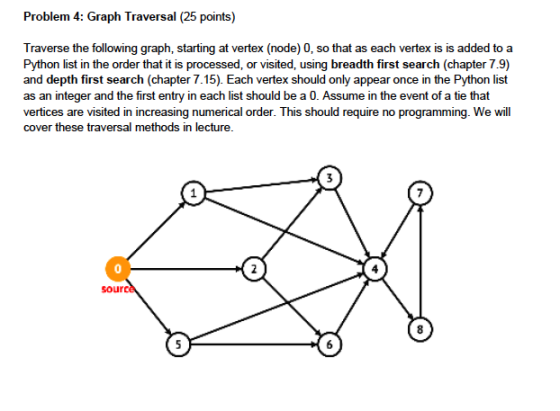
# Problem 4
problem4_breadth_first_traversal = [0,]
problem4_depth_first_traversal = [0,]
def bfs(g,start):
  start.setDistance(0)
  start.setPred(None)
  vertQueue = Queue()
  vertQueue.enqueue(start)
  while (vertQueue.size() > 0):
    currentVert = vertQueue.dequeue()
    for nbr in currentVert.getConnections():
      if (nbr.getColor() == 'white'):
        nbr.setColor('gray')
        nbr.setDistance(currentVert.getDistance() + 1)
        nbr.setPred(currentVert)
        vertQueue.enqueue(nbr)
    currentVert.setColor('black')
class DFSGraph(Graph):
    def __init__(self):
        super().__init__()
        self.time = 0

    def dfs(self):
        for aVertex in self:
            aVertex.setColor('white')
            aVertex.setPred(-1)
        for aVertex in self:
            if aVertex.getColor() == 'white':
                self.dfsvisit(aVertex)

    def dfsvisit(self,startVertex):
        startVertex.setColor('gray')
        self.time += 1
        startVertex.setDiscovery(self.time)
        for nextVertex in startVertex.getConnections():
            if nextVertex.getColor() == 'white':
                nextVertex.setPred(startVertex)
                self.dfsvisit(nextVertex)
        startVertex.setColor('black')
        self.time += 1
startVertex.setFinish(self.time)Homework Answers
a) BFS
Just create  list and insert nodes while traversing

def bfs(g,start):
  start.setDistance(0)
  start.setPred(None)
  List = []
  vertQueue = Queue()
  vertQueue.enqueue(start)
  while (vertQueue.size() > 0):
    currentVert = vertQueue.dequeue()
    List.append(cuurentVert)
    for nbr in currentVert.getConnections():
      if (nbr.getColor() == 'white'):
        nbr.setColor('gray')
        nbr.setDistance(currentVert.getDistance() + 1)
        nbr.setPred(currentVert)
        vertQueue.enqueue(nbr)
    currentVert.setColor('black')
 return List
b) DFS
Just try to create a new list in dfs function and pass it as parameter to dfsvisit
def dfs(self):
        List = []
        for aVertex in self:
            aVertex.setColor('white')
            aVertex.setPred(-1)
        for aVertex in self:
            if aVertex.getColor() == 'white':
                self.dfsvisit(aVertex)
        return List

    def dfsvisit(self,startVertex,List):
        startVertex.setColor('gray')
        List.append(startVertex)
        self.time += 1
        startVertex.setDiscovery(self.time)
        for nextVertex in startVertex.getConnections():
            if nextVertex.getColor() == 'white':
                nextVertex.setPred(startVertex)
                self.dfsvisit(nextVertex,List)
        startVertex.setColor('black')
        self.time += 1
        startVertex.setFinish(self.time)
Add Answer to:
# Problem 4 problem4_breadth_first_traversal = [0,] problem4_depth_first_traversal = [0,] def bfs(g,start): start.set...
In Python 3 please Apply Breadth First Search (BFS) to traverse the following graph. Start your...
 In Python 3 please
Apply Breadth First Search (BFS) to traverse the following graph. Start your traversal from vertex 0, and write down the order in which vertices will be visited during the traversal. 1 8 6 7 2 9 5 4 3
In Python 3 please
Apply Breadth First Search (BFS) to traverse the following graph. Start your traversal from vertex 0, and write down the order in which vertices will be visited during the traversal. 1 8 6 7 2 9 5 4 3
from collections import defaultdict # This class represents a directed graph using # adjacency list...
from collections import defaultdict # This class represents a directed graph using # adjacency list representation class Graph: # Constructor def __init__(self): # default dictionary to store graph self.graph = defaultdict(list) # function to add an edge to graph def addEdge(self,u,v): self.graph[u].append(v) # Function to print a BFS of graph def BFS(self, s): # Mark all the vertices as not visited visited = [False] * (len(self.graph)) # Create a queue for BFS queue...
In the breadth first traversal procedure BFS, each vertex v has an attribute v.color. Modify BFS...
 In the breadth first traversal procedure BFS, each vertex
v has an attribute v.color. Modify BFS
so that instead of x.color, each vertex
x has a Boolean attribute called x.mark,
whose value is either TRUE or FALSE. The attribute
x.mark must be FALSE if x has never been
visited. It must be TRUE if x has been visited, but will
not be visited again.
Thank you!!!
BFS(G, s) 1 for each vertex u e G.V-(s 11, color WHITE 4 5...
In the breadth first traversal procedure BFS, each vertex
v has an attribute v.color. Modify BFS
so that instead of x.color, each vertex
x has a Boolean attribute called x.mark,
whose value is either TRUE or FALSE. The attribute
x.mark must be FALSE if x has never been
visited. It must be TRUE if x has been visited, but will
not be visited again.
Thank you!!!
BFS(G, s) 1 for each vertex u e G.V-(s 11, color WHITE 4 5...
Previous code: class BinarySearchTree: def __init__(self, data): self.data = data self.left = None self.right = None de...
 Previous code:
class BinarySearchTree:
def __init__(self, data):
self.data = data
self.left = None
self.right = None
def search(self, find_data):
if self.data == find_data:
return self
elif find_data < self.data and self.left != None:
return self.left.search(find_data)
elif find_data > self.data and self.right != None:
return self.right.search(find_data)
else:
return None
def get_left(self):
return self.left
def get_right(self):
return self.right
def set_left(self, tree):
self.left = tree
def set_right(self, tree):
self.right = tree
def set_data(self, data):
self.data = data
def get_data(self):
return self.data
def traverse(root,order):...
Previous code:
class BinarySearchTree:
def __init__(self, data):
self.data = data
self.left = None
self.right = None
def search(self, find_data):
if self.data == find_data:
return self
elif find_data < self.data and self.left != None:
return self.left.search(find_data)
elif find_data > self.data and self.right != None:
return self.right.search(find_data)
else:
return None
def get_left(self):
return self.left
def get_right(self):
return self.right
def set_left(self, tree):
self.left = tree
def set_right(self, tree):
self.right = tree
def set_data(self, data):
self.data = data
def get_data(self):
return self.data
def traverse(root,order):...
Please answer all three parts. And show step-by-step answers for each part. Draw anything if necessary....
 Please answer all three parts. And show step-by-step
answers for each part. Draw anything if necessary. And
please don't copy other answers to be at risk being downvoted.
Thank you.
Question 1 (50 POINTS): Given a graph G and the Breadth First Search (BFS) and Depth First Search (DFS) traversal algorithms as follows: BFSG) 1 for each vertex u € G.V – {3} 1 2 u.color = WHITE 3 u.d = 0 4 un = NIL 3 5 S.color =...
Please answer all three parts. And show step-by-step
answers for each part. Draw anything if necessary. And
please don't copy other answers to be at risk being downvoted.
Thank you.
Question 1 (50 POINTS): Given a graph G and the Breadth First Search (BFS) and Depth First Search (DFS) traversal algorithms as follows: BFSG) 1 for each vertex u € G.V – {3} 1 2 u.color = WHITE 3 u.d = 0 4 un = NIL 3 5 S.color =...
The following is an adjacency matrix of a directed graph. Start from vertex D, write down...
 The following is an adjacency matrix of a directed graph. Start from vertex D, write down the order of node visited in Breadth-First- Search (BFS) traversal. (Enter the nodes in order in the following format: [A B C D E F G]) Adjacenc y Matrix ABCDEFG A 1111 000 BO00 0101 C0111010 DO 0 1 0 0 1 1 E 0 1 0 1 000 F 100 1 100 G0000100
# Problem 3 def printexp(tree): sVal = "" if tree: sVal = '(' + printexp(tree.getLeftChild()) sVal = sV...
 # Problem 3
def printexp(tree):
sVal = ""
if tree:
sVal = '(' + printexp(tree.getLeftChild())
sVal = sVal + str(tree.getRootVal())
sVal = sVal + printexp(tree.getRightChild())+')'
return sVal
#### Functions and classes to help with Homework 6
#### You should not make any changes to the functions and
classes in this file,
#### but you should understand what they do and how they work.
import sys
### This function will be re-defined in hw6.py. However, it is
needed for ExpTree,
###...
# Problem 3
def printexp(tree):
sVal = ""
if tree:
sVal = '(' + printexp(tree.getLeftChild())
sVal = sVal + str(tree.getRootVal())
sVal = sVal + printexp(tree.getRightChild())+')'
return sVal
#### Functions and classes to help with Homework 6
#### You should not make any changes to the functions and
classes in this file,
#### but you should understand what they do and how they work.
import sys
### This function will be re-defined in hw6.py. However, it is
needed for ExpTree,
###...
(5 marks) a. The pseudo-code for breadth-first search, modified slightly from Drozdek,1 is as follows: void...
 (5 marks) a. The pseudo-code for breadth-first search, modified slightly from Drozdek,1 is as follows: void breadthFirstSearch (vertex w) for all vertices u num (u) 0 null edges i=1; num (w) i++ enqueue (w) while queue is not empty dequeue ( V= for all vertices u adjacent to v if num(u) is 0 num (u) = i++; enqueue (u) attach edge (vu) to edges; output edges; Now consider the following graph. Give the breadth-first traversal of the graph, starting from...
1. Code a breadth First traversal. 2. Code a depth First traversal. Note, your traversals should return a string listing...
1. Code a breadth First traversal. 2. Code a depth First traversal. Note, your traversals should return a string listing the nodes added to the min spanning tree and the order they are added. Using Python. Starter code: from collections import deque class Edge: def __init__(self, endIndex, next = None): self.endIndex = endIndex self.next = next class Node: def __init__(self, name): self.name = name self.visited = False self.connects = None class Graph: def __init__(self): self.nodeList = [] self.size = 20...
Consider the simple graph G, given the following: (assume A=0,B=1, C=2, D=3, E=4, F=5, G=6) A...
 Consider the simple graph G, given the following: (assume A=0,B=1, C=2, D=3, E=4, F=5, G=6) A 3 3 8 B D 5 ho 5 8 E F G 4 3 a) Use the Breadth-First Search algorithm to traverse G and give the traverse sequence, starting from A. Assume you always choose the candidate with the SMALLEST index among the candidates at each step. b) Use the Depth-First Search algorithm to traverse G and give the traverse sequence, starting from A....
 In Python 3 please
Apply Breadth First Search (BFS) to traverse the following graph. Start your traversal from vertex 0, and write down the order in which vertices will be visited during the traversal. 1 8 6 7 2 9 5 4 3
In Python 3 please
Apply Breadth First Search (BFS) to traverse the following graph. Start your traversal from vertex 0, and write down the order in which vertices will be visited during the traversal. 1 8 6 7 2 9 5 4 3
 In the breadth first traversal procedure BFS, each vertex
v has an attribute v.color. Modify BFS
so that instead of x.color, each vertex
x has a Boolean attribute called x.mark,
whose value is either TRUE or FALSE. The attribute
x.mark must be FALSE if x has never been
visited. It must be TRUE if x has been visited, but will
not be visited again.
Thank you!!!
BFS(G, s) 1 for each vertex u e G.V-(s 11, color WHITE 4 5...
In the breadth first traversal procedure BFS, each vertex
v has an attribute v.color. Modify BFS
so that instead of x.color, each vertex
x has a Boolean attribute called x.mark,
whose value is either TRUE or FALSE. The attribute
x.mark must be FALSE if x has never been
visited. It must be TRUE if x has been visited, but will
not be visited again.
Thank you!!!
BFS(G, s) 1 for each vertex u e G.V-(s 11, color WHITE 4 5...
 Previous code:
class BinarySearchTree:
def __init__(self, data):
self.data = data
self.left = None
self.right = None
def search(self, find_data):
if self.data == find_data:
return self
elif find_data < self.data and self.left != None:
return self.left.search(find_data)
elif find_data > self.data and self.right != None:
return self.right.search(find_data)
else:
return None
def get_left(self):
return self.left
def get_right(self):
return self.right
def set_left(self, tree):
self.left = tree
def set_right(self, tree):
self.right = tree
def set_data(self, data):
self.data = data
def get_data(self):
return self.data
def traverse(root,order):...
Previous code:
class BinarySearchTree:
def __init__(self, data):
self.data = data
self.left = None
self.right = None
def search(self, find_data):
if self.data == find_data:
return self
elif find_data < self.data and self.left != None:
return self.left.search(find_data)
elif find_data > self.data and self.right != None:
return self.right.search(find_data)
else:
return None
def get_left(self):
return self.left
def get_right(self):
return self.right
def set_left(self, tree):
self.left = tree
def set_right(self, tree):
self.right = tree
def set_data(self, data):
self.data = data
def get_data(self):
return self.data
def traverse(root,order):...
 Please answer all three parts. And show step-by-step
answers for each part. Draw anything if necessary. And
please don't copy other answers to be at risk being downvoted.
Thank you.
Question 1 (50 POINTS): Given a graph G and the Breadth First Search (BFS) and Depth First Search (DFS) traversal algorithms as follows: BFSG) 1 for each vertex u € G.V – {3} 1 2 u.color = WHITE 3 u.d = 0 4 un = NIL 3 5 S.color =...
Please answer all three parts. And show step-by-step
answers for each part. Draw anything if necessary. And
please don't copy other answers to be at risk being downvoted.
Thank you.
Question 1 (50 POINTS): Given a graph G and the Breadth First Search (BFS) and Depth First Search (DFS) traversal algorithms as follows: BFSG) 1 for each vertex u € G.V – {3} 1 2 u.color = WHITE 3 u.d = 0 4 un = NIL 3 5 S.color =...
 The following is an adjacency matrix of a directed graph. Start from vertex D, write down the order of node visited in Breadth-First- Search (BFS) traversal. (Enter the nodes in order in the following format: [A B C D E F G]) Adjacenc y Matrix ABCDEFG A 1111 000 BO00 0101 C0111010 DO 0 1 0 0 1 1 E 0 1 0 1 000 F 100 1 100 G0000100
 # Problem 3
def printexp(tree):
sVal = ""
if tree:
sVal = '(' + printexp(tree.getLeftChild())
sVal = sVal + str(tree.getRootVal())
sVal = sVal + printexp(tree.getRightChild())+')'
return sVal
#### Functions and classes to help with Homework 6
#### You should not make any changes to the functions and
classes in this file,
#### but you should understand what they do and how they work.
import sys
### This function will be re-defined in hw6.py. However, it is
needed for ExpTree,
###...
# Problem 3
def printexp(tree):
sVal = ""
if tree:
sVal = '(' + printexp(tree.getLeftChild())
sVal = sVal + str(tree.getRootVal())
sVal = sVal + printexp(tree.getRightChild())+')'
return sVal
#### Functions and classes to help with Homework 6
#### You should not make any changes to the functions and
classes in this file,
#### but you should understand what they do and how they work.
import sys
### This function will be re-defined in hw6.py. However, it is
needed for ExpTree,
###...
 (5 marks) a. The pseudo-code for breadth-first search, modified slightly from Drozdek,1 is as follows: void breadthFirstSearch (vertex w) for all vertices u num (u) 0 null edges i=1; num (w) i++ enqueue (w) while queue is not empty dequeue ( V= for all vertices u adjacent to v if num(u) is 0 num (u) = i++; enqueue (u) attach edge (vu) to edges; output edges; Now consider the following graph. Give the breadth-first traversal of the graph, starting from...
 Consider the simple graph G, given the following: (assume A=0,B=1, C=2, D=3, E=4, F=5, G=6) A 3 3 8 B D 5 ho 5 8 E F G 4 3 a) Use the Breadth-First Search algorithm to traverse G and give the traverse sequence, starting from A. Assume you always choose the candidate with the SMALLEST index among the candidates at each step. b) Use the Depth-First Search algorithm to traverse G and give the traverse sequence, starting from A....
Most questions answered within 3 hours.
-
Where is the error in this code sequence?
String s1 = "Hello";
String s2 = "ello";...
asked 10 months ago -
Financial data for Joel de Paris, Inc., for last year
follow:
Joel de Paris, Inc.
Balance...
asked 10 months ago -
Consider this reaction:
Al2(SO4)3 (aq)+ BaCl3
(aq) Al2Cl6 (aq)- +
3BaSO4(s) . What is the...
asked 10 months ago -
Suppose that Savneet is considering increasing her
recent random sample from 20 car rentals to 40...
asked 10 months ago -
Trucks arrive at an unloading terminal at an average rate of 120
per hour.
Trucks arrive...
asked 10 months ago -
Why are methanol and ethanol completely soluble in water while
octanol is not very little soluble....
asked 10 months ago -
A facilities manager at a university reads in a research report
that the mean amount of...
asked 10 months ago -
When the CuSO4 is rehydrated by adding water to the anhydrous
compound, is this an endothermic...
asked 10 months ago -
A ray of sunlight is passing from diamond into crown glass; the
angle of incidence is...
asked 10 months ago -
A block of mass 0.249 kg is placed on top of a light, vertical
spring of...
asked 10 months ago -
how do the kidneys compensate in the presences of acidosis
a) trigger hyperventilate
b) reserve acid...
asked 10 months ago -
Question 501 pts
The rental rate of capital to the firm increases. Which of the
following...
asked 10 months ago