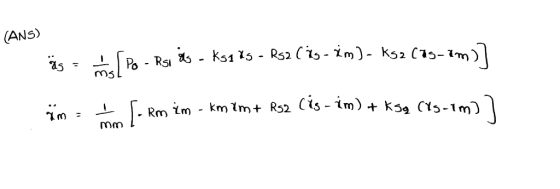
Can you convert the two equations into their block diagram representation? (Mechanical Engineering: Modeling & Analysis of Dynamic Systems)

![\large \ddot{x_m}=(\frac{1}{m_m})[-R_{m}\dot{x_m}-K_{m}x_m+R_{s2}(\dot{x_s}-\dot{x_m})+K_{s2}(x_s-x_m)]](http://img.homeworklib.com/images/c0fbd960-8d79-44d9-af90-1307d16c391a.latex?%5Clarge%20%5Cddot%7Bx_m%7D%3D%28%5Cfrac%7B1%7D%7Bm_m%7D%29%5B-R_%7Bm%7D%5Cdot%7Bx_m%7D-K_%7Bm%7Dx_m+R_%7Bs2%7D%28%5Cdot%7Bx_s%7D-%5Cdot%7Bx_m%7D%29+K_%7Bs2%7D%28x_s-x_m%29%5D?x-oss-process=image/resize,w_560)
Homework Answers
 please rate it... it will
improve my performance score..............
please rate it... it will
improve my performance score..............
Add Answer to:
Can you convert the two equations into their block diagram representation? (Mechanical Engineering: Modeling & Analy...
For a Mechanical Engineering System Dynamics class 3. A system is modeled with the following equations....
 For a Mechanical Engineering System Dynamics class
3. A system is modeled with the following equations. * = y – 5x + d(t) y = 10f (t) – 30x The outputs are x(t) and y(t); the inputs are f(t) and d(t). a) b) c) From the two equations above, draw a complete block diagram for the model with X(s) at the rightmost position and F(s) at the leftmost position. All arrows must be shown clearly. Indicate the location of Y(s)...
For a Mechanical Engineering System Dynamics class
3. A system is modeled with the following equations. * = y – 5x + d(t) y = 10f (t) – 30x The outputs are x(t) and y(t); the inputs are f(t) and d(t). a) b) c) From the two equations above, draw a complete block diagram for the model with X(s) at the rightmost position and F(s) at the leftmost position. All arrows must be shown clearly. Indicate the location of Y(s)...
1) Develop the electrical and mechanical equations for the electro-mechanical system. 2) Develop ...
 1) Develop the electrical and mechanical equations for the electro-mechanical system. 2) Develop the transfer function G(s) for the electro-mechanical system We were unable to transcribe this imageTable 1: Information for the Electro-Mechanical System 1 DOF Robot Parameters 1.140 Nms Da 0.00148 rad R lohm ohm 0.0048 I [A] 8.25 97.2 150 10 np-load Nms 100 150
1) Develop the electrical and mechanical equations for the electro-mechanical system. 2) Develop the transfer function G(s) for the electro-mechanical system
Table 1:...
1) Develop the electrical and mechanical equations for the electro-mechanical system. 2) Develop the transfer function G(s) for the electro-mechanical system We were unable to transcribe this imageTable 1: Information for the Electro-Mechanical System 1 DOF Robot Parameters 1.140 Nms Da 0.00148 rad R lohm ohm 0.0048 I [A] 8.25 97.2 150 10 np-load Nms 100 150
1) Develop the electrical and mechanical equations for the electro-mechanical system. 2) Develop the transfer function G(s) for the electro-mechanical system
Table 1:...
Newton's Method with two variables This problem focuses on the system of simultaneous equations Choose any...
 Newton's Method with two variables
This problem focuses on the system of simultaneous equations
Choose any initial point
anywhere near either solution
of the system of equations
For this problem you need to only complete at least one
iteration starting with numerical values for
terminating with numerical values for
We were unable to transcribe this imageWe were unable to transcribe this image(10, yo) We were unable to transcribe this image(10, yo) We were unable to transcribe this image
Newton's Method with two variables
This problem focuses on the system of simultaneous equations
Choose any initial point
anywhere near either solution
of the system of equations
For this problem you need to only complete at least one
iteration starting with numerical values for
terminating with numerical values for
We were unable to transcribe this imageWe were unable to transcribe this image(10, yo) We were unable to transcribe this image(10, yo) We were unable to transcribe this image
Given the following equations, draw the simple Venn Diagram to match the equation. b) There are...
Given the following equations, draw the simple Venn Diagram to match the equation. b) There are three events: A, B and C A = { 1, 2, 3, 4 } B = { 2, 4, 6, 8 } C = { 10, 12 } Draw ( A ∩ B) C c) There are three events: A, B and C – same as in part b. Draw (B C)′ Note: apostrophe is complement. d) There are three events: A, B and...
Convert the following formulation to a 2 variable problem so that it can be solved graphically...
 Convert the following formulation to a 2 variable problem so
that it can be solved graphically (HINT: Eliminate one of the
variables – say X3...). Sketch the feasible region and compute the
coordinates of its extreme points.
5X1 + X3
17
2X1 + 1.5X2 + X3
14
.5X1 + 2X2 + X3
10
X1 , X2 , X3
0
We were unable to transcribe this imageWe were unable to transcribe this imageWe were unable to transcribe this imageWe were unable...
Convert the following formulation to a 2 variable problem so
that it can be solved graphically (HINT: Eliminate one of the
variables – say X3...). Sketch the feasible region and compute the
coordinates of its extreme points.
5X1 + X3
17
2X1 + 1.5X2 + X3
14
.5X1 + 2X2 + X3
10
X1 , X2 , X3
0
We were unable to transcribe this imageWe were unable to transcribe this imageWe were unable to transcribe this imageWe were unable...
Convert the following grammar into Chomsky Normal Form (CNF): S → aS | A | bS...
 Convert the following grammar into Chomsky Normal Form
(CNF):
S → aS | A
| bS
A → aA |
bBa | aAa
B → bb |
bBb
Note: you need to first simplify the grammar ( remove any
λ -
productions, unit productions, and useless productions), and then
convert the simplified grammar to CNF.
Convert the following grammar into Chomsky Normal Form (CNF): SaSAS A → AbBa| aAa B+bb | bBb Note: you need to first simplify the grammar...
Convert the following grammar into Chomsky Normal Form
(CNF):
S → aS | A
| bS
A → aA |
bBa | aAa
B → bb |
bBb
Note: you need to first simplify the grammar ( remove any
λ -
productions, unit productions, and useless productions), and then
convert the simplified grammar to CNF.
Convert the following grammar into Chomsky Normal Form (CNF): SaSAS A → AbBa| aAa B+bb | bBb Note: you need to first simplify the grammar...
Given the two equations below, can you show how v1 and v2 are equal to the...
 Given the two equations below, can you show how v1 and v2 are
equal to the values given.
Im not sure how j gets used, please show step by step. Thank
you.
Values of v1 and v2.
We were unable to transcribe this image323 L - 1773° v V2055 L-56-3°v
Given the two equations below, can you show how v1 and v2 are
equal to the values given.
Im not sure how j gets used, please show step by step. Thank
you.
Values of v1 and v2.
We were unable to transcribe this image323 L - 1773° v V2055 L-56-3°v
Use the Engineering approach to find the following (assuming: given): a) derive the zero-input r...
 Use the Engineering approach to find the following (assuming:
given): a) derive the
zero-input response of the circuit, b) derive the impulse response
of the circuit, and c) derive the zero-state response to a step
input (You are required to perform convolution by using the
graphical method on this part).
Draw the s-domain circuit (use a current source for the
capacitor initial condition) for the circuit and perform s-domain
analysis to find the following (assuming: given): a) zero-input
response of...
Use the Engineering approach to find the following (assuming:
given): a) derive the
zero-input response of the circuit, b) derive the impulse response
of the circuit, and c) derive the zero-state response to a step
input (You are required to perform convolution by using the
graphical method on this part).
Draw the s-domain circuit (use a current source for the
capacitor initial condition) for the circuit and perform s-domain
analysis to find the following (assuming: given): a) zero-input
response of...
An autonomous system of two first order differential equations can be written as: A third order...
An autonomous system of two first order differential equations can be written as: A third order explicit Runge-Kutta scheme for an autonomous system of two first order equations is Consider the following second order differential equation, Use the Runge-Kutta scheme to find an approximate solutions of the second order differential equation, at t = 1.2, if the step size h = 0.1. Maintain at least eight decimal digit accuracy throughout all your calculations. You may express your answer as a...
there are two questions 2 and 3 Question 2) Block diagram representation of a multi-loop feedback...
 there are two questions 2 and 3
Question 2) Block diagram representation of a multi-loop feedback system is given below. -H2(5) T(s) For the corresponding block diagram, determine; a. Transfer function Gyr (s) between the input T(s) and the output Y (5) b. Transfer function Gyx (s) between the input R(s) and the output Y(s) Do not use block diagram algebra. Question 3) Consider the mechanical system shown in figure T(t) is the torque applied to shaft 1 and 8(t)...
there are two questions 2 and 3
Question 2) Block diagram representation of a multi-loop feedback system is given below. -H2(5) T(s) For the corresponding block diagram, determine; a. Transfer function Gyr (s) between the input T(s) and the output Y (5) b. Transfer function Gyx (s) between the input R(s) and the output Y(s) Do not use block diagram algebra. Question 3) Consider the mechanical system shown in figure T(t) is the torque applied to shaft 1 and 8(t)...
 For a Mechanical Engineering System Dynamics class
3. A system is modeled with the following equations. * = y – 5x + d(t) y = 10f (t) – 30x The outputs are x(t) and y(t); the inputs are f(t) and d(t). a) b) c) From the two equations above, draw a complete block diagram for the model with X(s) at the rightmost position and F(s) at the leftmost position. All arrows must be shown clearly. Indicate the location of Y(s)...
For a Mechanical Engineering System Dynamics class
3. A system is modeled with the following equations. * = y – 5x + d(t) y = 10f (t) – 30x The outputs are x(t) and y(t); the inputs are f(t) and d(t). a) b) c) From the two equations above, draw a complete block diagram for the model with X(s) at the rightmost position and F(s) at the leftmost position. All arrows must be shown clearly. Indicate the location of Y(s)...
 1) Develop the electrical and mechanical equations for the electro-mechanical system. 2) Develop the transfer function G(s) for the electro-mechanical system We were unable to transcribe this imageTable 1: Information for the Electro-Mechanical System 1 DOF Robot Parameters 1.140 Nms Da 0.00148 rad R lohm ohm 0.0048 I [A] 8.25 97.2 150 10 np-load Nms 100 150
1) Develop the electrical and mechanical equations for the electro-mechanical system. 2) Develop the transfer function G(s) for the electro-mechanical system
Table 1:...
1) Develop the electrical and mechanical equations for the electro-mechanical system. 2) Develop the transfer function G(s) for the electro-mechanical system We were unable to transcribe this imageTable 1: Information for the Electro-Mechanical System 1 DOF Robot Parameters 1.140 Nms Da 0.00148 rad R lohm ohm 0.0048 I [A] 8.25 97.2 150 10 np-load Nms 100 150
1) Develop the electrical and mechanical equations for the electro-mechanical system. 2) Develop the transfer function G(s) for the electro-mechanical system
Table 1:...
 Newton's Method with two variables
This problem focuses on the system of simultaneous equations
Choose any initial point
anywhere near either solution
of the system of equations
For this problem you need to only complete at least one
iteration starting with numerical values for
terminating with numerical values for
We were unable to transcribe this imageWe were unable to transcribe this image(10, yo) We were unable to transcribe this image(10, yo) We were unable to transcribe this image
Newton's Method with two variables
This problem focuses on the system of simultaneous equations
Choose any initial point
anywhere near either solution
of the system of equations
For this problem you need to only complete at least one
iteration starting with numerical values for
terminating with numerical values for
We were unable to transcribe this imageWe were unable to transcribe this image(10, yo) We were unable to transcribe this image(10, yo) We were unable to transcribe this image
 Convert the following formulation to a 2 variable problem so
that it can be solved graphically (HINT: Eliminate one of the
variables – say X3...). Sketch the feasible region and compute the
coordinates of its extreme points.
5X1 + X3
17
2X1 + 1.5X2 + X3
14
.5X1 + 2X2 + X3
10
X1 , X2 , X3
0
We were unable to transcribe this imageWe were unable to transcribe this imageWe were unable to transcribe this imageWe were unable...
Convert the following formulation to a 2 variable problem so
that it can be solved graphically (HINT: Eliminate one of the
variables – say X3...). Sketch the feasible region and compute the
coordinates of its extreme points.
5X1 + X3
17
2X1 + 1.5X2 + X3
14
.5X1 + 2X2 + X3
10
X1 , X2 , X3
0
We were unable to transcribe this imageWe were unable to transcribe this imageWe were unable to transcribe this imageWe were unable...
 Convert the following grammar into Chomsky Normal Form
(CNF):
S → aS | A
| bS
A → aA |
bBa | aAa
B → bb |
bBb
Note: you need to first simplify the grammar ( remove any
λ -
productions, unit productions, and useless productions), and then
convert the simplified grammar to CNF.
Convert the following grammar into Chomsky Normal Form (CNF): SaSAS A → AbBa| aAa B+bb | bBb Note: you need to first simplify the grammar...
Convert the following grammar into Chomsky Normal Form
(CNF):
S → aS | A
| bS
A → aA |
bBa | aAa
B → bb |
bBb
Note: you need to first simplify the grammar ( remove any
λ -
productions, unit productions, and useless productions), and then
convert the simplified grammar to CNF.
Convert the following grammar into Chomsky Normal Form (CNF): SaSAS A → AbBa| aAa B+bb | bBb Note: you need to first simplify the grammar...
 Given the two equations below, can you show how v1 and v2 are
equal to the values given.
Im not sure how j gets used, please show step by step. Thank
you.
Values of v1 and v2.
We were unable to transcribe this image323 L - 1773° v V2055 L-56-3°v
Given the two equations below, can you show how v1 and v2 are
equal to the values given.
Im not sure how j gets used, please show step by step. Thank
you.
Values of v1 and v2.
We were unable to transcribe this image323 L - 1773° v V2055 L-56-3°v
 Use the Engineering approach to find the following (assuming:
given): a) derive the
zero-input response of the circuit, b) derive the impulse response
of the circuit, and c) derive the zero-state response to a step
input (You are required to perform convolution by using the
graphical method on this part).
Draw the s-domain circuit (use a current source for the
capacitor initial condition) for the circuit and perform s-domain
analysis to find the following (assuming: given): a) zero-input
response of...
Use the Engineering approach to find the following (assuming:
given): a) derive the
zero-input response of the circuit, b) derive the impulse response
of the circuit, and c) derive the zero-state response to a step
input (You are required to perform convolution by using the
graphical method on this part).
Draw the s-domain circuit (use a current source for the
capacitor initial condition) for the circuit and perform s-domain
analysis to find the following (assuming: given): a) zero-input
response of...
 there are two questions 2 and 3
Question 2) Block diagram representation of a multi-loop feedback system is given below. -H2(5) T(s) For the corresponding block diagram, determine; a. Transfer function Gyr (s) between the input T(s) and the output Y (5) b. Transfer function Gyx (s) between the input R(s) and the output Y(s) Do not use block diagram algebra. Question 3) Consider the mechanical system shown in figure T(t) is the torque applied to shaft 1 and 8(t)...
there are two questions 2 and 3
Question 2) Block diagram representation of a multi-loop feedback system is given below. -H2(5) T(s) For the corresponding block diagram, determine; a. Transfer function Gyr (s) between the input T(s) and the output Y (5) b. Transfer function Gyx (s) between the input R(s) and the output Y(s) Do not use block diagram algebra. Question 3) Consider the mechanical system shown in figure T(t) is the torque applied to shaft 1 and 8(t)...
Most questions answered within 3 hours.
-
Where is the error in this code sequence?
String s1 = "Hello";
String s2 = "ello";...
asked 10 months ago -
Financial data for Joel de Paris, Inc., for last year
follow:
Joel de Paris, Inc.
Balance...
asked 10 months ago -
Consider this reaction:
Al2(SO4)3 (aq)+ BaCl3
(aq) Al2Cl6 (aq)- +
3BaSO4(s) . What is the...
asked 10 months ago -
Suppose that Savneet is considering increasing her
recent random sample from 20 car rentals to 40...
asked 10 months ago -
Trucks arrive at an unloading terminal at an average rate of 120
per hour.
Trucks arrive...
asked 10 months ago -
Why are methanol and ethanol completely soluble in water while
octanol is not very little soluble....
asked 10 months ago -
A facilities manager at a university reads in a research report
that the mean amount of...
asked 10 months ago -
When the CuSO4 is rehydrated by adding water to the anhydrous
compound, is this an endothermic...
asked 10 months ago -
A ray of sunlight is passing from diamond into crown glass; the
angle of incidence is...
asked 10 months ago -
A block of mass 0.249 kg is placed on top of a light, vertical
spring of...
asked 10 months ago -
how do the kidneys compensate in the presences of acidosis
a) trigger hyperventilate
b) reserve acid...
asked 10 months ago -
Question 501 pts
The rental rate of capital to the firm increases. Which of the
following...
asked 10 months ago