
Homework Answers
Add Answer to:
Objectives - Section 1 • Identify a substituent as an ortho para director or a meta director, Draw the resonance st...
An NH2 substituent in an aromatic ring is: Select one: a. activating ortho-, meta- and para-directing...
An NH2 substituent in an aromatic ring is: Select one: a. activating ortho-, meta- and para-directing b. deactivating and ortho- and para-directing c. deactivating and meta-directing d. activating and meta-directing e. activating and ortho- and para-directing
Label the following as activating (A) or deactivating (D), and then also as ortho/para directors (OP)...
 Label the following as activating (A) or deactivating (D), and then also as ortho/para directors (OP) or meta directors (M). Write the answer below each group. N "Here with other ty A/D? = = = = OP/M? = f) Using resonance structures, explain why a nitro group is "meta-directing" (i.e. does the nitro group actually affect the meta positions?) g) As mentioned in class, the halogens are a bit anomalous as substituents on the aromatic ring: they are deactivating groups,...
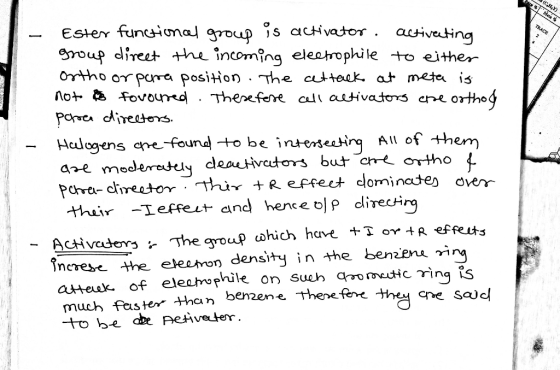
• Explain why the halogens are orthopars dilectons but are deactivators 1. Draw the mechanism of...
 • Explain why the halogens are orthopars dilectons but are deactivators 1. Draw the mechanism of the reaction below and use resonance structures of the arenium ion intermediate to explain why the starting material is an ortho/para director
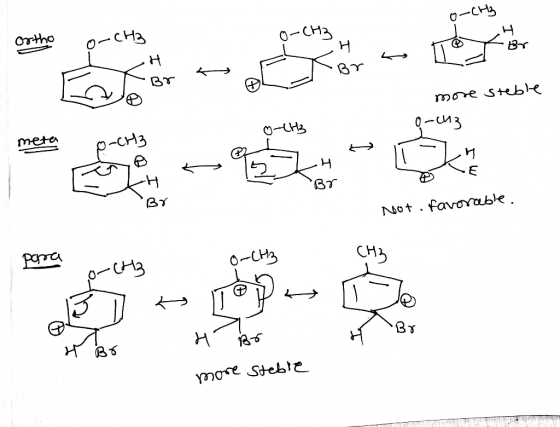
Using resonance structures and a brief explanation, explain why phenol (C6H5OH) is an ortho-para director (25...
Using resonance structures and a brief explanation, explain why phenol (C6H5OH) is an ortho-para director (25 pts).
Question 3 1s 3 ORTHO Today we learned about adding a second group to a mono-substituted...
 Question 3
1s 3 ORTHO Today we learned about adding a second group to a mono-substituted benzene ring. Any group on a benzene will affect the rate of the reaction (activated or deactivated relative to benzene) and the regioselectivity Where does the electrophile add? Ortho? Meta? Para? Some combination thereof? We found that EDGs (electron-donating groups) direct the electrophile to the ortho and para positions while EWGs (electron-withdrawing groups) direct the electrophile to the meta position. Now, it is time...
Question 3
1s 3 ORTHO Today we learned about adding a second group to a mono-substituted benzene ring. Any group on a benzene will affect the rate of the reaction (activated or deactivated relative to benzene) and the regioselectivity Where does the electrophile add? Ortho? Meta? Para? Some combination thereof? We found that EDGs (electron-donating groups) direct the electrophile to the ortho and para positions while EWGs (electron-withdrawing groups) direct the electrophile to the meta position. Now, it is time...
#1. Using curved arrows to symbolize electrons, write a complete reaction mechanism for the bromination of...
#1. Using curved arrows to symbolize electrons, write a complete reaction mechanism for the bromination of acetanilide to create the product. Include the resonance structures for any charged, delocalized intermediates that are involved. #2. Why does performing the experiment at 0 degrees Celsius help you identify some of the relative rates of reactivity? #3. Explain why a methyl group is a mildly activating group while a methoxy group is strong activating. #4. Explain why-- NH2 act as an activator and--...
1.) (9 points) Give structures for the following compounds: a) meta-phenylphenol b) 6-benzyl-3-heptanol e) ortho-sec-butyltoluene 2.)...
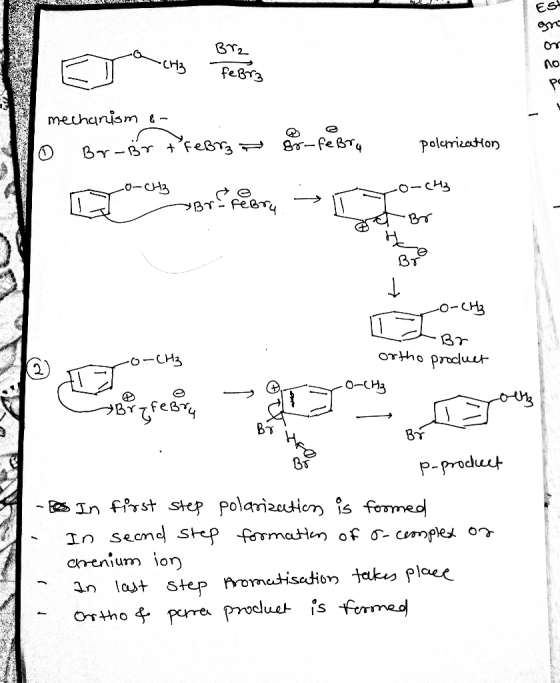
 1.) (9 points) Give structures for the following compounds: a) meta-phenylphenol b) 6-benzyl-3-heptanol e) ortho-sec-butyltoluene 2.) (9 points) Name the following compounds: 3.) (8 points) Label the following molecules as aromatic, anti-aromatic, or non-aromatic. For the ones th aren't aromatic, explain why they are either non-aromatic or anti-aromatic. 0.8 4.) (11 points) For the following electrophilic aromatic substitution reaction: Вт, FeBr; a) Which product is the major one? b) Draw a complete mechanism for the formation of the major product...
use the notes provided to help answer the question above. will rate well The second step...
 use the notes provided to help answer the question
above. will rate well
The second step of the synthesis transformation of the chlorosulfonyl functional group into a sulfonamide) is an example of a a. Nucleophilic displacement (substitution) b Elimination C. Electrophilic aromatic substitution d. Acid hydrolysis Esterification e. THE SULFONIC ACID GROUP AND ITS DERIVATIVES Sulfonic acids are organic analogs of sulfuric acid, a very strong acid. They are highly corrosive, react vigorously with water, and can cause skin bums....
use the notes provided to help answer the question
above. will rate well
The second step of the synthesis transformation of the chlorosulfonyl functional group into a sulfonamide) is an example of a a. Nucleophilic displacement (substitution) b Elimination C. Electrophilic aromatic substitution d. Acid hydrolysis Esterification e. THE SULFONIC ACID GROUP AND ITS DERIVATIVES Sulfonic acids are organic analogs of sulfuric acid, a very strong acid. They are highly corrosive, react vigorously with water, and can cause skin bums....
 Label the following as activating (A) or deactivating (D), and then also as ortho/para directors (OP) or meta directors (M). Write the answer below each group. N "Here with other ty A/D? = = = = OP/M? = f) Using resonance structures, explain why a nitro group is "meta-directing" (i.e. does the nitro group actually affect the meta positions?) g) As mentioned in class, the halogens are a bit anomalous as substituents on the aromatic ring: they are deactivating groups,...
 • Explain why the halogens are orthopars dilectons but are deactivators 1. Draw the mechanism of the reaction below and use resonance structures of the arenium ion intermediate to explain why the starting material is an ortho/para director
 Question 3
1s 3 ORTHO Today we learned about adding a second group to a mono-substituted benzene ring. Any group on a benzene will affect the rate of the reaction (activated or deactivated relative to benzene) and the regioselectivity Where does the electrophile add? Ortho? Meta? Para? Some combination thereof? We found that EDGs (electron-donating groups) direct the electrophile to the ortho and para positions while EWGs (electron-withdrawing groups) direct the electrophile to the meta position. Now, it is time...
Question 3
1s 3 ORTHO Today we learned about adding a second group to a mono-substituted benzene ring. Any group on a benzene will affect the rate of the reaction (activated or deactivated relative to benzene) and the regioselectivity Where does the electrophile add? Ortho? Meta? Para? Some combination thereof? We found that EDGs (electron-donating groups) direct the electrophile to the ortho and para positions while EWGs (electron-withdrawing groups) direct the electrophile to the meta position. Now, it is time...
 1.) (9 points) Give structures for the following compounds: a) meta-phenylphenol b) 6-benzyl-3-heptanol e) ortho-sec-butyltoluene 2.) (9 points) Name the following compounds: 3.) (8 points) Label the following molecules as aromatic, anti-aromatic, or non-aromatic. For the ones th aren't aromatic, explain why they are either non-aromatic or anti-aromatic. 0.8 4.) (11 points) For the following electrophilic aromatic substitution reaction: Вт, FeBr; a) Which product is the major one? b) Draw a complete mechanism for the formation of the major product...
 use the notes provided to help answer the question
above. will rate well
The second step of the synthesis transformation of the chlorosulfonyl functional group into a sulfonamide) is an example of a a. Nucleophilic displacement (substitution) b Elimination C. Electrophilic aromatic substitution d. Acid hydrolysis Esterification e. THE SULFONIC ACID GROUP AND ITS DERIVATIVES Sulfonic acids are organic analogs of sulfuric acid, a very strong acid. They are highly corrosive, react vigorously with water, and can cause skin bums....
use the notes provided to help answer the question
above. will rate well
The second step of the synthesis transformation of the chlorosulfonyl functional group into a sulfonamide) is an example of a a. Nucleophilic displacement (substitution) b Elimination C. Electrophilic aromatic substitution d. Acid hydrolysis Esterification e. THE SULFONIC ACID GROUP AND ITS DERIVATIVES Sulfonic acids are organic analogs of sulfuric acid, a very strong acid. They are highly corrosive, react vigorously with water, and can cause skin bums....
Most questions answered within 3 hours.
-
Where is the error in this code sequence?
String s1 = "Hello";
String s2 = "ello";...
asked 10 months ago -
Financial data for Joel de Paris, Inc., for last year
follow:
Joel de Paris, Inc.
Balance...
asked 10 months ago -
Consider this reaction:
Al2(SO4)3 (aq)+ BaCl3
(aq) Al2Cl6 (aq)- +
3BaSO4(s) . What is the...
asked 10 months ago -
Suppose that Savneet is considering increasing her
recent random sample from 20 car rentals to 40...
asked 10 months ago -
Trucks arrive at an unloading terminal at an average rate of 120
per hour.
Trucks arrive...
asked 10 months ago -
Why are methanol and ethanol completely soluble in water while
octanol is not very little soluble....
asked 10 months ago -
A facilities manager at a university reads in a research report
that the mean amount of...
asked 10 months ago -
When the CuSO4 is rehydrated by adding water to the anhydrous
compound, is this an endothermic...
asked 10 months ago -
A ray of sunlight is passing from diamond into crown glass; the
angle of incidence is...
asked 10 months ago -
A block of mass 0.249 kg is placed on top of a light, vertical
spring of...
asked 10 months ago -
how do the kidneys compensate in the presences of acidosis
a) trigger hyperventilate
b) reserve acid...
asked 10 months ago -
Question 501 pts
The rental rate of capital to the firm increases. Which of the
following...
asked 10 months ago