
Homework Answers
Add Answer to:
Use first order condition and second order condition thank you so much Тип уоu • 7. Perfectly competitive firm fac...
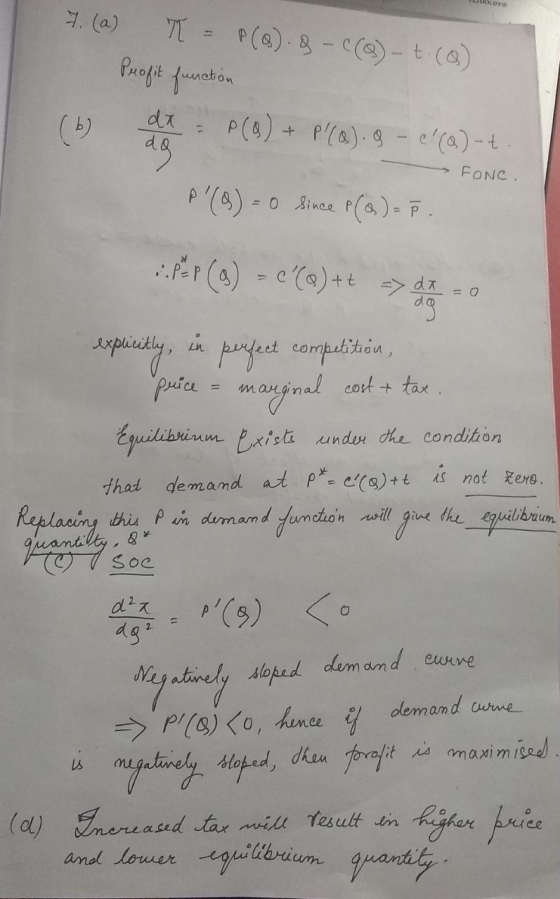
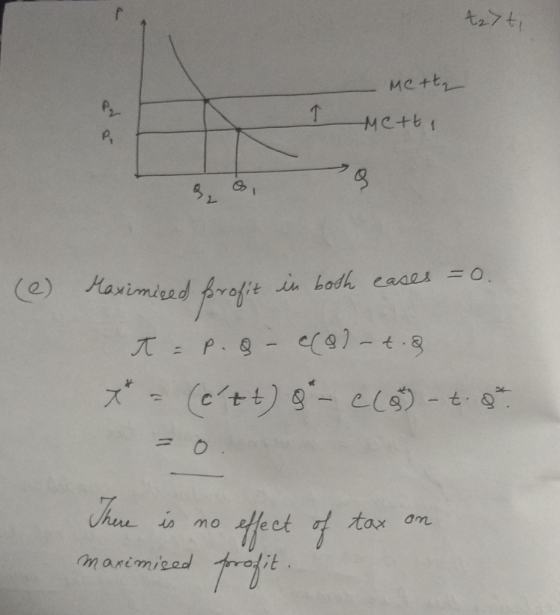
7. Perfectly competitive firm faces P(Q) = P inverse demand curve and its costs are given by a cost function C(Q), a...
 7. Perfectly competitive firm faces P(Q) = P inverse demand curve and its costs are given by a cost function C(Q), assuming that marginal costs are positive. Firm is also taxed at rate t per unit of output. (a) Write down the firm's profit function. Identify the choice variable, and the parameter if the firm maximizes the profit. (b) Write down the FONC for profit maximization. What does this equa- tion solve for? Can you get it explicitly? Discuss. Under...
Can you label each one please . (1)A firm in a perfectly competitive market sells all...
 Can you label each one please .
(1)A firm in a perfectly competitive market sells all its product (Q) at a constant price (P) of $60. Suppose the total cost function (TC) for this firm is described by the following equation: 2 3 TC(Q) 128+ 690-14Q + Q (a)Form the profit function and determine the output that maximizes the firm's profit. Evaluate the second order condition to assure that profit is maximized at this level of output. (b)Derive the marginal...
Can you label each one please .
(1)A firm in a perfectly competitive market sells all its product (Q) at a constant price (P) of $60. Suppose the total cost function (TC) for this firm is described by the following equation: 2 3 TC(Q) 128+ 690-14Q + Q (a)Form the profit function and determine the output that maximizes the firm's profit. Evaluate the second order condition to assure that profit is maximized at this level of output. (b)Derive the marginal...
the firm faces a constant price (P) of $60 A firm in a perfectly competitive market...
 the
firm faces a constant price (P) of $60
A firm in a perfectly competitive market sells all its product (Q) at a constant price (P) of $60. Suppose the total cost function (TC) for this firm is described by the following equation: 2 3 TC(Q) = 128 + 69Q - 140 + Q (a)Form the profit function and determine the output that maximizes the firm's profit. Evaluate the second order condition to assure that profit is maximized at this...
the
firm faces a constant price (P) of $60
A firm in a perfectly competitive market sells all its product (Q) at a constant price (P) of $60. Suppose the total cost function (TC) for this firm is described by the following equation: 2 3 TC(Q) = 128 + 69Q - 140 + Q (a)Form the profit function and determine the output that maximizes the firm's profit. Evaluate the second order condition to assure that profit is maximized at this...
a firm in perfectly competitive market sells all its products Q at constant price p (1)A...
 a firm in perfectly competitive market sells all its products
Q at constant price p
(1)A firm in a perfectly competitive market sells all its product (Q) at a constant price (P) of $60. Suppose the total cost function (TC) for this firm is described by the following equation: 2 3 TC(Q) = 128 +690 - 140 + Q (a)Form the profit function and determine the output that maximizes the firm's profit. Evaluate the second order condition to assure that...
a firm in perfectly competitive market sells all its products
Q at constant price p
(1)A firm in a perfectly competitive market sells all its product (Q) at a constant price (P) of $60. Suppose the total cost function (TC) for this firm is described by the following equation: 2 3 TC(Q) = 128 +690 - 140 + Q (a)Form the profit function and determine the output that maximizes the firm's profit. Evaluate the second order condition to assure that...
A firm operates in a perfectly competitive market with a price of P = 50 for...
A firm operates in a perfectly competitive market with a price of P = 50 for the product. TVC = 0.5Q3 − 18Q2 + 170Q Q (output) TFC = 300. Write an equation expressing the firm’s total revenue (TR) as function of Q. Write an equation expressing the firm’s total cost (TC), as a function of Q. Write an equation expressing the firm’s profit (π), as a function of Q.Find the first-order condition for the firm’s profit-maximization decision. Find the...
(1)A firm in a perfectly competitive market sells all its product (Q) at a constant price...
 (1)A firm in a perfectly competitive market sells all its product (Q) at a constant price (P) of $60. Suppose the total cost function (TC) for this firm is described by the following equation: 2 3 Q TC(Q) = 128 +690-140 (a)Form the profit function and determine the output that maximizes the firm's profit. Evaluate the second order condition to assure that profit is maximized at this level of output. (b)Derive the marginal revenue (MR) and the marginal cost(MC). Graph...
6. A purely competitive firm has a single variable input L (labor), with the wage rate...
 6. A purely competitive firm has a single variable input L (labor), with the wage rate Wo per period. Its fixed inputs cost the firm a total of Fdollars per period. The price of the product is Po. (a) Write the production function, revenue function, cost function, and profit function of the firm, (b) What is the first-order condition for profit maximization? Give this condition an economic interpretation. ( What economic circumstances would ensure that profit is maximized rather than...
please answer all of the following questions since theyre all related (1)A firm in a perfectly...
 please answer all of the following questions since theyre all
related
(1)A firm in a perfectly competitive market sells all its product (Q) at a constant price (P) of $60. Suppose the total cost function (TC) for this firm is described by the following equation: 2 3 TC(Q) = 128 +69Q - 140 + Q (a)Form the profit function and determine the output that maximizes the firm's profit. Evaluate the second order condition to assure that profit is maximized at...
please answer all of the following questions since theyre all
related
(1)A firm in a perfectly competitive market sells all its product (Q) at a constant price (P) of $60. Suppose the total cost function (TC) for this firm is described by the following equation: 2 3 TC(Q) = 128 +69Q - 140 + Q (a)Form the profit function and determine the output that maximizes the firm's profit. Evaluate the second order condition to assure that profit is maximized at...
please answer all of the following questions since theyre all related (1)A firm in a perfectly...
 please answer all of the following questions since theyre all
related
(1)A firm in a perfectly competitive market sells all its product (Q) at a constant price (P) of $60. Suppose the total cost function (TC) for this firm is described by the following equation: 2 3 TC(Q) = 128 +69Q - 140 + Q (a)Form the profit function and determine the output that maximizes the firm's profit. Evaluate the second order condition to assure that profit is maximized at...
please answer all of the following questions since theyre all
related
(1)A firm in a perfectly competitive market sells all its product (Q) at a constant price (P) of $60. Suppose the total cost function (TC) for this firm is described by the following equation: 2 3 TC(Q) = 128 +69Q - 140 + Q (a)Form the profit function and determine the output that maximizes the firm's profit. Evaluate the second order condition to assure that profit is maximized at...
Sorry this problem is little long, thank you so much! 8. Consider a firm with a...
 Sorry this problem is little long, thank you so much!
8. Consider a firm with a production function Q = Q(L), a total revenue function TR=TR(Q), and total cost function TC = TC(Q). (a) Suppose the firm's goal is to maximize profit. Find and interpret the first- and second-order conditions for the firm's problem. Draw a pic- ture of the result in terms of the marginal conditions that are applied by first- and second-order conditions. (b) Suppose the firm's goal...
Sorry this problem is little long, thank you so much!
8. Consider a firm with a production function Q = Q(L), a total revenue function TR=TR(Q), and total cost function TC = TC(Q). (a) Suppose the firm's goal is to maximize profit. Find and interpret the first- and second-order conditions for the firm's problem. Draw a pic- ture of the result in terms of the marginal conditions that are applied by first- and second-order conditions. (b) Suppose the firm's goal...
 7. Perfectly competitive firm faces P(Q) = P inverse demand curve and its costs are given by a cost function C(Q), assuming that marginal costs are positive. Firm is also taxed at rate t per unit of output. (a) Write down the firm's profit function. Identify the choice variable, and the parameter if the firm maximizes the profit. (b) Write down the FONC for profit maximization. What does this equa- tion solve for? Can you get it explicitly? Discuss. Under...
 Can you label each one please .
(1)A firm in a perfectly competitive market sells all its product (Q) at a constant price (P) of $60. Suppose the total cost function (TC) for this firm is described by the following equation: 2 3 TC(Q) 128+ 690-14Q + Q (a)Form the profit function and determine the output that maximizes the firm's profit. Evaluate the second order condition to assure that profit is maximized at this level of output. (b)Derive the marginal...
Can you label each one please .
(1)A firm in a perfectly competitive market sells all its product (Q) at a constant price (P) of $60. Suppose the total cost function (TC) for this firm is described by the following equation: 2 3 TC(Q) 128+ 690-14Q + Q (a)Form the profit function and determine the output that maximizes the firm's profit. Evaluate the second order condition to assure that profit is maximized at this level of output. (b)Derive the marginal...
 the
firm faces a constant price (P) of $60
A firm in a perfectly competitive market sells all its product (Q) at a constant price (P) of $60. Suppose the total cost function (TC) for this firm is described by the following equation: 2 3 TC(Q) = 128 + 69Q - 140 + Q (a)Form the profit function and determine the output that maximizes the firm's profit. Evaluate the second order condition to assure that profit is maximized at this...
the
firm faces a constant price (P) of $60
A firm in a perfectly competitive market sells all its product (Q) at a constant price (P) of $60. Suppose the total cost function (TC) for this firm is described by the following equation: 2 3 TC(Q) = 128 + 69Q - 140 + Q (a)Form the profit function and determine the output that maximizes the firm's profit. Evaluate the second order condition to assure that profit is maximized at this...
 a firm in perfectly competitive market sells all its products
Q at constant price p
(1)A firm in a perfectly competitive market sells all its product (Q) at a constant price (P) of $60. Suppose the total cost function (TC) for this firm is described by the following equation: 2 3 TC(Q) = 128 +690 - 140 + Q (a)Form the profit function and determine the output that maximizes the firm's profit. Evaluate the second order condition to assure that...
a firm in perfectly competitive market sells all its products
Q at constant price p
(1)A firm in a perfectly competitive market sells all its product (Q) at a constant price (P) of $60. Suppose the total cost function (TC) for this firm is described by the following equation: 2 3 TC(Q) = 128 +690 - 140 + Q (a)Form the profit function and determine the output that maximizes the firm's profit. Evaluate the second order condition to assure that...
 (1)A firm in a perfectly competitive market sells all its product (Q) at a constant price (P) of $60. Suppose the total cost function (TC) for this firm is described by the following equation: 2 3 Q TC(Q) = 128 +690-140 (a)Form the profit function and determine the output that maximizes the firm's profit. Evaluate the second order condition to assure that profit is maximized at this level of output. (b)Derive the marginal revenue (MR) and the marginal cost(MC). Graph...
 6. A purely competitive firm has a single variable input L (labor), with the wage rate Wo per period. Its fixed inputs cost the firm a total of Fdollars per period. The price of the product is Po. (a) Write the production function, revenue function, cost function, and profit function of the firm, (b) What is the first-order condition for profit maximization? Give this condition an economic interpretation. ( What economic circumstances would ensure that profit is maximized rather than...
 please answer all of the following questions since theyre all
related
(1)A firm in a perfectly competitive market sells all its product (Q) at a constant price (P) of $60. Suppose the total cost function (TC) for this firm is described by the following equation: 2 3 TC(Q) = 128 +69Q - 140 + Q (a)Form the profit function and determine the output that maximizes the firm's profit. Evaluate the second order condition to assure that profit is maximized at...
please answer all of the following questions since theyre all
related
(1)A firm in a perfectly competitive market sells all its product (Q) at a constant price (P) of $60. Suppose the total cost function (TC) for this firm is described by the following equation: 2 3 TC(Q) = 128 +69Q - 140 + Q (a)Form the profit function and determine the output that maximizes the firm's profit. Evaluate the second order condition to assure that profit is maximized at...
 please answer all of the following questions since theyre all
related
(1)A firm in a perfectly competitive market sells all its product (Q) at a constant price (P) of $60. Suppose the total cost function (TC) for this firm is described by the following equation: 2 3 TC(Q) = 128 +69Q - 140 + Q (a)Form the profit function and determine the output that maximizes the firm's profit. Evaluate the second order condition to assure that profit is maximized at...
please answer all of the following questions since theyre all
related
(1)A firm in a perfectly competitive market sells all its product (Q) at a constant price (P) of $60. Suppose the total cost function (TC) for this firm is described by the following equation: 2 3 TC(Q) = 128 +69Q - 140 + Q (a)Form the profit function and determine the output that maximizes the firm's profit. Evaluate the second order condition to assure that profit is maximized at...
 Sorry this problem is little long, thank you so much!
8. Consider a firm with a production function Q = Q(L), a total revenue function TR=TR(Q), and total cost function TC = TC(Q). (a) Suppose the firm's goal is to maximize profit. Find and interpret the first- and second-order conditions for the firm's problem. Draw a pic- ture of the result in terms of the marginal conditions that are applied by first- and second-order conditions. (b) Suppose the firm's goal...
Sorry this problem is little long, thank you so much!
8. Consider a firm with a production function Q = Q(L), a total revenue function TR=TR(Q), and total cost function TC = TC(Q). (a) Suppose the firm's goal is to maximize profit. Find and interpret the first- and second-order conditions for the firm's problem. Draw a pic- ture of the result in terms of the marginal conditions that are applied by first- and second-order conditions. (b) Suppose the firm's goal...
Most questions answered within 3 hours.
-
Where is the error in this code sequence?
String s1 = "Hello";
String s2 = "ello";...
asked 10 months ago -
Financial data for Joel de Paris, Inc., for last year
follow:
Joel de Paris, Inc.
Balance...
asked 10 months ago -
Consider this reaction:
Al2(SO4)3 (aq)+ BaCl3
(aq) Al2Cl6 (aq)- +
3BaSO4(s) . What is the...
asked 10 months ago -
Suppose that Savneet is considering increasing her
recent random sample from 20 car rentals to 40...
asked 10 months ago -
Trucks arrive at an unloading terminal at an average rate of 120
per hour.
Trucks arrive...
asked 10 months ago -
Why are methanol and ethanol completely soluble in water while
octanol is not very little soluble....
asked 10 months ago -
A facilities manager at a university reads in a research report
that the mean amount of...
asked 10 months ago -
When the CuSO4 is rehydrated by adding water to the anhydrous
compound, is this an endothermic...
asked 10 months ago -
A ray of sunlight is passing from diamond into crown glass; the
angle of incidence is...
asked 10 months ago -
A block of mass 0.249 kg is placed on top of a light, vertical
spring of...
asked 10 months ago -
how do the kidneys compensate in the presences of acidosis
a) trigger hyperventilate
b) reserve acid...
asked 10 months ago -
Question 501 pts
The rental rate of capital to the firm increases. Which of the
following...
asked 10 months ago