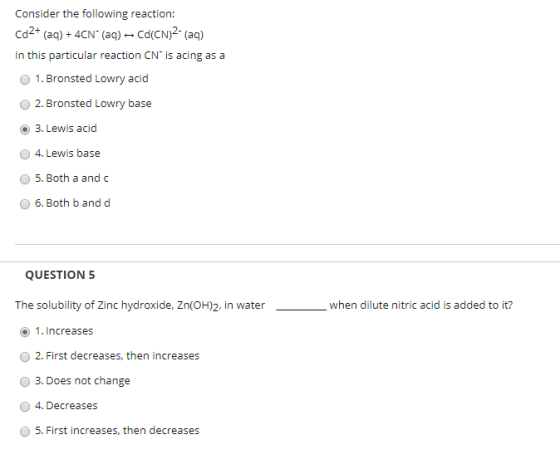
PLEASE ONLY ANSWER FIRST QUESTION
Homework Answers
Lewis base is defined as the species that can donate the
elecrtrons.It include the species having negative charge or lone
pairs.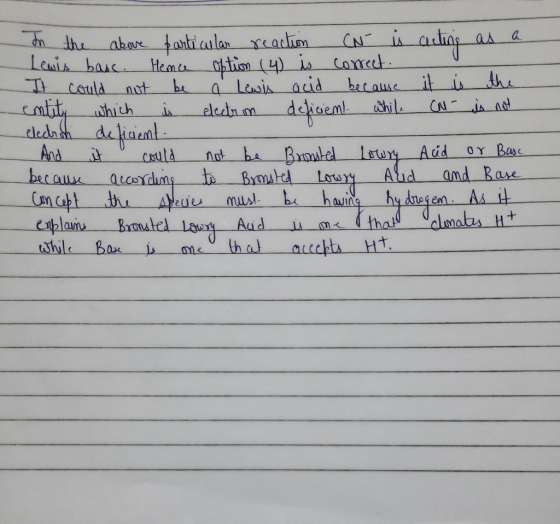
Add Answer to:
PLEASE ONLY ANSWER FIRST QUESTION Consider the following reaction: Cd2+ (aq) + 4CN (aq) +- Cd(CN)2- (aq) In this partic...
Consider the following reaction: Cd2+ (aq) + 4CN- (aq) ↔ Cd(CN)2- (aq) In this particular reaction...
Consider the following reaction: Cd2+ (aq) + 4CN- (aq) ↔ Cd(CN)2- (aq) In this particular reaction CN- is acing as a 1. Bronsted Lowry acid 2. Bronsted Lowry base 3. Lewis acid 4. Lewis base 5. Both a and c 6. Both b and d
The following Lewis acid-base reaction has A.G° =-39.9 kJ. Cd2+ (aq) + 4 NH3(aq) → [Cd(NH3)4]2+(aq)...
 The following Lewis acid-base reaction has A.G° =-39.9 kJ. Cd2+ (aq) + 4 NH3(aq) → [Cd(NH3)4]2+(aq) What is the formation constant of [Cd(NH3)4]2+ at 25 °C? (R = 8.314510 J/Kºmol) 1. -1.0 x 10⁷ 2. 1.0 x 10⁷ 3. 1.0 x 10⁻⁷ 4. 1.3 x 10¹⁶
Be sure to answer all parts. Consider the following reaction: Cd(s) + Fe2+(aq) → Cd2+(aq) +...
Be sure to answer all parts. Consider the following reaction: Cd(s) + Fe2+(aq) → Cd2+(aq) + Fe(s) E o (Fe2+ / Fe) = −0.4400 V, E o (Cd2+ / Cd) = −0.4000 V Calculate the emf for this reaction at 298 K if [Fe2+] = 0.60 M and [Cd2+] = 0.010 M. E =____ V Will the reaction occur spontaneously at these conditions? yes no cannot predict
Be sure to answer all parts. Consider the following reaction: Cd(s) + Fe2+(aq) → Cd2+(aq) +...
 Be sure to answer all parts. Consider the following reaction: Cd(s) + Fe2+(aq) → Cd2+(aq) + Fe(s) E° (Fe2+ / Fe) =-0.4400 V, Eº (Cd2+ / Cd) = -0.4000 V Calculate the emf for this reaction at 298 K if [Fe2+] = 0.85 M and [Cd2+] = 0.010 M. E= Lv Will the reaction occur spontaneously at these conditions? o o yes no cannot predict o
QUESTION 2 What is the name of a proton donor in a reaction? a. Arrhenius acid...
 QUESTION 2 What is the name of a proton donor in a reaction? a. Arrhenius acid b. Arrhenius base c. Bronsted-Lowry acid d. Bronsted-Lowry base e. Lewis base
Consider the following Bronsted-Lowry Acid/Base neutralization reaction: NH3 (aq) + HBr (aq) => NH4+(aq) + Br-(aq)...
Consider the following Bronsted-Lowry Acid/Base neutralization reaction: NH3 (aq) + HBr (aq) => NH4+(aq) + Br-(aq) Please list 1.) the acid and 2.) the conjugate base in this reaction.
Be sure to answer all parts. Consider the following reaction: Cd(s) + Fe2+(aq) → Cd2+(aq) +...
 Be sure to answer all parts. Consider the following reaction: Cd(s) + Fe2+(aq) → Cd2+(aq) + Fe(s) e°(Fe2+ / Fe) = -0.4400 V, Eº (Cd2+ / Ca) = -0.4000 V Calculate the emf for this reaction at 298 K if [Fe2+1 0.75 M and Ca2+] = 0.010 M. E- L v Will the reaction occur spontaneously at these conditions? O yes no cannot predict
Acids and bases: Part I Consider the following reactions: (a) 2 NH3 + Ag+ → [Ag(NH3)2]+...
Acids and bases: Part I Consider the following reactions: (a) 2 NH3 + Ag+ → [Ag(NH3)2]+ (b) NH4+ + CO32- → NH3 + HCO3- (c) 2 HBr + Ca(OH)2 → CaBr2 + 2 H2O Match with the definitions that apply for the substances indicated. Note: In a given reaction, the same definition must apply for both the acid and base for it to hold true. Choices: a)Lewis-base b)Bronsted-Lowry and Lewis Base c) Lewis acid d) Arrhenius, Bronsted-Lowry, and Lewis acid...
A) Consider the insoluble compound zinc hydroxide, Zn(OH)2. The zinc ion also forms a complex with...
A) Consider the insoluble compound zinc hydroxide, Zn(OH)2. The zinc ion also forms a complex with ammonia. Write a balanced net ionic equation to show why the solubility of Zn(OH)2(s) increases in the presence of ammonia and calculate the equilibrium constant for this reaction. For Zn(NH3)42+, Kf = 2.9×10⁹. Specify states such as (aq) or (s) and provide K. K = ______ B) Consider the insoluble compound nickel(II) hydroxide, Ni(OH)2. The nickel ion also forms a complex with cyanide ions....
Consider the half‑reaction for the reduction of Cd 2+ Cd2+ to Cd(s) Cd(s) . Cd 2...
 Consider the half‑reaction for the reduction of Cd 2+ Cd2+ to
Cd(s) Cd(s) . Cd 2 +(aq)+2 e − ⟶Cd(s) ? ∘ Cd 2+ /Cd =−0.403 V
Cd2+(aq)+2e−⟶Cd(s)ECd2+/Cd∘=−0.403 V Calculate the potential of the
cadmium electrode at 25 ∘ C 25 ∘C when immersed in a 0.0560 M
0.0560 M solution of CdBr 2 . CdBr2. ? Cd = ECd= V V Calculate the
potential of the cadmium electrode at 25 ∘ C 25 ∘C when immersed in
a 0.0330...
Consider the half‑reaction for the reduction of Cd 2+ Cd2+ to
Cd(s) Cd(s) . Cd 2 +(aq)+2 e − ⟶Cd(s) ? ∘ Cd 2+ /Cd =−0.403 V
Cd2+(aq)+2e−⟶Cd(s)ECd2+/Cd∘=−0.403 V Calculate the potential of the
cadmium electrode at 25 ∘ C 25 ∘C when immersed in a 0.0560 M
0.0560 M solution of CdBr 2 . CdBr2. ? Cd = ECd= V V Calculate the
potential of the cadmium electrode at 25 ∘ C 25 ∘C when immersed in
a 0.0330...
 The following Lewis acid-base reaction has A.G° =-39.9 kJ. Cd2+ (aq) + 4 NH3(aq) → [Cd(NH3)4]2+(aq) What is the formation constant of [Cd(NH3)4]2+ at 25 °C? (R = 8.314510 J/Kºmol) 1. -1.0 x 10⁷ 2. 1.0 x 10⁷ 3. 1.0 x 10⁻⁷ 4. 1.3 x 10¹⁶
 Be sure to answer all parts. Consider the following reaction: Cd(s) + Fe2+(aq) → Cd2+(aq) + Fe(s) E° (Fe2+ / Fe) =-0.4400 V, Eº (Cd2+ / Cd) = -0.4000 V Calculate the emf for this reaction at 298 K if [Fe2+] = 0.85 M and [Cd2+] = 0.010 M. E= Lv Will the reaction occur spontaneously at these conditions? o o yes no cannot predict o
 QUESTION 2 What is the name of a proton donor in a reaction? a. Arrhenius acid b. Arrhenius base c. Bronsted-Lowry acid d. Bronsted-Lowry base e. Lewis base
 Be sure to answer all parts. Consider the following reaction: Cd(s) + Fe2+(aq) → Cd2+(aq) + Fe(s) e°(Fe2+ / Fe) = -0.4400 V, Eº (Cd2+ / Ca) = -0.4000 V Calculate the emf for this reaction at 298 K if [Fe2+1 0.75 M and Ca2+] = 0.010 M. E- L v Will the reaction occur spontaneously at these conditions? O yes no cannot predict
 Consider the half‑reaction for the reduction of Cd 2+ Cd2+ to
Cd(s) Cd(s) . Cd 2 +(aq)+2 e − ⟶Cd(s) ? ∘ Cd 2+ /Cd =−0.403 V
Cd2+(aq)+2e−⟶Cd(s)ECd2+/Cd∘=−0.403 V Calculate the potential of the
cadmium electrode at 25 ∘ C 25 ∘C when immersed in a 0.0560 M
0.0560 M solution of CdBr 2 . CdBr2. ? Cd = ECd= V V Calculate the
potential of the cadmium electrode at 25 ∘ C 25 ∘C when immersed in
a 0.0330...
Consider the half‑reaction for the reduction of Cd 2+ Cd2+ to
Cd(s) Cd(s) . Cd 2 +(aq)+2 e − ⟶Cd(s) ? ∘ Cd 2+ /Cd =−0.403 V
Cd2+(aq)+2e−⟶Cd(s)ECd2+/Cd∘=−0.403 V Calculate the potential of the
cadmium electrode at 25 ∘ C 25 ∘C when immersed in a 0.0560 M
0.0560 M solution of CdBr 2 . CdBr2. ? Cd = ECd= V V Calculate the
potential of the cadmium electrode at 25 ∘ C 25 ∘C when immersed in
a 0.0330...
Most questions answered within 3 hours.
-
Where is the error in this code sequence?
String s1 = "Hello";
String s2 = "ello";...
asked 10 months ago -
Financial data for Joel de Paris, Inc., for last year
follow:
Joel de Paris, Inc.
Balance...
asked 10 months ago -
Consider this reaction:
Al2(SO4)3 (aq)+ BaCl3
(aq) Al2Cl6 (aq)- +
3BaSO4(s) . What is the...
asked 10 months ago -
Suppose that Savneet is considering increasing her
recent random sample from 20 car rentals to 40...
asked 10 months ago -
Trucks arrive at an unloading terminal at an average rate of 120
per hour.
Trucks arrive...
asked 10 months ago -
Why are methanol and ethanol completely soluble in water while
octanol is not very little soluble....
asked 10 months ago -
A facilities manager at a university reads in a research report
that the mean amount of...
asked 10 months ago -
When the CuSO4 is rehydrated by adding water to the anhydrous
compound, is this an endothermic...
asked 10 months ago -
A ray of sunlight is passing from diamond into crown glass; the
angle of incidence is...
asked 10 months ago -
A block of mass 0.249 kg is placed on top of a light, vertical
spring of...
asked 10 months ago -
how do the kidneys compensate in the presences of acidosis
a) trigger hyperventilate
b) reserve acid...
asked 10 months ago -
Question 501 pts
The rental rate of capital to the firm increases. Which of the
following...
asked 10 months ago