
Homework Answers
Anny query in any step then comment below..i will help you..
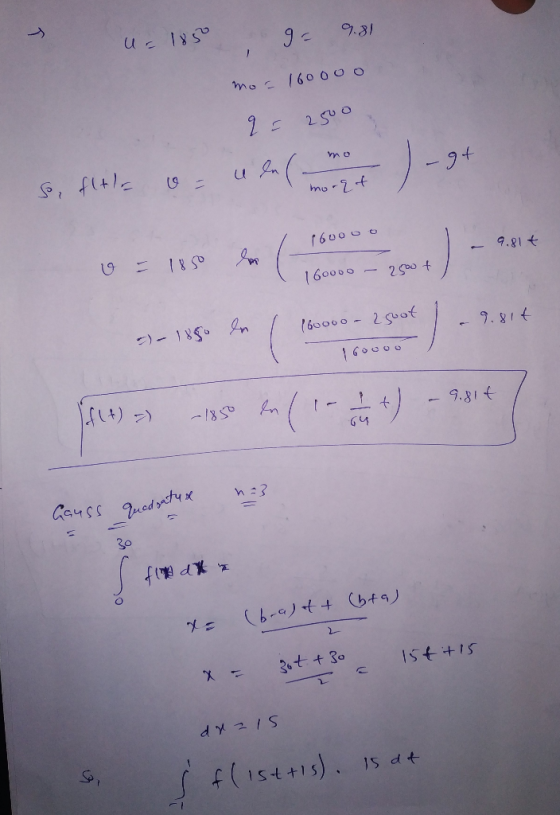
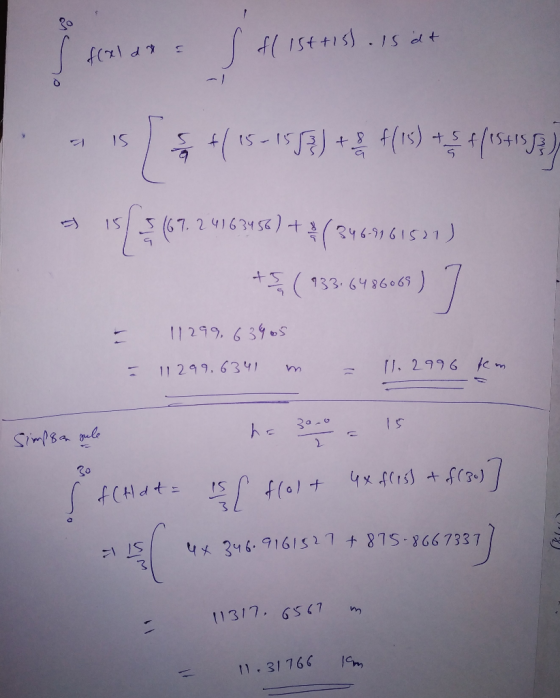
In gauss quadraature , firstly we convert interval (0 , 30 ) to ( -1 ,1) ...then we apply quadrature formula..
Add Answer to:
PLEASE ALSO SOLVE USING THE SIMPSONS 1/3RULE.PLEASE DONT ATTEMPT THE QUESTION IF YOU CANT SOLVE BOTH GUASS AND SIMPSONS...
2-1): The upward velocity of a rocket can be computed be the following formula: mo mo - qt where ...
 Please show all your steps and
calculations.
2-1): The upward velocity of a rocket can be computed be the following formula: mo mo - qt where v upward velocity (m/s), u velocity at which fuel is expelled relative to the rocket (m/s), mo- initial mass of the rocket at time t 0s (kg), q -fuel consumption rate (kg/s), and g downward acceleration of gravity (assumed constant 9.81 m/s2). If u 1850 m/s, mo 160,000 kg, and q 2500 kg/s. a)...
Please show all your steps and
calculations.
2-1): The upward velocity of a rocket can be computed be the following formula: mo mo - qt where v upward velocity (m/s), u velocity at which fuel is expelled relative to the rocket (m/s), mo- initial mass of the rocket at time t 0s (kg), q -fuel consumption rate (kg/s), and g downward acceleration of gravity (assumed constant 9.81 m/s2). If u 1850 m/s, mo 160,000 kg, and q 2500 kg/s. a)...
The MATLAB code should have the outline of this: m0 = 160e3; % [kg] u =...
 The MATLAB code should have the outline of this:
m0 = 160e3; % [kg]
u = 1800; % [m/s]
v = 750; % [m/s]
q = 2600; % [kg/s]
g = 9.81; % [m/s^2]
tl = 10; % Lower guess [s]
tu = 50; % Upper guess [s]
es = 0.0001; %Stopping criterion
t_v750 = rocket(m0, g, q, u, v,tl,tu,es)
function t_root = rocket(m0,g,q,u,v,xl,xu,es);
% Inputs:
% m0: initial mass of rocket at time t=0 [kg] (scalar)
% g: gravitational...
The MATLAB code should have the outline of this:
m0 = 160e3; % [kg]
u = 1800; % [m/s]
v = 750; % [m/s]
q = 2600; % [kg/s]
g = 9.81; % [m/s^2]
tl = 10; % Lower guess [s]
tu = 50; % Upper guess [s]
es = 0.0001; %Stopping criterion
t_v750 = rocket(m0, g, q, u, v,tl,tu,es)
function t_root = rocket(m0,g,q,u,v,xl,xu,es);
% Inputs:
% m0: initial mass of rocket at time t=0 [kg] (scalar)
% g: gravitational...
MATLAB WORK PLEASE The upward velocity of a rocket can be computed from the following formula:...
 MATLAB WORK PLEASE
The upward velocity of a rocket can be computed from the following formula: v=u* In mo -91 mo-91 where v = upward velocity, u = the velocity at which fuel is expelled relative to the rocket, me = the initial mass of the rocket at time t=0,9 = the fuel consumption rate, and g = the acceleration due to gravity. Compute the time tro at which v reaches an arbitrary value using the bisection method. Use the...
MATLAB WORK PLEASE
The upward velocity of a rocket can be computed from the following formula: v=u* In mo -91 mo-91 where v = upward velocity, u = the velocity at which fuel is expelled relative to the rocket, me = the initial mass of the rocket at time t=0,9 = the fuel consumption rate, and g = the acceleration due to gravity. Compute the time tro at which v reaches an arbitrary value using the bisection method. Use the...
 Please show all your steps and
calculations.
2-1): The upward velocity of a rocket can be computed be the following formula: mo mo - qt where v upward velocity (m/s), u velocity at which fuel is expelled relative to the rocket (m/s), mo- initial mass of the rocket at time t 0s (kg), q -fuel consumption rate (kg/s), and g downward acceleration of gravity (assumed constant 9.81 m/s2). If u 1850 m/s, mo 160,000 kg, and q 2500 kg/s. a)...
Please show all your steps and
calculations.
2-1): The upward velocity of a rocket can be computed be the following formula: mo mo - qt where v upward velocity (m/s), u velocity at which fuel is expelled relative to the rocket (m/s), mo- initial mass of the rocket at time t 0s (kg), q -fuel consumption rate (kg/s), and g downward acceleration of gravity (assumed constant 9.81 m/s2). If u 1850 m/s, mo 160,000 kg, and q 2500 kg/s. a)...
 The MATLAB code should have the outline of this:
m0 = 160e3; % [kg]
u = 1800; % [m/s]
v = 750; % [m/s]
q = 2600; % [kg/s]
g = 9.81; % [m/s^2]
tl = 10; % Lower guess [s]
tu = 50; % Upper guess [s]
es = 0.0001; %Stopping criterion
t_v750 = rocket(m0, g, q, u, v,tl,tu,es)
function t_root = rocket(m0,g,q,u,v,xl,xu,es);
% Inputs:
% m0: initial mass of rocket at time t=0 [kg] (scalar)
% g: gravitational...
The MATLAB code should have the outline of this:
m0 = 160e3; % [kg]
u = 1800; % [m/s]
v = 750; % [m/s]
q = 2600; % [kg/s]
g = 9.81; % [m/s^2]
tl = 10; % Lower guess [s]
tu = 50; % Upper guess [s]
es = 0.0001; %Stopping criterion
t_v750 = rocket(m0, g, q, u, v,tl,tu,es)
function t_root = rocket(m0,g,q,u,v,xl,xu,es);
% Inputs:
% m0: initial mass of rocket at time t=0 [kg] (scalar)
% g: gravitational...
 MATLAB WORK PLEASE
The upward velocity of a rocket can be computed from the following formula: v=u* In mo -91 mo-91 where v = upward velocity, u = the velocity at which fuel is expelled relative to the rocket, me = the initial mass of the rocket at time t=0,9 = the fuel consumption rate, and g = the acceleration due to gravity. Compute the time tro at which v reaches an arbitrary value using the bisection method. Use the...
MATLAB WORK PLEASE
The upward velocity of a rocket can be computed from the following formula: v=u* In mo -91 mo-91 where v = upward velocity, u = the velocity at which fuel is expelled relative to the rocket, me = the initial mass of the rocket at time t=0,9 = the fuel consumption rate, and g = the acceleration due to gravity. Compute the time tro at which v reaches an arbitrary value using the bisection method. Use the...
Most questions answered within 3 hours.
-
Where is the error in this code sequence?
String s1 = "Hello";
String s2 = "ello";...
asked 10 months ago -
Financial data for Joel de Paris, Inc., for last year
follow:
Joel de Paris, Inc.
Balance...
asked 10 months ago -
Consider this reaction:
Al2(SO4)3 (aq)+ BaCl3
(aq) Al2Cl6 (aq)- +
3BaSO4(s) . What is the...
asked 10 months ago -
Suppose that Savneet is considering increasing her
recent random sample from 20 car rentals to 40...
asked 10 months ago -
Trucks arrive at an unloading terminal at an average rate of 120
per hour.
Trucks arrive...
asked 10 months ago -
Why are methanol and ethanol completely soluble in water while
octanol is not very little soluble....
asked 10 months ago -
A facilities manager at a university reads in a research report
that the mean amount of...
asked 10 months ago -
When the CuSO4 is rehydrated by adding water to the anhydrous
compound, is this an endothermic...
asked 10 months ago -
A ray of sunlight is passing from diamond into crown glass; the
angle of incidence is...
asked 10 months ago -
A block of mass 0.249 kg is placed on top of a light, vertical
spring of...
asked 10 months ago -
how do the kidneys compensate in the presences of acidosis
a) trigger hyperventilate
b) reserve acid...
asked 10 months ago -
Question 501 pts
The rental rate of capital to the firm increases. Which of the
following...
asked 10 months ago