
Homework Answers
QUESTION 9 :-
Given,
Start of the year value = $ 171000000
Gross annual return (r) = 13.4% or 0.134
Expense ratio = 1.7%
Solution :-


Add Answer to:
QUESTION 9 Consider a mutual fund with 171 million dollars in assets at the start of the year, and 29 millon shares out...
A fund has $870 million dollars of assets, $35 million of liabilities, and 14 million shares...
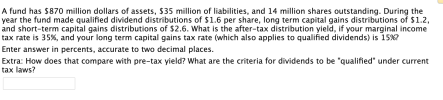 A fund has $870 million dollars of assets, $35 million of liabilities, and 14 million shares outstanding. During the year the fund made qualified dividend distributions of $1.6 per share, long term capital gains distributions of $1.2, and short-term capital gains distributions of $2.6. What is the after-tax distribution yield, if your marginal income tax rate is 35%, and your long term capital gains tax rate (which also applies to qualified dividends) is 15%? Enter answer in percents, accurate to...
A fund has $878 million dollars of assets, $21 million of liabilities, and 13 million shares...
A fund has $878 million dollars of assets, $21 million of liabilities, and 13 million shares outstanding. During the year the fund made qualified dividend distributions of $2.9 per share, long term capital gains distributions of $1.6, and short-term capital gains distributions of $1.9. What is the after-tax distribution yield, if your marginal income tax rate is 35%, and your long term capital gains tax rate (which also applies to qualified dividends) is 15%? Enter answer in percents, accurate to...
QUESTION 11 A fund has $863 million dollars of assets, $37 million of liabilities, and 14...
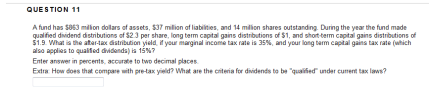 QUESTION 11 A fund has $863 million dollars of assets, $37 million of liabilities, and 14 million shares outstanding. During the year the fund made qualified dividend distributions of $2.3 per share, long term capital gains distributions of $1, and short-term capital gains distributions of $1.9. What is the after-tax distribution yield, if your marginal income tax rate is 35%, and your long term capital gains tax rate (which also applies to qualified dividends) is 15%? Enter answer in percents,...
A. Consider a mutual fund with $206 million in assets at the start of the year...
A. Consider a mutual fund with $206 million in assets at the start of the year and with 20 million shares outstanding. The fund invests in a portfolio of stocks that provides dividend income at the end of the year of $2 million. The stocks included in the fund's portfolio increase in price by 6%, but no securities are sold, and there are no capital gains distributions. The fund charges 12b-1 fees of 0.50%, which are deducted from portfolio assets...
Consider a mutual fund with $214 million in assets at the start of the year and...
 Consider a mutual fund with $214 million in assets at the start of the year and with 10 million shares outstanding. The fund invests in a portfolio of stocks that provides dividend income at the end of the year of $2 million. The stocks included in the fund's portfolio increase in price by 8%, but no securities are sold, and there are no capital gains distributions. The fund charges 12b-1 fees of 1.00 % , which are deducted from portfolio...
Consider a mutual fund with $213 million in assets at the start of the year and...
Consider a mutual fund with $213 million in assets at the start of the year and with 12 million shares outstanding. The fund invests in a portfolio of stocks that provides dividend income at the end of the year of $3 million. The stocks included in the fund's portfolio increase in price by 6%, but no securities are sold, and there are no capital gains distributions. The fund charges 12b-1 fees of 1.00%, which are deducted from portfolio assets at...
Consider a mutual fund with $203 million in assets at the start of the year and...
 Consider a mutual fund with $203 million in assets at the start of the year and with 10 million shares outstanding. The fund invests in a portfolio of stocks that provides dividend income at the end of the year of $5 million. The stocks included in the fund's portfolio increase in price by 7%, but no securities are sold, and there are no capital gains distributions. The fund charges 12b-1 fees of 0.75%, which are deducted from portfolio assets at...
Consider a no-load mutual fund with $200 million in assets and 10 million shares at the...
Consider a no-load mutual fund with $200 million in assets and 10 million shares at the start of the year and with $250 million in assets and 11 million shares at the end of the year. During the year investors have received income distributions of $2 per share and capital gain distributions of $0.55 per share. Assuming that the fund carries no debt, and that the total expense ratio is 1%, what is the rate of return on the fund
1b) Consider a no-load mutual fund with $200 million in assets and 10 million shares at...
 1b) Consider a no-load mutual fund with $200 million in assets and 10 million shares at the start of the year and with $250 million in assets and 11 million shares at the end of the year. During the year investors have received income distributions of $2 per share and capital gain distributions of $.25 per share. Assuming that the fund carries no debt, and that the total expense ratio is 1%, what is the rate of return on the...
Consider a no-load mutual fund with $200 million in assets and 10 million shares at the...
 Consider a no-load mutual fund with $200 million in assets and 10 million shares at the start of the year and with $250 million in assets and 11 million shares at the end of the year. During the year investors have received income distributions of $2 per share and capital gain distributions of $.25 per share. Assuming that the fund carries no debt, and that the total expense ratio is 1%, what is the rate of return on the fund?...
 A fund has $870 million dollars of assets, $35 million of liabilities, and 14 million shares outstanding. During the year the fund made qualified dividend distributions of $1.6 per share, long term capital gains distributions of $1.2, and short-term capital gains distributions of $2.6. What is the after-tax distribution yield, if your marginal income tax rate is 35%, and your long term capital gains tax rate (which also applies to qualified dividends) is 15%? Enter answer in percents, accurate to...
 QUESTION 11 A fund has $863 million dollars of assets, $37 million of liabilities, and 14 million shares outstanding. During the year the fund made qualified dividend distributions of $2.3 per share, long term capital gains distributions of $1, and short-term capital gains distributions of $1.9. What is the after-tax distribution yield, if your marginal income tax rate is 35%, and your long term capital gains tax rate (which also applies to qualified dividends) is 15%? Enter answer in percents,...
 Consider a mutual fund with $214 million in assets at the start of the year and with 10 million shares outstanding. The fund invests in a portfolio of stocks that provides dividend income at the end of the year of $2 million. The stocks included in the fund's portfolio increase in price by 8%, but no securities are sold, and there are no capital gains distributions. The fund charges 12b-1 fees of 1.00 % , which are deducted from portfolio...
 Consider a mutual fund with $203 million in assets at the start of the year and with 10 million shares outstanding. The fund invests in a portfolio of stocks that provides dividend income at the end of the year of $5 million. The stocks included in the fund's portfolio increase in price by 7%, but no securities are sold, and there are no capital gains distributions. The fund charges 12b-1 fees of 0.75%, which are deducted from portfolio assets at...
 1b) Consider a no-load mutual fund with $200 million in assets and 10 million shares at the start of the year and with $250 million in assets and 11 million shares at the end of the year. During the year investors have received income distributions of $2 per share and capital gain distributions of $.25 per share. Assuming that the fund carries no debt, and that the total expense ratio is 1%, what is the rate of return on the...
 Consider a no-load mutual fund with $200 million in assets and 10 million shares at the start of the year and with $250 million in assets and 11 million shares at the end of the year. During the year investors have received income distributions of $2 per share and capital gain distributions of $.25 per share. Assuming that the fund carries no debt, and that the total expense ratio is 1%, what is the rate of return on the fund?...
Most questions answered within 3 hours.
-
Where is the error in this code sequence?
String s1 = "Hello";
String s2 = "ello";...
asked 10 months ago -
Financial data for Joel de Paris, Inc., for last year
follow:
Joel de Paris, Inc.
Balance...
asked 10 months ago -
Consider this reaction:
Al2(SO4)3 (aq)+ BaCl3
(aq) Al2Cl6 (aq)- +
3BaSO4(s) . What is the...
asked 10 months ago -
Suppose that Savneet is considering increasing her
recent random sample from 20 car rentals to 40...
asked 10 months ago -
Trucks arrive at an unloading terminal at an average rate of 120
per hour.
Trucks arrive...
asked 10 months ago -
Why are methanol and ethanol completely soluble in water while
octanol is not very little soluble....
asked 10 months ago -
A facilities manager at a university reads in a research report
that the mean amount of...
asked 10 months ago -
When the CuSO4 is rehydrated by adding water to the anhydrous
compound, is this an endothermic...
asked 10 months ago -
A ray of sunlight is passing from diamond into crown glass; the
angle of incidence is...
asked 10 months ago -
A block of mass 0.249 kg is placed on top of a light, vertical
spring of...
asked 10 months ago -
how do the kidneys compensate in the presences of acidosis
a) trigger hyperventilate
b) reserve acid...
asked 10 months ago -
Question 501 pts
The rental rate of capital to the firm increases. Which of the
following...
asked 10 months ago