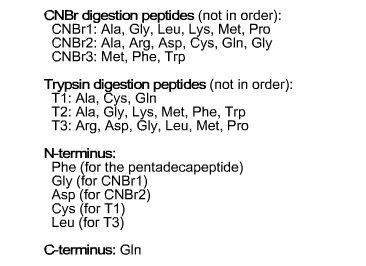
The following data were obtained from partial cleavage and analysis of a pentadecapeptide. Determine the sequence of the pentadecapeptide. Use three-letter abbreviations in your answer. Please explain thoroughly, step by step.
Homework Answers
Trypsin cuts chain on the right(carboxylic acid) side of any basic amino acid ...(lys,arg) .
Chimotrypsin cuts chain on the right(carboxylic acid) side of any aromatic amino acid ...(phe,trp,hys,tyr) .
CnBr cuts chain on the right(carboxylic acid) side of metheonine .
Based on these information , we can predict the sequence . That will be ,
Phe- Trp-Met-Gly-Ala-Lys-Leu-Pro-Met-Asp-Gly-Arg-Cys-Ala-Gln
Add Answer to:
The following data were obtained from partial cleavage and analysis of a pentadecapeptide. Determine the sequence of the...
Based on where CNBR and trypsin cut, evaluate the following experimental data and predict the N-...
Based on where CNBR and trypsin cut, evaluate the following experimental data and predict the N- and C-terminal amino acids of the parent peptide (peptide before cutting). Enter your answer using the three letter amino acid abbreviations, with a comma in between. For example, if the N-terminal residue is alanine and C-terminal residue is glycine you would write: Ala, Gly. Cleavage with CNBR produced the following peptides: Gly-Ala-Lys-Leu-Pro-Met Phe-Trp-Met Asp-Gly-Arg-Cys-Ala-Gln Cleavage with trypsin: Cys-Ala-Gln Phe-Trp-Met-Gly-Ala-Lys Leu-Pro-Met-Asp-Gly-Arg
please explain how to solve this problem, the answer is provided 9. Peptides: (20 pts.). A...
 please explain how to solve this problem, the answer
is provided
9. Peptides: (20 pts.). A polypeptide (X) gives 7 fragments when treated with chymotrypsin (A-G). The same peptide also gives 9 fragments when treated with trypsin (I- IX). After Chymotrypsin A) Thr-Thr-Tyr-Ala-Gly-Phe-Phe-Ile-Asp- Lys B) Ala-Cys-Pro-Leu-Tyr-Gin-lle-Arg C) Met-Ser-Thr-Tyr-Pro-Gly-Arg D) Cys-Leu-Val-Phe-Ile-Lys E) Leu-Ala-Trp-Gly-Val F) Ser-Phe-Ala-Pro-Lys G) Met-Asp-Lys Afier Trypsin I) Ala-Pro-Lys-Met-Asp-Lys-Thr-Thr-Tyr II) Pro-Gly-Arg-Cys-Leu-Val-Phe III) Ile-Lys-Ala-Cys-Pro-Leu-Tyr IV) Ile-Asp-Lys-Met-Ser-Thr-Tyr V) Gin-Ile-Arg-Leu-Ala-Trp VIAla-Gly-Phe VII) Gly-Val VIII) Ser-Phe LX) Phe A) What is the primary...
please explain how to solve this problem, the answer
is provided
9. Peptides: (20 pts.). A polypeptide (X) gives 7 fragments when treated with chymotrypsin (A-G). The same peptide also gives 9 fragments when treated with trypsin (I- IX). After Chymotrypsin A) Thr-Thr-Tyr-Ala-Gly-Phe-Phe-Ile-Asp- Lys B) Ala-Cys-Pro-Leu-Tyr-Gin-lle-Arg C) Met-Ser-Thr-Tyr-Pro-Gly-Arg D) Cys-Leu-Val-Phe-Ile-Lys E) Leu-Ala-Trp-Gly-Val F) Ser-Phe-Ala-Pro-Lys G) Met-Asp-Lys Afier Trypsin I) Ala-Pro-Lys-Met-Asp-Lys-Thr-Thr-Tyr II) Pro-Gly-Arg-Cys-Leu-Val-Phe III) Ile-Lys-Ala-Cys-Pro-Leu-Tyr IV) Ile-Asp-Lys-Met-Ser-Thr-Tyr V) Gin-Ile-Arg-Leu-Ala-Trp VIAla-Gly-Phe VII) Gly-Val VIII) Ser-Phe LX) Phe A) What is the primary...
How many amino acids are there in the disease causing variant of the Amyloid-beta (Ab) peptide?...
 How many amino acids are there in the disease causing variant of
the Amyloid-beta (Ab) peptide?
Determine which of these four peptides is most likely to become a beta sheet. Lys-Thr-Val-Ile-Trp-Pro-Phe-Tyr-Ile-Gln-Ile-Gly Arg-Ser-Tyr-Glu-Gly-Leu-Lys-Arg-Ile-Ala-Glu-Ser Ala-Glu-Met-Leu-Gln-Lys-Arg-Gly-Cys-Gly-Asp-Glu Met-Leu-Lys-Ala-Ser-Ala-Leu-Glu-Lys-Leu-Ser-Glu
How many amino acids are there in the disease causing variant of
the Amyloid-beta (Ab) peptide?
Determine which of these four peptides is most likely to become a beta sheet. Lys-Thr-Val-Ile-Trp-Pro-Phe-Tyr-Ile-Gln-Ile-Gly Arg-Ser-Tyr-Glu-Gly-Leu-Lys-Arg-Ile-Ala-Glu-Ser Ala-Glu-Met-Leu-Gln-Lys-Arg-Gly-Cys-Gly-Asp-Glu Met-Leu-Lys-Ala-Ser-Ala-Leu-Glu-Lys-Leu-Ser-Glu
Indicate the peptides that would result from cleavage by the indicated reagent: Gly-Lys-Leu-Ala-Cys-Arg-Ala-Phe by trypsin Enter...
Indicate the peptides that would result from cleavage by the indicated reagent: Gly-Lys-Leu-Ala-Cys-Arg-Ala-Phe by trypsin Enter your answers in respective order separated by commas. Phe-Pro-Tyr-Gly-Val-Met by chymotrypsin Enter your answers in respective order separated by comma.
What fragments will be obtained by a trypsin hydrolysis of the following octapeptide? Ala-Val-Trp-Lys-Phe-Gly-Arg-Met A) Ala-Val-Trp-Lys-Phe...
 What fragments will be obtained by a trypsin hydrolysis of the following octapeptide? Ala-Val-Trp-Lys-Phe-Gly-Arg-Met A) Ala-Val-Trp-Lys-Phe and Gly-Arg-Met 3) Ala-Val-Trp-Lys-Phe-Gly and Arg-Met - Ala-Val-Trp-Lys and Phe-Gly-Arg and Met ) Ala-Val-Trp-Lys and Phe and Gly-Arg and Met ) Ala-Val-Trp and Lys-Phe-Gly and Arg-Met Bradykinin is a nonapeptide, Arg-Pro-Pro-Gly-Phe-Ser-Pro-Phe-Arg. In addition to one mole of Arg, what peptides are present after hydrolysis of bradykinin with chymotrypsin? A) Arg-Pro-Pro and Gly-Phe and Ser-Pro-Phe B) Pro-Pro-Gly and Phe-Ser-Pro-Phe-Arg C) Arg-Pro-Pro-Gly-Phe and Ser-Pro-Phe ?) Arg-Pro-Pro-Gly-Phe-Ser...
5. Consider the following peptide: His-Ser-Gln-Gly-Thr-Phe-Thr-Ser-Asp-Tyr-Ser-Lys-Tyr-Leu-Asp-Ser-Arg-Arg-Ala-Gin- Asp-Phe-Val-Gln-Trp-Leu-Met-Asn-Thr a. What are the fragments, if it is cleaved...
 5. Consider the following peptide: His-Ser-Gln-Gly-Thr-Phe-Thr-Ser-Asp-Tyr-Ser-Lys-Tyr-Leu-Asp-Ser-Arg-Arg-Ala-Gin- Asp-Phe-Val-Gln-Trp-Leu-Met-Asn-Thr a. What are the fragments, if it is cleaved by trypsin? b. What are the fragments, if it is cleaved by chymotrypsin? c. What are the fragments, if it is cleaved by pepsin?
What two restriction enzymes could you use if you wanted to produce a protein that was fused to a GST-tag that could be removed using thrombin? Would this experimental design place any other tags on y...
 What two restriction enzymes could you use if you wanted to
produce a protein that was fused to a GST-tag that could be removed
using thrombin? Would this experimental design place any other tags
on your protein?
Here is the vector:
T7 promoter lac operator Xbal rbs Ndel AATTAATACGACTCACTATAGGGGAATTGTGAGCGGATAACAATTCCCCTCTAGAAATAATTTTGTTTAACTTTAAGAAGGAGATATACATATGTCCCCT Met Ser Pro GST Ta His TagSacl ATACTAGGTTAT.627bp...GACCATCCTCCAAAATCGGATGGTTCAACTAGTGGTTCTGGTCATCACCATCACCATCACTCCGCGGGTCTGGTGCCACGCGGTAGT lle Leu Gly Tyr.. .209aa. . . Asp His Pro Pro Lys Ser Asp Gly Ser Thr Ser Gly Ser Gly His His...
What two restriction enzymes could you use if you wanted to
produce a protein that was fused to a GST-tag that could be removed
using thrombin? Would this experimental design place any other tags
on your protein?
Here is the vector:
T7 promoter lac operator Xbal rbs Ndel AATTAATACGACTCACTATAGGGGAATTGTGAGCGGATAACAATTCCCCTCTAGAAATAATTTTGTTTAACTTTAAGAAGGAGATATACATATGTCCCCT Met Ser Pro GST Ta His TagSacl ATACTAGGTTAT.627bp...GACCATCCTCCAAAATCGGATGGTTCAACTAGTGGTTCTGGTCATCACCATCACCATCACTCCGCGGGTCTGGTGCCACGCGGTAGT lle Leu Gly Tyr.. .209aa. . . Asp His Pro Pro Lys Ser Asp Gly Ser Thr Ser Gly Ser Gly His His...
Which of these protein sequences is most likely to span a cell membrane? Gly-Asp-Val-Ala-Gly-Arg-Gly-Asn-Gly-Lys-Lys-Pro-Ser-Ser-Val-Arg-Ala-Leu-Ser Ile-Val-Leu-Pro-Ile-Val-Leu-Leu-Val-Phe-Leu-Cys-Leu-Gly-Val-Phe-Leu-Leu-Trp Lys-Asn-Trp-Arg-Leu-Lys-Asn-I
 Which of these protein sequences is most likely to span a cell
membrane?
Gly-Asp-Val-Ala-Gly-Arg-Gly-Asn-Gly-Lys-Lys-Pro-Ser-Ser-Val-Arg-Ala-Leu-Ser Ile-Val-Leu-Pro-Ile-Val-Leu-Leu-Val-Phe-Leu-Cys-Leu-Gly-Val-Phe-Leu-Leu-Trp Lys-Asn-Trp-Arg-Leu-Lys-Asn-Ile-Asn-ser-Ile-Asn-Phe-Asp-Asn-Pro-Val-Tyr-Gln A. 773 B. 792 C. 811
Which of these protein sequences is most likely to span a cell
membrane?
Gly-Asp-Val-Ala-Gly-Arg-Gly-Asn-Gly-Lys-Lys-Pro-Ser-Ser-Val-Arg-Ala-Leu-Ser Ile-Val-Leu-Pro-Ile-Val-Leu-Leu-Val-Phe-Leu-Cys-Leu-Gly-Val-Phe-Leu-Leu-Trp Lys-Asn-Trp-Arg-Leu-Lys-Asn-Ile-Asn-ser-Ile-Asn-Phe-Asp-Asn-Pro-Val-Tyr-Gln A. 773 B. 792 C. 811
anyone can help me with it? A protein biochemist attempted to determine the amino acid sequence...
 anyone can help me with it?
A protein biochemist attempted to determine the amino acid sequence of a decapeptide. Use the results from the trypsin, chymotrypsin, and cyanogen bromide treatments to suggest the amino acid sequence of this decapeptide. Trypsin digestion gave two fragments with multiple residues (not in order): • T1: Ala, Arg, Phe, Gly, Thr, Trp, Tyr • T2: Lys, Met, Val Chymotrypsin digestion gave four fragments with multiple residues (not in order): • CT1: Ala, Phe •...
anyone can help me with it?
A protein biochemist attempted to determine the amino acid sequence of a decapeptide. Use the results from the trypsin, chymotrypsin, and cyanogen bromide treatments to suggest the amino acid sequence of this decapeptide. Trypsin digestion gave two fragments with multiple residues (not in order): • T1: Ala, Arg, Phe, Gly, Thr, Trp, Tyr • T2: Lys, Met, Val Chymotrypsin digestion gave four fragments with multiple residues (not in order): • CT1: Ala, Phe •...
i think there are two right answers? From the partial nucleotide sequence given below, what peptides could be encoded?...
 i think there are two right answers?
From the partial nucleotide sequence given below, what peptides could be encoded? 5-GCCUCCAAAccccucCA-3' Choose one or more: A. Ala-Ser-Lys-Pro-Leu B. Leu-Gln-Thr-Pro-Pro C. Pro-Pro-Asn-Pro-Ser D. Lys-Pro-Ser-Gly-Met E. Met-Arg-His-Asp-Pro
From the partial nucleotide sequence given below, what peptides could be encoded? 5-GCCUCCAAAccccucCA-3' Choose one or more: A. Ala-Ser-Lys-Pro-Leu B. Leu-Gln-Thr-Pro-Pro C. Pro-Pro-Asn-Pro-Ser D. Lys-Pro-Ser-Gly-Met E. Met-Arg-His-Asp-Pro
i think there are two right answers?
From the partial nucleotide sequence given below, what peptides could be encoded? 5-GCCUCCAAAccccucCA-3' Choose one or more: A. Ala-Ser-Lys-Pro-Leu B. Leu-Gln-Thr-Pro-Pro C. Pro-Pro-Asn-Pro-Ser D. Lys-Pro-Ser-Gly-Met E. Met-Arg-His-Asp-Pro
From the partial nucleotide sequence given below, what peptides could be encoded? 5-GCCUCCAAAccccucCA-3' Choose one or more: A. Ala-Ser-Lys-Pro-Leu B. Leu-Gln-Thr-Pro-Pro C. Pro-Pro-Asn-Pro-Ser D. Lys-Pro-Ser-Gly-Met E. Met-Arg-His-Asp-Pro
 please explain how to solve this problem, the answer
is provided
9. Peptides: (20 pts.). A polypeptide (X) gives 7 fragments when treated with chymotrypsin (A-G). The same peptide also gives 9 fragments when treated with trypsin (I- IX). After Chymotrypsin A) Thr-Thr-Tyr-Ala-Gly-Phe-Phe-Ile-Asp- Lys B) Ala-Cys-Pro-Leu-Tyr-Gin-lle-Arg C) Met-Ser-Thr-Tyr-Pro-Gly-Arg D) Cys-Leu-Val-Phe-Ile-Lys E) Leu-Ala-Trp-Gly-Val F) Ser-Phe-Ala-Pro-Lys G) Met-Asp-Lys Afier Trypsin I) Ala-Pro-Lys-Met-Asp-Lys-Thr-Thr-Tyr II) Pro-Gly-Arg-Cys-Leu-Val-Phe III) Ile-Lys-Ala-Cys-Pro-Leu-Tyr IV) Ile-Asp-Lys-Met-Ser-Thr-Tyr V) Gin-Ile-Arg-Leu-Ala-Trp VIAla-Gly-Phe VII) Gly-Val VIII) Ser-Phe LX) Phe A) What is the primary...
please explain how to solve this problem, the answer
is provided
9. Peptides: (20 pts.). A polypeptide (X) gives 7 fragments when treated with chymotrypsin (A-G). The same peptide also gives 9 fragments when treated with trypsin (I- IX). After Chymotrypsin A) Thr-Thr-Tyr-Ala-Gly-Phe-Phe-Ile-Asp- Lys B) Ala-Cys-Pro-Leu-Tyr-Gin-lle-Arg C) Met-Ser-Thr-Tyr-Pro-Gly-Arg D) Cys-Leu-Val-Phe-Ile-Lys E) Leu-Ala-Trp-Gly-Val F) Ser-Phe-Ala-Pro-Lys G) Met-Asp-Lys Afier Trypsin I) Ala-Pro-Lys-Met-Asp-Lys-Thr-Thr-Tyr II) Pro-Gly-Arg-Cys-Leu-Val-Phe III) Ile-Lys-Ala-Cys-Pro-Leu-Tyr IV) Ile-Asp-Lys-Met-Ser-Thr-Tyr V) Gin-Ile-Arg-Leu-Ala-Trp VIAla-Gly-Phe VII) Gly-Val VIII) Ser-Phe LX) Phe A) What is the primary...
 How many amino acids are there in the disease causing variant of
the Amyloid-beta (Ab) peptide?
Determine which of these four peptides is most likely to become a beta sheet. Lys-Thr-Val-Ile-Trp-Pro-Phe-Tyr-Ile-Gln-Ile-Gly Arg-Ser-Tyr-Glu-Gly-Leu-Lys-Arg-Ile-Ala-Glu-Ser Ala-Glu-Met-Leu-Gln-Lys-Arg-Gly-Cys-Gly-Asp-Glu Met-Leu-Lys-Ala-Ser-Ala-Leu-Glu-Lys-Leu-Ser-Glu
How many amino acids are there in the disease causing variant of
the Amyloid-beta (Ab) peptide?
Determine which of these four peptides is most likely to become a beta sheet. Lys-Thr-Val-Ile-Trp-Pro-Phe-Tyr-Ile-Gln-Ile-Gly Arg-Ser-Tyr-Glu-Gly-Leu-Lys-Arg-Ile-Ala-Glu-Ser Ala-Glu-Met-Leu-Gln-Lys-Arg-Gly-Cys-Gly-Asp-Glu Met-Leu-Lys-Ala-Ser-Ala-Leu-Glu-Lys-Leu-Ser-Glu
 What fragments will be obtained by a trypsin hydrolysis of the following octapeptide? Ala-Val-Trp-Lys-Phe-Gly-Arg-Met A) Ala-Val-Trp-Lys-Phe and Gly-Arg-Met 3) Ala-Val-Trp-Lys-Phe-Gly and Arg-Met - Ala-Val-Trp-Lys and Phe-Gly-Arg and Met ) Ala-Val-Trp-Lys and Phe and Gly-Arg and Met ) Ala-Val-Trp and Lys-Phe-Gly and Arg-Met Bradykinin is a nonapeptide, Arg-Pro-Pro-Gly-Phe-Ser-Pro-Phe-Arg. In addition to one mole of Arg, what peptides are present after hydrolysis of bradykinin with chymotrypsin? A) Arg-Pro-Pro and Gly-Phe and Ser-Pro-Phe B) Pro-Pro-Gly and Phe-Ser-Pro-Phe-Arg C) Arg-Pro-Pro-Gly-Phe and Ser-Pro-Phe ?) Arg-Pro-Pro-Gly-Phe-Ser...
 5. Consider the following peptide: His-Ser-Gln-Gly-Thr-Phe-Thr-Ser-Asp-Tyr-Ser-Lys-Tyr-Leu-Asp-Ser-Arg-Arg-Ala-Gin- Asp-Phe-Val-Gln-Trp-Leu-Met-Asn-Thr a. What are the fragments, if it is cleaved by trypsin? b. What are the fragments, if it is cleaved by chymotrypsin? c. What are the fragments, if it is cleaved by pepsin?
 What two restriction enzymes could you use if you wanted to
produce a protein that was fused to a GST-tag that could be removed
using thrombin? Would this experimental design place any other tags
on your protein?
Here is the vector:
T7 promoter lac operator Xbal rbs Ndel AATTAATACGACTCACTATAGGGGAATTGTGAGCGGATAACAATTCCCCTCTAGAAATAATTTTGTTTAACTTTAAGAAGGAGATATACATATGTCCCCT Met Ser Pro GST Ta His TagSacl ATACTAGGTTAT.627bp...GACCATCCTCCAAAATCGGATGGTTCAACTAGTGGTTCTGGTCATCACCATCACCATCACTCCGCGGGTCTGGTGCCACGCGGTAGT lle Leu Gly Tyr.. .209aa. . . Asp His Pro Pro Lys Ser Asp Gly Ser Thr Ser Gly Ser Gly His His...
What two restriction enzymes could you use if you wanted to
produce a protein that was fused to a GST-tag that could be removed
using thrombin? Would this experimental design place any other tags
on your protein?
Here is the vector:
T7 promoter lac operator Xbal rbs Ndel AATTAATACGACTCACTATAGGGGAATTGTGAGCGGATAACAATTCCCCTCTAGAAATAATTTTGTTTAACTTTAAGAAGGAGATATACATATGTCCCCT Met Ser Pro GST Ta His TagSacl ATACTAGGTTAT.627bp...GACCATCCTCCAAAATCGGATGGTTCAACTAGTGGTTCTGGTCATCACCATCACCATCACTCCGCGGGTCTGGTGCCACGCGGTAGT lle Leu Gly Tyr.. .209aa. . . Asp His Pro Pro Lys Ser Asp Gly Ser Thr Ser Gly Ser Gly His His...
 Which of these protein sequences is most likely to span a cell
membrane?
Gly-Asp-Val-Ala-Gly-Arg-Gly-Asn-Gly-Lys-Lys-Pro-Ser-Ser-Val-Arg-Ala-Leu-Ser Ile-Val-Leu-Pro-Ile-Val-Leu-Leu-Val-Phe-Leu-Cys-Leu-Gly-Val-Phe-Leu-Leu-Trp Lys-Asn-Trp-Arg-Leu-Lys-Asn-Ile-Asn-ser-Ile-Asn-Phe-Asp-Asn-Pro-Val-Tyr-Gln A. 773 B. 792 C. 811
Which of these protein sequences is most likely to span a cell
membrane?
Gly-Asp-Val-Ala-Gly-Arg-Gly-Asn-Gly-Lys-Lys-Pro-Ser-Ser-Val-Arg-Ala-Leu-Ser Ile-Val-Leu-Pro-Ile-Val-Leu-Leu-Val-Phe-Leu-Cys-Leu-Gly-Val-Phe-Leu-Leu-Trp Lys-Asn-Trp-Arg-Leu-Lys-Asn-Ile-Asn-ser-Ile-Asn-Phe-Asp-Asn-Pro-Val-Tyr-Gln A. 773 B. 792 C. 811
 anyone can help me with it?
A protein biochemist attempted to determine the amino acid sequence of a decapeptide. Use the results from the trypsin, chymotrypsin, and cyanogen bromide treatments to suggest the amino acid sequence of this decapeptide. Trypsin digestion gave two fragments with multiple residues (not in order): • T1: Ala, Arg, Phe, Gly, Thr, Trp, Tyr • T2: Lys, Met, Val Chymotrypsin digestion gave four fragments with multiple residues (not in order): • CT1: Ala, Phe •...
anyone can help me with it?
A protein biochemist attempted to determine the amino acid sequence of a decapeptide. Use the results from the trypsin, chymotrypsin, and cyanogen bromide treatments to suggest the amino acid sequence of this decapeptide. Trypsin digestion gave two fragments with multiple residues (not in order): • T1: Ala, Arg, Phe, Gly, Thr, Trp, Tyr • T2: Lys, Met, Val Chymotrypsin digestion gave four fragments with multiple residues (not in order): • CT1: Ala, Phe •...
 i think there are two right answers?
From the partial nucleotide sequence given below, what peptides could be encoded? 5-GCCUCCAAAccccucCA-3' Choose one or more: A. Ala-Ser-Lys-Pro-Leu B. Leu-Gln-Thr-Pro-Pro C. Pro-Pro-Asn-Pro-Ser D. Lys-Pro-Ser-Gly-Met E. Met-Arg-His-Asp-Pro
From the partial nucleotide sequence given below, what peptides could be encoded? 5-GCCUCCAAAccccucCA-3' Choose one or more: A. Ala-Ser-Lys-Pro-Leu B. Leu-Gln-Thr-Pro-Pro C. Pro-Pro-Asn-Pro-Ser D. Lys-Pro-Ser-Gly-Met E. Met-Arg-His-Asp-Pro
i think there are two right answers?
From the partial nucleotide sequence given below, what peptides could be encoded? 5-GCCUCCAAAccccucCA-3' Choose one or more: A. Ala-Ser-Lys-Pro-Leu B. Leu-Gln-Thr-Pro-Pro C. Pro-Pro-Asn-Pro-Ser D. Lys-Pro-Ser-Gly-Met E. Met-Arg-His-Asp-Pro
From the partial nucleotide sequence given below, what peptides could be encoded? 5-GCCUCCAAAccccucCA-3' Choose one or more: A. Ala-Ser-Lys-Pro-Leu B. Leu-Gln-Thr-Pro-Pro C. Pro-Pro-Asn-Pro-Ser D. Lys-Pro-Ser-Gly-Met E. Met-Arg-His-Asp-Pro
Most questions answered within 3 hours.
-
Where is the error in this code sequence?
String s1 = "Hello";
String s2 = "ello";...
asked 10 months ago -
Financial data for Joel de Paris, Inc., for last year
follow:
Joel de Paris, Inc.
Balance...
asked 10 months ago -
Consider this reaction:
Al2(SO4)3 (aq)+ BaCl3
(aq) Al2Cl6 (aq)- +
3BaSO4(s) . What is the...
asked 10 months ago -
Suppose that Savneet is considering increasing her
recent random sample from 20 car rentals to 40...
asked 10 months ago -
Trucks arrive at an unloading terminal at an average rate of 120
per hour.
Trucks arrive...
asked 10 months ago -
Why are methanol and ethanol completely soluble in water while
octanol is not very little soluble....
asked 10 months ago -
A facilities manager at a university reads in a research report
that the mean amount of...
asked 10 months ago -
When the CuSO4 is rehydrated by adding water to the anhydrous
compound, is this an endothermic...
asked 10 months ago -
A ray of sunlight is passing from diamond into crown glass; the
angle of incidence is...
asked 10 months ago -
A block of mass 0.249 kg is placed on top of a light, vertical
spring of...
asked 10 months ago -
how do the kidneys compensate in the presences of acidosis
a) trigger hyperventilate
b) reserve acid...
asked 10 months ago -
Question 501 pts
The rental rate of capital to the firm increases. Which of the
following...
asked 10 months ago