What is "perfect competition" and how does it affect the levels of prevailing freight rates?
Elaborate on the differences and similarities between the charter and the liner markets. What is "perfect competition" and how does it affect the levels of prevailing freight rates?
Homework Answers
Liner market – It operates within a schedule and has a fixed port rotation with published dates of calls at the advertised ports.. A liner service generally fulfils the schedule unless in cases where a call at one of the ports has been unduly delayed due to natural or man-mad causes
Example : The UK/NWC continent container service of MSC which has a fixed weekly schedule calling the South African ports of Durban, Cape Town and Port Elizabeth and carrying cargo to the UK/NWC ports of Felixstowe, Antwerp, Hamburg, Le Havre and Rotterdam..
Liner shipping relates not just to containers, but also to other types of cargoes which have a regular and fixed routing/service like RoRo services, Bulk cargo services on a COA or long-term charter.
Charter market - It has no fixed routing or itinerary or schedule and is available at short notice (or fixture) to load any cargo from any port to any port.
Example : A ship that arrives at Durban from Korea to discharge cargo might carry some other cargo from Durban to the Oakland in the West Coast of USA which is in an entirely different direction.. From Oakland, it could carry some cargo to Bremerhaven..
One of the main differences between Liner and Tramp would be in the type of contract of carriage and Bill of Lading used.
Perfect Competition
Pure or perfect competition is a theoretical market structure in which the following criteria are met: all firms sell an identical product (the product is a "commodity" or "homogeneous"); all firms are price takers (they cannot influence the market price of their product); market share has no influence on price; buyers have complete or "perfect" information – in the past, present and future – about the product being sold and the prices charged by each firm; resources such a labor are perfectly mobile; and firms can enter or exit the market without cost.
The existing freight charges will become floating in a Perfect Competition
Add Answer to:
What is "perfect competition" and how does it affect the levels of prevailing freight rates?
What are the characteristics of a monopolistic competition? What are the differences and...
What are the characteristics of a monopolistic competition? What are the differences and similarities between a monopolistic competition and a perfect completion? Give an example for each of these two market structures.
1. Competition (40 points) a. Describe perfect competition, monopoly and oligopolies and the relationship between marginal...
 1. Competition (40 points) a. Describe perfect competition, monopoly and oligopolies and the relationship between marginal costs, marginal revenue and the price levels at equilibrium within each type of these markets (Using graphs might be helpful). b. Under what conditions do oligopolies function like perfect competition or monopolies? Explain in detail. Can we ever observe perfectly competitive markets or tendency towards them in the real world? Why, why not? C.
How does monopolistic competition differ from both perfect competition and monopoly? What is 'Excess Capacity' in...
 How does monopolistic competition differ from both perfect competition and monopoly? What is 'Excess Capacity' in Chamberlin's model / Depict long-run equilibrium in monopolistic competition diagrammatically.
WHAT ARE TWO DIFFERENCES BETWEEN MONOPOLISTIC COMPETITION AND PERFECT COMPETITION?
WHAT ARE TWO DIFFERENCES BETWEEN MONOPOLISTIC COMPETITION AND PERFECT COMPETITION? ON THE GRAPH, DRAW THE AVERAGE TOTAL COST, DEMAND, MARGINAL COST. AND MARGINAL REVENUE CURVES FOR A MONOPOLISTICALLY COMPETITIVE FIRM SHOWING A PROFIT. BE SURE TO LABEL THE PROFIT MAXIMIZING PRICE AND QUANTITY.
What does perfect competition look like?
What does perfect competition look like?
How does temperature affect nitrate levels in an ecosystem?
How does temperature affect nitrate levels in an ecosystem?
What is multicollinearity and how does it affect the standard errors of OLS estimators? (b) In the context of perfect mu...
What is multicollinearity and how does it affect the standard errors of OLS estimators? (b) In the context of perfect multicollinearity between explanatory variables, explain why the OLS estimators cannot be derived. (c) With what methods can one detect multicollinearity? (d) Given relatively high variance of individual explanatory variables, explain why relatively low t-statistics but a relatively high F-statistic for the regression is an indication of multicollinearity.
What are bond ratings and why are they important? How does inflation affect interest rates? What...
What are bond ratings and why are they important? How does inflation affect interest rates? What is the term structure of interest rates?
Monopoly and perfect competition are polar opposites. In the former, there is only one producer of...
Monopoly and perfect competition are polar opposites. In the former, there is only one producer of a good. Barriers to entry are high. In the latter, there are many producers of an identical product. There are no barriers to entry. Most markets are not perfectly competitive, nor are they monopolized. We categorize everything in between these polar extremes as "imperfect competition". There are two major models of imperfect competition – monopolistic competition and oligopoly. Questions for discussion: 1. What are...
3. What is a catalyst? How does it work to affect reaction rates (list 2 ways)?
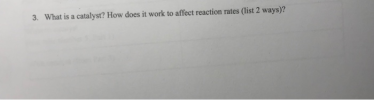 3. What is a catalyst? How does it work to affect reaction rates (list 2 ways)?
 1. Competition (40 points) a. Describe perfect competition, monopoly and oligopolies and the relationship between marginal costs, marginal revenue and the price levels at equilibrium within each type of these markets (Using graphs might be helpful). b. Under what conditions do oligopolies function like perfect competition or monopolies? Explain in detail. Can we ever observe perfectly competitive markets or tendency towards them in the real world? Why, why not? C.
 How does monopolistic competition differ from both perfect competition and monopoly? What is 'Excess Capacity' in Chamberlin's model / Depict long-run equilibrium in monopolistic competition diagrammatically.
 3. What is a catalyst? How does it work to affect reaction rates (list 2 ways)?
Most questions answered within 3 hours.
-
Where is the error in this code sequence?
String s1 = "Hello";
String s2 = "ello";...
asked 10 months ago -
Financial data for Joel de Paris, Inc., for last year
follow:
Joel de Paris, Inc.
Balance...
asked 10 months ago -
Consider this reaction:
Al2(SO4)3 (aq)+ BaCl3
(aq) Al2Cl6 (aq)- +
3BaSO4(s) . What is the...
asked 10 months ago -
Suppose that Savneet is considering increasing her
recent random sample from 20 car rentals to 40...
asked 10 months ago -
Trucks arrive at an unloading terminal at an average rate of 120
per hour.
Trucks arrive...
asked 10 months ago -
Why are methanol and ethanol completely soluble in water while
octanol is not very little soluble....
asked 10 months ago -
A facilities manager at a university reads in a research report
that the mean amount of...
asked 10 months ago -
When the CuSO4 is rehydrated by adding water to the anhydrous
compound, is this an endothermic...
asked 10 months ago -
A ray of sunlight is passing from diamond into crown glass; the
angle of incidence is...
asked 10 months ago -
A block of mass 0.249 kg is placed on top of a light, vertical
spring of...
asked 10 months ago -
how do the kidneys compensate in the presences of acidosis
a) trigger hyperventilate
b) reserve acid...
asked 10 months ago -
Question 501 pts
The rental rate of capital to the firm increases. Which of the
following...
asked 10 months ago