
Homework Answers
Add Answer to:
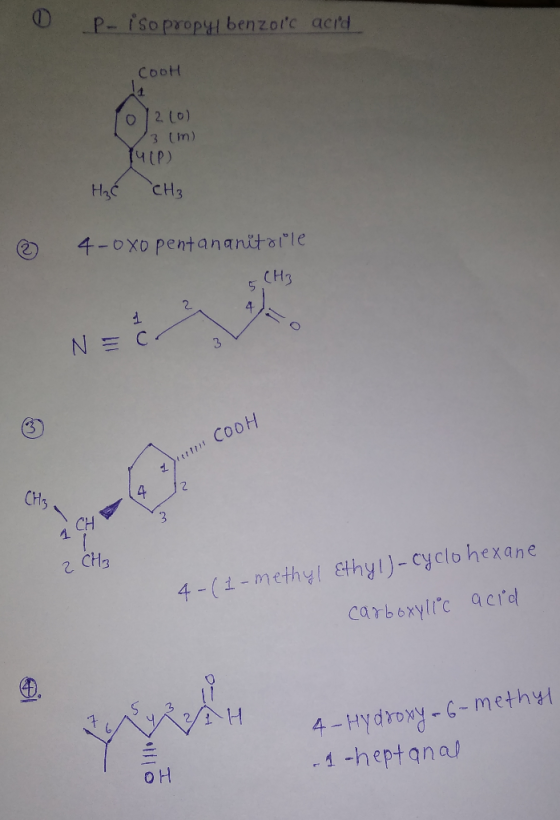
wirte the iupac name or the structural form p-isopropyl benzoic acid Acidop-isopropittenzeica. 4 өдөрentanonitrilo 14-oxopentanonitrile COOH...
Write the name IUPAC or the structural formula to complete the following table. p-isopropylbenzoic acid ácido...
 Write the name IUPAC or the structural formula to complete the
following table.
p-isopropylbenzoic acid ácido p-isopropilbenzoico 4-oxopentanonitrilo 4- oxopentanonitrile HC-CH OH
Write the name IUPAC or the structural formula to complete the
following table.
p-isopropylbenzoic acid ácido p-isopropilbenzoico 4-oxopentanonitrilo 4- oxopentanonitrile HC-CH OH
1. (48 pts, 4 pts each) Give an acceptable IUPAC name for the following compound: CH)...
 1. (48 pts, 4 pts each) Give an acceptable IUPAC name for the following compound: CH) i 0 CO,H CH, OH Font Font COOH CH,_ch, bi-ch, bi-CH, CN CH OH CHO Font соон NO 2. (36 pts, 4 pts each) Draw a structure for the following compounds: a. 2-Amino-2-methylbutanol b. 4-Hexynol C. 3-Methoxycycloheptanecarboxylic acid d. 2-Phenylethanol e. 3-Hydroxycyclopentanecarboxamide f. 4-Bromobenzaldehyde Font g. 6-Bromohexanoic acid h. 2, 3, 4-Hexanetriol L1-Decanthi 3. (16 pts, 4 pts each) Draw a structural formula for...
Question 14 4 pts For the following fatty acid molecules, which of the following is correct?...
 Question 14 4 pts For the following fatty acid molecules, which of the following is correct? Oleic acid CH-(CH2)-CH=CH(CH2),COOH Lauric acid CHECH COOH Arachidonic acid CH3(CH2).CH=CHCH2CH=CHCH2CH=CHCH2CH=CH(CH3),COOH Stearic acid CH-(CH2)76COOH Linoleic acid CH(CH2).CH=CHCH2CH=CH(CH2),COOH Oleic acid is a polyunsaturated fatty acid and lauric acid is a saturated fatty acid. O Both oleic acid and arachidonic acid are polyunsaturated fatty acids. Lauric acid is a saturated fatty acid and arachidonic acid is a polyunsaturated fatty acid. O Both lauric acid and stearic acid...
Compound A Compound B Give the IUPAC name for Compound A. 2. Give the IUPAC name...
 Compound A Compound B Give the IUPAC name for Compound A. 2. Give the IUPAC name for Compound B. 3. Which compound from above (Compound A or Compound B) is more soluble in water and why? 4. Which compound can be dehydrated to form a double bond (Compound A or Compound B)? Draw the most likely product of that dehydration. (Insert a picture of your drawing of the molecule or a scan of your drawing of the molecule) 5. Could...
help with question #7 pts) 1. Give the IUPAC name for the following compound: NH OH...
 help with question #7
pts) 1. Give the IUPAC name for the following compound: NH OH H3 CH-CH2-CH-CH2-CH, D 5-amino-3-Hexanol amn 4 3 2 2 pts) 2. Draw the structural formula for 2-amino-3-oxo-pentanal. H-CH₂-CH₂-C- CH₂ - CH3 2 pts) 3. Write the balanced chemical equation (using structural formulas) for the lissociation of diethylamine in water. CH₃-CH₂-N-CH₂-CH₃ + H₂O -> CH₃-CH ₂ - N - CH₂ +OH-CH3 CAN- | CH-CH2N-CH, - Lidocaine (Xylocaine) 3 pts) 4. Lidocaine (Xylocaine) is used as...
help with question #7
pts) 1. Give the IUPAC name for the following compound: NH OH H3 CH-CH2-CH-CH2-CH, D 5-amino-3-Hexanol amn 4 3 2 2 pts) 2. Draw the structural formula for 2-amino-3-oxo-pentanal. H-CH₂-CH₂-C- CH₂ - CH3 2 pts) 3. Write the balanced chemical equation (using structural formulas) for the lissociation of diethylamine in water. CH₃-CH₂-N-CH₂-CH₃ + H₂O -> CH₃-CH ₂ - N - CH₂ +OH-CH3 CAN- | CH-CH2N-CH, - Lidocaine (Xylocaine) 3 pts) 4. Lidocaine (Xylocaine) is used as...
Name or Draw the following compounds: COOL COOH -p-carboxybenzenesulfonic acid ? C(CH3)3 (13) 3. m-methoxyanisole? 4....
 Name or Draw the following compounds: COOL COOH -p-carboxybenzenesulfonic acid ? C(CH3)3 (13) 3. m-methoxyanisole? 4. 3,4-dimethoxyhenvaldyde? CHO OL OCH3 H2N ОСН,
what is the name of the enzyme that catalyzes the reaction shown below? 14.) (4 pts)...
 what is the name of the enzyme that catalyzes the reaction shown
below?
14.) (4 pts) What is the name of the enzyme that catalyzes the reaction shown below? Glyceraldehyde 3-P + Sedoheptulose 7-P. Xylulose 5-P + Ribose 5-P. This enzyme requires the following coenzyme. What is it? Draw the mechanism of this reaction converting reactants into products. Draw the structure of any relevant intermediates. You may use B-H and B: for the general acid / base groups. PUSH ARROWS!...
what is the name of the enzyme that catalyzes the reaction shown
below?
14.) (4 pts) What is the name of the enzyme that catalyzes the reaction shown below? Glyceraldehyde 3-P + Sedoheptulose 7-P. Xylulose 5-P + Ribose 5-P. This enzyme requires the following coenzyme. What is it? Draw the mechanism of this reaction converting reactants into products. Draw the structure of any relevant intermediates. You may use B-H and B: for the general acid / base groups. PUSH ARROWS!...
1) Name the following carboxylic acids (use both IUPAC and common names): ОН ОН (b) (c)...
 1) Name the following carboxylic acids (use both IUPAC and common names): ОН ОН (b) (c) ОН ОН (d) Br ОН ОН NH2 2) Draw the condensed and line structures for the following compounds (a) 3,4-dimethylhexanoic acid (b) Phenylacetic acid (c) 3,4-dinitrobenzoic acid (d) 2,2,3-triflurobutanoic acid (e) 3-hydroxybutanoic acid (1) o-hydroxybenzoic acid (g) a-aminopropionic acid 3) Name the following dicarboxylic acids (use both IUPAC and common names) Он (а) НО ОН НО. (b) он ОН ОН (d) ОН он ОН...
PLEASE ANSWER THIS IMMEDIATELY! a point Dorius will be awardea COOH COON *1. Which compound is...
 PLEASE ANSWER THIS IMMEDIATELY!
a point Dorius will be awardea COOH COON *1. Which compound is the strongest acid? COOH COONa. (B) | HOOC COOH . HOOC COOH 2. Which compound is most likely to form an enolate upon addition of lithium diisopropylamide (LDA) 1) C O COON COON 3. Which route will produce Target starting with ethyl acetoacetate. (The IUPAC name for styrene oxide is 2-phenyloxirane) 1. NaOEt (2 eq) 1. LDA (2 eq) 1. LDA (2 ) 1....
PLEASE ANSWER THIS IMMEDIATELY!
a point Dorius will be awardea COOH COON *1. Which compound is the strongest acid? COOH COONa. (B) | HOOC COOH . HOOC COOH 2. Which compound is most likely to form an enolate upon addition of lithium diisopropylamide (LDA) 1) C O COON COON 3. Which route will produce Target starting with ethyl acetoacetate. (The IUPAC name for styrene oxide is 2-phenyloxirane) 1. NaOEt (2 eq) 1. LDA (2 eq) 1. LDA (2 ) 1....
What is the correct name for the following compound? d) 5-oxo-3-octenoic acid What is the defining...
 What is the correct name for the following compound? d) 5-oxo-3-octenoic acid What is the defining functional group of a carboxylic acid? a) an-H attached to a carbonyl group b) an-H attached to a carbon-carbon triple bond c) an-OH attached to a carbonyl group d) an -OH group attached to a O-C double bond e) an-OH group attached to an aromatic ring To convert a carboxylic acid to an aldehyde a) convert the acid to an acid chloride, then use...
 Write the name IUPAC or the structural formula to complete the
following table.
p-isopropylbenzoic acid ácido p-isopropilbenzoico 4-oxopentanonitrilo 4- oxopentanonitrile HC-CH OH
Write the name IUPAC or the structural formula to complete the
following table.
p-isopropylbenzoic acid ácido p-isopropilbenzoico 4-oxopentanonitrilo 4- oxopentanonitrile HC-CH OH
 1. (48 pts, 4 pts each) Give an acceptable IUPAC name for the following compound: CH) i 0 CO,H CH, OH Font Font COOH CH,_ch, bi-ch, bi-CH, CN CH OH CHO Font соон NO 2. (36 pts, 4 pts each) Draw a structure for the following compounds: a. 2-Amino-2-methylbutanol b. 4-Hexynol C. 3-Methoxycycloheptanecarboxylic acid d. 2-Phenylethanol e. 3-Hydroxycyclopentanecarboxamide f. 4-Bromobenzaldehyde Font g. 6-Bromohexanoic acid h. 2, 3, 4-Hexanetriol L1-Decanthi 3. (16 pts, 4 pts each) Draw a structural formula for...
 Question 14 4 pts For the following fatty acid molecules, which of the following is correct? Oleic acid CH-(CH2)-CH=CH(CH2),COOH Lauric acid CHECH COOH Arachidonic acid CH3(CH2).CH=CHCH2CH=CHCH2CH=CHCH2CH=CH(CH3),COOH Stearic acid CH-(CH2)76COOH Linoleic acid CH(CH2).CH=CHCH2CH=CH(CH2),COOH Oleic acid is a polyunsaturated fatty acid and lauric acid is a saturated fatty acid. O Both oleic acid and arachidonic acid are polyunsaturated fatty acids. Lauric acid is a saturated fatty acid and arachidonic acid is a polyunsaturated fatty acid. O Both lauric acid and stearic acid...
 Compound A Compound B Give the IUPAC name for Compound A. 2. Give the IUPAC name for Compound B. 3. Which compound from above (Compound A or Compound B) is more soluble in water and why? 4. Which compound can be dehydrated to form a double bond (Compound A or Compound B)? Draw the most likely product of that dehydration. (Insert a picture of your drawing of the molecule or a scan of your drawing of the molecule) 5. Could...
 help with question #7
pts) 1. Give the IUPAC name for the following compound: NH OH H3 CH-CH2-CH-CH2-CH, D 5-amino-3-Hexanol amn 4 3 2 2 pts) 2. Draw the structural formula for 2-amino-3-oxo-pentanal. H-CH₂-CH₂-C- CH₂ - CH3 2 pts) 3. Write the balanced chemical equation (using structural formulas) for the lissociation of diethylamine in water. CH₃-CH₂-N-CH₂-CH₃ + H₂O -> CH₃-CH ₂ - N - CH₂ +OH-CH3 CAN- | CH-CH2N-CH, - Lidocaine (Xylocaine) 3 pts) 4. Lidocaine (Xylocaine) is used as...
help with question #7
pts) 1. Give the IUPAC name for the following compound: NH OH H3 CH-CH2-CH-CH2-CH, D 5-amino-3-Hexanol amn 4 3 2 2 pts) 2. Draw the structural formula for 2-amino-3-oxo-pentanal. H-CH₂-CH₂-C- CH₂ - CH3 2 pts) 3. Write the balanced chemical equation (using structural formulas) for the lissociation of diethylamine in water. CH₃-CH₂-N-CH₂-CH₃ + H₂O -> CH₃-CH ₂ - N - CH₂ +OH-CH3 CAN- | CH-CH2N-CH, - Lidocaine (Xylocaine) 3 pts) 4. Lidocaine (Xylocaine) is used as...
 Name or Draw the following compounds: COOL COOH -p-carboxybenzenesulfonic acid ? C(CH3)3 (13) 3. m-methoxyanisole? 4. 3,4-dimethoxyhenvaldyde? CHO OL OCH3 H2N ОСН,
 what is the name of the enzyme that catalyzes the reaction shown
below?
14.) (4 pts) What is the name of the enzyme that catalyzes the reaction shown below? Glyceraldehyde 3-P + Sedoheptulose 7-P. Xylulose 5-P + Ribose 5-P. This enzyme requires the following coenzyme. What is it? Draw the mechanism of this reaction converting reactants into products. Draw the structure of any relevant intermediates. You may use B-H and B: for the general acid / base groups. PUSH ARROWS!...
what is the name of the enzyme that catalyzes the reaction shown
below?
14.) (4 pts) What is the name of the enzyme that catalyzes the reaction shown below? Glyceraldehyde 3-P + Sedoheptulose 7-P. Xylulose 5-P + Ribose 5-P. This enzyme requires the following coenzyme. What is it? Draw the mechanism of this reaction converting reactants into products. Draw the structure of any relevant intermediates. You may use B-H and B: for the general acid / base groups. PUSH ARROWS!...
 1) Name the following carboxylic acids (use both IUPAC and common names): ОН ОН (b) (c) ОН ОН (d) Br ОН ОН NH2 2) Draw the condensed and line structures for the following compounds (a) 3,4-dimethylhexanoic acid (b) Phenylacetic acid (c) 3,4-dinitrobenzoic acid (d) 2,2,3-triflurobutanoic acid (e) 3-hydroxybutanoic acid (1) o-hydroxybenzoic acid (g) a-aminopropionic acid 3) Name the following dicarboxylic acids (use both IUPAC and common names) Он (а) НО ОН НО. (b) он ОН ОН (d) ОН он ОН...
 PLEASE ANSWER THIS IMMEDIATELY!
a point Dorius will be awardea COOH COON *1. Which compound is the strongest acid? COOH COONa. (B) | HOOC COOH . HOOC COOH 2. Which compound is most likely to form an enolate upon addition of lithium diisopropylamide (LDA) 1) C O COON COON 3. Which route will produce Target starting with ethyl acetoacetate. (The IUPAC name for styrene oxide is 2-phenyloxirane) 1. NaOEt (2 eq) 1. LDA (2 eq) 1. LDA (2 ) 1....
PLEASE ANSWER THIS IMMEDIATELY!
a point Dorius will be awardea COOH COON *1. Which compound is the strongest acid? COOH COONa. (B) | HOOC COOH . HOOC COOH 2. Which compound is most likely to form an enolate upon addition of lithium diisopropylamide (LDA) 1) C O COON COON 3. Which route will produce Target starting with ethyl acetoacetate. (The IUPAC name for styrene oxide is 2-phenyloxirane) 1. NaOEt (2 eq) 1. LDA (2 eq) 1. LDA (2 ) 1....
 What is the correct name for the following compound? d) 5-oxo-3-octenoic acid What is the defining functional group of a carboxylic acid? a) an-H attached to a carbonyl group b) an-H attached to a carbon-carbon triple bond c) an-OH attached to a carbonyl group d) an -OH group attached to a O-C double bond e) an-OH group attached to an aromatic ring To convert a carboxylic acid to an aldehyde a) convert the acid to an acid chloride, then use...
Most questions answered within 3 hours.
-
Where is the error in this code sequence?
String s1 = "Hello";
String s2 = "ello";...
asked 10 months ago -
Financial data for Joel de Paris, Inc., for last year
follow:
Joel de Paris, Inc.
Balance...
asked 10 months ago -
Consider this reaction:
Al2(SO4)3 (aq)+ BaCl3
(aq) Al2Cl6 (aq)- +
3BaSO4(s) . What is the...
asked 10 months ago -
Suppose that Savneet is considering increasing her
recent random sample from 20 car rentals to 40...
asked 10 months ago -
Trucks arrive at an unloading terminal at an average rate of 120
per hour.
Trucks arrive...
asked 10 months ago -
Why are methanol and ethanol completely soluble in water while
octanol is not very little soluble....
asked 10 months ago -
A facilities manager at a university reads in a research report
that the mean amount of...
asked 10 months ago -
When the CuSO4 is rehydrated by adding water to the anhydrous
compound, is this an endothermic...
asked 10 months ago -
A ray of sunlight is passing from diamond into crown glass; the
angle of incidence is...
asked 10 months ago -
A block of mass 0.249 kg is placed on top of a light, vertical
spring of...
asked 10 months ago -
how do the kidneys compensate in the presences of acidosis
a) trigger hyperventilate
b) reserve acid...
asked 10 months ago -
Question 501 pts
The rental rate of capital to the firm increases. Which of the
following...
asked 10 months ago