
Homework Answers
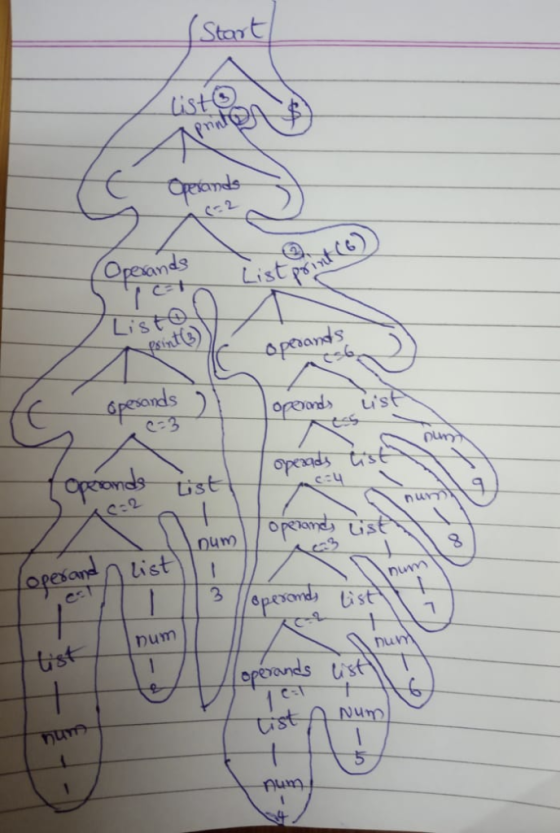
It will print 3 6 2. Please comment for further help.
Add Answer to:
4. (Syntax-directed translation) Assume that a bottom-up parser is used for the following grammar. follows? (1...
- 4. (Syntax-directed translation) Assume that a bottom-up parser is used for the following grammar. What...
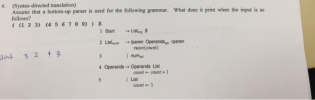 - 4. (Syntax-directed translation) Assume that a bottom-up parser is used for the following grammar. What does it print when the input is as follows? ( (1 2 3) (4 5 6 7 8 9) ) $. 1 Start Lista $ 2 Lista! Iparen Operands, paren PRINT(count) Hint 3 2 4 3 3 num 4 Operands-Operands List count count +1 5 List count1
The language generated by the grammar in Figure 7.8 uses the terminal x to introduce the...
 The language generated by the grammar in Figure 7.8 uses the
terminal x to introduce the base. Amore common convention is to
separate the base from the string of digits by some terminal
symbol. Instead of x 8 4 3 1 to represent , a language following
the common convention would use 8 x 4 3 1.
(a) Design an LALR(1) grammar for such a language and specify the
semantic actions that compute the string’s numeric value. In your
solution,...
The language generated by the grammar in Figure 7.8 uses the
terminal x to introduce the base. Amore common convention is to
separate the base from the string of digits by some terminal
symbol. Instead of x 8 4 3 1 to represent , a language following
the common convention would use 8 x 4 3 1.
(a) Design an LALR(1) grammar for such a language and specify the
semantic actions that compute the string’s numeric value. In your
solution,...
1 - Semantics - Attributes Grammar (25 points) Using the following grammar write an attributes grammar...
 1 - Semantics - Attributes Grammar (25 points) Using the following grammar write an attributes grammar that can calculate the decimal value of an octal number. Grammar: number = list list = list octal octal octal = '0'|'1'|'2'|'3'|'4'|'5'|'6'|'7' Notes: An octal number consists of octal digits, i.e. O to 7. The following example shows how to convert the octal 67 to its equivalent decimal. The symbol star represents multiplication. 67 = 6*87 + 7* 8° = 6 * 8 +...
Please help me with the coding for LL(1)!! The given grammar was: P → PL |...
 Please help me with the coding for LL(1)!!
The given grammar was:
P → PL | L
L → N; | M; | C
N → print E
M → print "W"
W → TW | ε
C → if E {P} | if E {P} else {P}
E → (EOE) | V (note: this has a variable O)
O → + | - | * V → 0 | 1 | 2 | 3 (note: this has a terminal...
Please help me with the coding for LL(1)!!
The given grammar was:
P → PL | L
L → N; | M; | C
N → print E
M → print "W"
W → TW | ε
C → if E {P} | if E {P} else {P}
E → (EOE) | V (note: this has a variable O)
O → + | - | * V → 0 | 1 | 2 | 3 (note: this has a terminal...
Questin 1 (CO 2) Which of the following is not a valid name in python? last_name...
Questin 1 (CO 2) Which of the following is not a valid name in python? last_name lastName last name lname Question 2 (CO 3) How many times will “Hello World” be displayed after the following code executes? num=2 while num<12: print("Hello world") num+=2 2 12 5 4 Question 3 (CO 1) The following code contains an error, what type of error is it and what line number is it? 1 count=1 2 while count<4 3 print("count = ",...
I have a python project that requires me to make a password saver. The major part...
I have a python project that requires me to make a password saver. The major part of the code is already giving. I am having trouble executing option 2 and 3. Some guidance will be appreciated. Below is the code giving to me. import csv import sys #The password list - We start with it populated for testing purposes passwords = [["yahoo","XqffoZeo"],["google","CoIushujSetu"]] #The password file name to store the passwords to passwordFileName = "samplePasswordFile" #The encryption key for the caesar...
1) Create an LR(0) parse table for the following grammar. Show all steps (creating closures, the...
1) Create an LR(0) parse table for the following grammar. Show all steps (creating closures, the DFA, the transition table, and finally the parse table): E -> E + T | E * T | T T -> ( E ) | id 2) Show a complete bottom-up parse, including the parse stack contents, input string, and action for the string below using the parse table you created in step 6. Think about how I went through this in class....
Given the following function: int fun1(int count){ int Num ; for (i = 0; i <...
Given the following function: int fun1(int count){ int Num ; for (i = 0; i < count; ++i) { cin >> Value; if (i == 0) Num = Value; else if (Value > Num) Num = Value; } return Num ; } What is the output of the following C++ code segment if the following list is entered? (Input list: 5 -15 -90 -2 -60 -30) int Num = 0 , Value, numValues; cin >> numValues; if (numValues > 0) cout...
4) [15 points total (5 points each)] Assume you are given a sorted array A of n numbers, where A is indexed from 1 up t...
 4) [15 points total (5 points each)] Assume you are given a sorted array A of n numbers, where A is indexed from 1 up to n, anda number num which we wish to insert into A, in the proper sorted position. The function Search finds the minimum index i such that num should be inserted into Ali]. It searches the array sequentially until it finds the location i. Another function MakeRoom moves A[i], .., AIn] to Ali+1]...AIn+1] same sort...
A. Construct a heap for the list ( 2, 5, 6, 4, 3, 1, 8, 7...
A. Construct a heap for the list ( 2, 5, 6, 4, 3, 1, 8, 7 ) by the bottom-up algorithm B. Construct a heap for the list ( 2, 5, 6, 4, 3, 1, 8, 7 ) by successive key imsertions (top-down algorithm) C. Is is true that the bottom-up and top-dowj alogorthms yield the same heap for the same input?
 - 4. (Syntax-directed translation) Assume that a bottom-up parser is used for the following grammar. What does it print when the input is as follows? ( (1 2 3) (4 5 6 7 8 9) ) $. 1 Start Lista $ 2 Lista! Iparen Operands, paren PRINT(count) Hint 3 2 4 3 3 num 4 Operands-Operands List count count +1 5 List count1
 The language generated by the grammar in Figure 7.8 uses the
terminal x to introduce the base. Amore common convention is to
separate the base from the string of digits by some terminal
symbol. Instead of x 8 4 3 1 to represent , a language following
the common convention would use 8 x 4 3 1.
(a) Design an LALR(1) grammar for such a language and specify the
semantic actions that compute the string’s numeric value. In your
solution,...
The language generated by the grammar in Figure 7.8 uses the
terminal x to introduce the base. Amore common convention is to
separate the base from the string of digits by some terminal
symbol. Instead of x 8 4 3 1 to represent , a language following
the common convention would use 8 x 4 3 1.
(a) Design an LALR(1) grammar for such a language and specify the
semantic actions that compute the string’s numeric value. In your
solution,...
 1 - Semantics - Attributes Grammar (25 points) Using the following grammar write an attributes grammar that can calculate the decimal value of an octal number. Grammar: number = list list = list octal octal octal = '0'|'1'|'2'|'3'|'4'|'5'|'6'|'7' Notes: An octal number consists of octal digits, i.e. O to 7. The following example shows how to convert the octal 67 to its equivalent decimal. The symbol star represents multiplication. 67 = 6*87 + 7* 8° = 6 * 8 +...
 Please help me with the coding for LL(1)!!
The given grammar was:
P → PL | L
L → N; | M; | C
N → print E
M → print "W"
W → TW | ε
C → if E {P} | if E {P} else {P}
E → (EOE) | V (note: this has a variable O)
O → + | - | * V → 0 | 1 | 2 | 3 (note: this has a terminal...
Please help me with the coding for LL(1)!!
The given grammar was:
P → PL | L
L → N; | M; | C
N → print E
M → print "W"
W → TW | ε
C → if E {P} | if E {P} else {P}
E → (EOE) | V (note: this has a variable O)
O → + | - | * V → 0 | 1 | 2 | 3 (note: this has a terminal...
 4) [15 points total (5 points each)] Assume you are given a sorted array A of n numbers, where A is indexed from 1 up to n, anda number num which we wish to insert into A, in the proper sorted position. The function Search finds the minimum index i such that num should be inserted into Ali]. It searches the array sequentially until it finds the location i. Another function MakeRoom moves A[i], .., AIn] to Ali+1]...AIn+1] same sort...
Most questions answered within 3 hours.
-
Where is the error in this code sequence?
String s1 = "Hello";
String s2 = "ello";...
asked 10 months ago -
Financial data for Joel de Paris, Inc., for last year
follow:
Joel de Paris, Inc.
Balance...
asked 10 months ago -
Consider this reaction:
Al2(SO4)3 (aq)+ BaCl3
(aq) Al2Cl6 (aq)- +
3BaSO4(s) . What is the...
asked 10 months ago -
Suppose that Savneet is considering increasing her
recent random sample from 20 car rentals to 40...
asked 10 months ago -
Trucks arrive at an unloading terminal at an average rate of 120
per hour.
Trucks arrive...
asked 10 months ago -
Why are methanol and ethanol completely soluble in water while
octanol is not very little soluble....
asked 10 months ago -
A facilities manager at a university reads in a research report
that the mean amount of...
asked 10 months ago -
When the CuSO4 is rehydrated by adding water to the anhydrous
compound, is this an endothermic...
asked 10 months ago -
A ray of sunlight is passing from diamond into crown glass; the
angle of incidence is...
asked 10 months ago -
A block of mass 0.249 kg is placed on top of a light, vertical
spring of...
asked 10 months ago -
how do the kidneys compensate in the presences of acidosis
a) trigger hyperventilate
b) reserve acid...
asked 10 months ago -
Question 501 pts
The rental rate of capital to the firm increases. Which of the
following...
asked 10 months ago