
Homework Answers
Add Answer to:
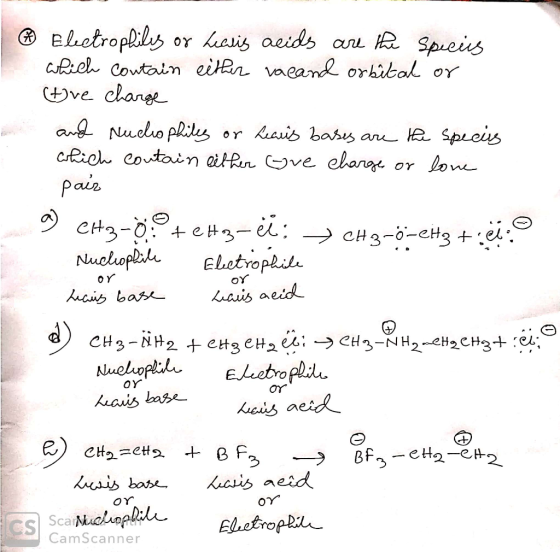
1. Label your assigned reactants in these acid-base reactions as Lewis acids (electrophiles) or Lewis bases...
reactants are in second picture! circled Label your assigned reactants in these acid-base reactions as Lewis...
 reactants are in second picture! circled
Label your assigned reactants in these acid-base reactions as Lewis acids (electrophiles) or Lewis bases (nucleophiles) 2. The following compound can become protonated on any of the three N atoms. However, one of the N is much more basic than the others. a. Draw the molecule with all three N protonated and then draw resonance structures for this protonated molecule. NH CH-NH-C NH b. For each resonance structure, give the formal charges on each...
reactants are in second picture! circled
Label your assigned reactants in these acid-base reactions as Lewis acids (electrophiles) or Lewis bases (nucleophiles) 2. The following compound can become protonated on any of the three N atoms. However, one of the N is much more basic than the others. a. Draw the molecule with all three N protonated and then draw resonance structures for this protonated molecule. NH CH-NH-C NH b. For each resonance structure, give the formal charges on each...
20. 3 marks) Add charges to the following molecules where necessary c) CH3-N-H CH3H CH3 21....
 20. 3 marks) Add charges to the following molecules where necessary c) CH3-N-H CH3H CH3 21. (2 marks) Label the reactants in these acid-base reactions as "LA" for Lewis Acids (electrophiles) or "LB" for Lewis Bases (nucleophiles). reactions. Used curved arrows to show the movement of electron pairs in the CH3-NH, CH-CH2-cl: CH-NH2-CH2-CH3 + --+ + :C1: Cl: -
Identify the Lewis acid and Lewis base in each of the following reactions. Cl^- +AlCl3 →...
 Identify the Lewis acid and Lewis base in each of the following reactions.
Cl^- +AlCl3 → AlCl^-4
BF3 +F^- → BF^-4
NH3 + H^+ → NH^+4
Identify the Lewis acid and Lewis base in each of the following reactions.
Cl^- +AlCl3 → AlCl^-4
BF3 +F^- → BF^-4
NH3 + H^+ → NH^+4
LOTCUTU. Problem 1: Label the acid and base, and the conjugate acid and base in the...
 LOTCUTU. Problem 1: Label the acid and base, and the conjugate acid and base in the following reactions. a. HCI + H2O ch- + H20+ O=0 G-CH2 OCH, + b. CH 6 CH H + CH2OH CH3 Problem 5: Draw the products formed from the acid-base reaction of HCl with each compound, a. CH3OH b. (CH3CH2)20 C. (CH)3 d. [NH
Using the Lewis concept of acids and bases, identify the Lewis acid and base in each...
Using the Lewis concept of acids and bases, identify the Lewis acid and base in each of the following reactions: Ni(NO3)3(s)+6H2O(l)→Ni(H2O)63+(aq)+3NO3−(aq) Can someone explain to me why Ni(NO3)3 is a lewis acid if it's accepting h2o and why h2o is a lewis base if it's giving itself instead of receiving an e-? CH3NH2(g)+HBr(g)→CH3NH3Br(s) Can someone also explain to me why HBR is a lewis base it's donating a H+? And why CH3NH2 is a lewis acid for accepting a H+?...
An Acid-Base Titration Lab Define Lewis acids and bases. Give an example of each. Based on...
An Acid-Base Titration Lab Define Lewis acids and bases. Give an example of each. Based on the Brønsted-Lowry theory of acids and bases, complete the equations for the following acid-base reactions. In your answer be sure to indicate each conjugate acid-base pair: HNO3 + OH- à CH3NH2 + H2O à OH- + HPO4-2 à When discussing the theories of acids and bases, the Arrhenius, Brønsted-Lowry, and Lewis theories will each describe compounds in their own unique and different way. Based...
3. Label the reactants as the Lewis base or the Lewis acid. How are these terms...
 3. Label the reactants as the Lewis base or the Lewis acid. How are these terms related to nucleophile and electrophile? C-A CHOHCH, C- 2-0-CH, CICH (C) (A) (B) 4. What order (1st, 2nd, 3rd...)/mechanism (SN1/SN2) would you propose if given this rate equation? Rate = k [CH3CH2Cl] [N3]
1. Label the acids, bases, conjugate acids, and conjugate bases in the reactions below: a. Na2CO3(aq)...
 1. Label the acids, bases, conjugate acids, and conjugate bases in the reactions below: a. Na2CO3(aq) + 2 HCl (aq) H2CO, (aq) + 2 NaCl (aq) b. NH” (aq) + CN + NH3 (aq) + HCN (aq) c. Na2HPO4 (aq) + NaOH(aq) - Na PO. (aq) + H20 (1) d. H2O(l) + NaH (s) H2(g) + NaOH(aq) 2. Calculate the pH of the following solutions: a. [H,O') = 4.5 x 10° b. 12 M HCl C. 0.13 M NaOH d....
of Acids and Bases e three ways in which to define acids and bases: the Arrhenius...
 of Acids and Bases e three ways in which to define acids and bases: the Arrhenius concept, the Bronsted-Lowry concept, and the Lewis cc d in water, increase the concentration of the H ion; Arrhenius bases are substances that, when dissolved in water, inc e substances that can donate a proton (H) to another substance; Bronsted-Lowry bases are substances that can acce r, and a Lewis base is an electron-pair donor. Part A Using the Arrhenius concept of acids and...
Identify the Lewis acid and Lewis base from among the reactants in each of the following...
 Identify the Lewis acid and Lewis base from among the reactants in each of the following equations. a. Fe^3+(aq) + 6H_2O(l) Fe(H_20)^3+_6 (aq) b. Zn^2+(aq) + 4(NH_3) (aq) Zn(NH_3)^2+_4 (aq) c. (CH_3)_3N(g) + BF_3 (g) (CH_3)_3NBF_3(aq) Fill in the blank for the following. d. Non-metal oxides are _____ acids. e. Metal oxides are _____ bases. f. Non-metal hydroxides are _____ acids. g. Metal hydroxides are _____ bases.
 reactants are in second picture! circled
Label your assigned reactants in these acid-base reactions as Lewis acids (electrophiles) or Lewis bases (nucleophiles) 2. The following compound can become protonated on any of the three N atoms. However, one of the N is much more basic than the others. a. Draw the molecule with all three N protonated and then draw resonance structures for this protonated molecule. NH CH-NH-C NH b. For each resonance structure, give the formal charges on each...
reactants are in second picture! circled
Label your assigned reactants in these acid-base reactions as Lewis acids (electrophiles) or Lewis bases (nucleophiles) 2. The following compound can become protonated on any of the three N atoms. However, one of the N is much more basic than the others. a. Draw the molecule with all three N protonated and then draw resonance structures for this protonated molecule. NH CH-NH-C NH b. For each resonance structure, give the formal charges on each...
 20. 3 marks) Add charges to the following molecules where necessary c) CH3-N-H CH3H CH3 21. (2 marks) Label the reactants in these acid-base reactions as "LA" for Lewis Acids (electrophiles) or "LB" for Lewis Bases (nucleophiles). reactions. Used curved arrows to show the movement of electron pairs in the CH3-NH, CH-CH2-cl: CH-NH2-CH2-CH3 + --+ + :C1: Cl: -
 Identify the Lewis acid and Lewis base in each of the following reactions.
Cl^- +AlCl3 → AlCl^-4
BF3 +F^- → BF^-4
NH3 + H^+ → NH^+4
Identify the Lewis acid and Lewis base in each of the following reactions.
Cl^- +AlCl3 → AlCl^-4
BF3 +F^- → BF^-4
NH3 + H^+ → NH^+4
 LOTCUTU. Problem 1: Label the acid and base, and the conjugate acid and base in the following reactions. a. HCI + H2O ch- + H20+ O=0 G-CH2 OCH, + b. CH 6 CH H + CH2OH CH3 Problem 5: Draw the products formed from the acid-base reaction of HCl with each compound, a. CH3OH b. (CH3CH2)20 C. (CH)3 d. [NH
 3. Label the reactants as the Lewis base or the Lewis acid. How are these terms related to nucleophile and electrophile? C-A CHOHCH, C- 2-0-CH, CICH (C) (A) (B) 4. What order (1st, 2nd, 3rd...)/mechanism (SN1/SN2) would you propose if given this rate equation? Rate = k [CH3CH2Cl] [N3]
 1. Label the acids, bases, conjugate acids, and conjugate bases in the reactions below: a. Na2CO3(aq) + 2 HCl (aq) H2CO, (aq) + 2 NaCl (aq) b. NH” (aq) + CN + NH3 (aq) + HCN (aq) c. Na2HPO4 (aq) + NaOH(aq) - Na PO. (aq) + H20 (1) d. H2O(l) + NaH (s) H2(g) + NaOH(aq) 2. Calculate the pH of the following solutions: a. [H,O') = 4.5 x 10° b. 12 M HCl C. 0.13 M NaOH d....
 of Acids and Bases e three ways in which to define acids and bases: the Arrhenius concept, the Bronsted-Lowry concept, and the Lewis cc d in water, increase the concentration of the H ion; Arrhenius bases are substances that, when dissolved in water, inc e substances that can donate a proton (H) to another substance; Bronsted-Lowry bases are substances that can acce r, and a Lewis base is an electron-pair donor. Part A Using the Arrhenius concept of acids and...
 Identify the Lewis acid and Lewis base from among the reactants in each of the following equations. a. Fe^3+(aq) + 6H_2O(l) Fe(H_20)^3+_6 (aq) b. Zn^2+(aq) + 4(NH_3) (aq) Zn(NH_3)^2+_4 (aq) c. (CH_3)_3N(g) + BF_3 (g) (CH_3)_3NBF_3(aq) Fill in the blank for the following. d. Non-metal oxides are _____ acids. e. Metal oxides are _____ bases. f. Non-metal hydroxides are _____ acids. g. Metal hydroxides are _____ bases.
Most questions answered within 3 hours.
-
Where is the error in this code sequence?
String s1 = "Hello";
String s2 = "ello";...
asked 10 months ago -
Financial data for Joel de Paris, Inc., for last year
follow:
Joel de Paris, Inc.
Balance...
asked 10 months ago -
Consider this reaction:
Al2(SO4)3 (aq)+ BaCl3
(aq) Al2Cl6 (aq)- +
3BaSO4(s) . What is the...
asked 10 months ago -
Suppose that Savneet is considering increasing her
recent random sample from 20 car rentals to 40...
asked 10 months ago -
Trucks arrive at an unloading terminal at an average rate of 120
per hour.
Trucks arrive...
asked 10 months ago -
Why are methanol and ethanol completely soluble in water while
octanol is not very little soluble....
asked 10 months ago -
A facilities manager at a university reads in a research report
that the mean amount of...
asked 10 months ago -
When the CuSO4 is rehydrated by adding water to the anhydrous
compound, is this an endothermic...
asked 10 months ago -
A ray of sunlight is passing from diamond into crown glass; the
angle of incidence is...
asked 10 months ago -
A block of mass 0.249 kg is placed on top of a light, vertical
spring of...
asked 10 months ago -
how do the kidneys compensate in the presences of acidosis
a) trigger hyperventilate
b) reserve acid...
asked 10 months ago -
Question 501 pts
The rental rate of capital to the firm increases. Which of the
following...
asked 10 months ago