Transactions. Consider an ATM system. We have 2 transactions. T1: withdraw $50 and T2: withdraw $100....
- Transactions. Consider an ATM system.
We have 2 transactions. T1: withdraw $50 and T2: withdraw $100. We consider concurrent executions of the transactions. Which schedule(s) is (are) serializable? Explain why.
- T2 reads the balance.
T1 reads the balance.
T2 withdraw $100.
T1 withdraw $50.
- T2 reads the balance.
T2 withdraw $100.
T1 reads the balance.
T1 withdraw $50.
- T2 reads the balance.
T1 reads the balance.
T2 withdraw $100.
T1 withdraw $50.
Homework Answers
to check for the serializability one must draw a precedense graph of transaction and check if there is any loop in graph the it is not serializable .
the graph contain vertex as no of different transaction and edges are drawn if any conflicts are found .
various conflicts are :
1] read -write
2] write- read
3] write-write
** TEXT GIVEN IN QUESTION IS CONVERTED INTO TABLE:
so ,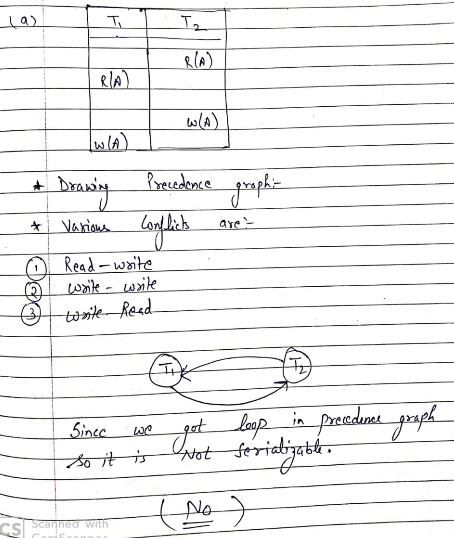
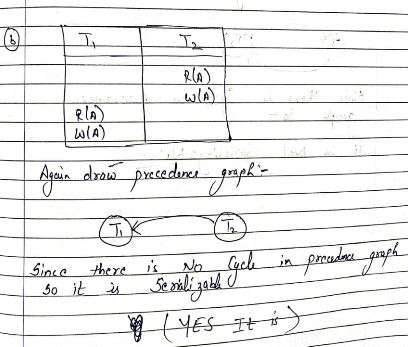
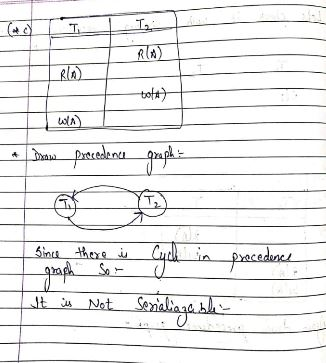
for drawing vertex stand in one coloumn and find the conflict in another coloumn and if found draw a vertex. dont found conflict in same coloumn.
Add Answer to:
Transactions. Consider an ATM system.
We have 2 transactions. T1: withdraw
$50 and T2: withdraw $100....
Consider the following schedule that performs actions taken by transactions T1 and T2 on database objects...
Consider the following schedule that performs actions taken by transactions T1 and T2 on database objects A and B : T1: S(A), R(A), X(B), U(A), R(B),W(B), Commit: U(B) T2: S(B), R(B), X(A), U(B), R(A), W(A), Commit: U(A) Because Strict 2PL is using, this schedule is guaranteed to be conflict serializable. A: True B:False
SQL question Consider the three transactions T1, T2 and T3, and the schedules S1, S2, S3...
SQL question Consider the three transactions T1, T2 and T3, and the schedules S1, S2, S3 and S4 given below. Which of the schedules is (conflict) serializable? The subscript for each database operation in a schedule denotes the transaction number for that operation. For each schedule, show all conflicts, draw the precedence graph, determine and write down if it is serializable or not, and the equivalent serial schedules if exist. T1: r1(x); w1(x); T2: r2(x); T3: r3(x); w3(x); S1: r1(x);...
-Advanced Database- Consider the following transaction schedule, where time increases from top to bottom. T1 T2...
-Advanced Database- Consider the following transaction schedule, where time increases from top to bottom. T1 T2 T3 T4 Read (X) Read(Y) Read(Z) Read(Y) Write(Y) Write(Z) Read(U) Read(Y) Write(Y) Read(Z) Write(Z) Read(U) Write(U) Answer the following questions: Draw the precedence graph of the above schedule. Is this schedule conflict serializable? If yes, show what serial schedule(s) it is equivalent to. If not, explain why. Is this schedule view serializable? If yes, show what serial schedule(s) it is equivalent to. If not,...
2. Given the following three transactions T1 = r1(x); w1(y); T2 = r2(z); r2(y); w2(y); w2(x);...
2. Given the following three transactions T1 = r1(x); w1(y); T2 = r2(z); r2(y); w2(y); w2(x); T3 = r3(z); w3(x); r3(y); Consider the schedule S = r1(x); r3(z); r2(z); w3(x); r2(y); r3(y); w2(y); w1(y); w2(x); a. Draw the precedence graph of schedule S, and label each edge with data item(s). b. Based on the precedence graph, determine whether S is conflict serializable and justify your answer. If it is serializable, specify all possible equivalent serial schedule(s).
Question 5. (20pts) (Briefly justify your answer) 1) Consider three transactions: T1, T2 and T3. Draw...
 Question 5. (20pts) (Briefly justify your answer) 1) Consider three transactions: T1, T2 and T3. Draw the precedence graph for the following schedule consisting of these three transactions and determine whether it is conflict serializable a) (5points) S: R1(X); R3(Z); W2(X); RI(Z); R3(Y); W2(Y), R3(Z), W1(Z), b) (5points) S: RI(X); R3(Z); W20x); RI(Y); R2(Y); W3(Y); R3(Z); WI(Z);
2. Given the following three transactions T1 = r1(x); w1(y); T2 = r2(z); r2(y); w2(y); w2(x); T3 ...
2. Given the following three transactions T1 = r1(x); w1(y); T2 = r2(z); r2(y); w2(y); w2(x); T3 = r3(z); w3(x); r3(y); Consider the schedule S = r1(x); r3(z); r2(z); w3(x); r2(y); r3(y); w2(y); w1(y); w2(x); a. Draw the precedence graph of schedule S, and label each edge with data item(s). b. Based on the precedence graph, determine whether S is conflict serializable and justify your answer. If it is serializable, specify all possible equivalent serial schedule(s).
1. What is the difference between Two-Phase Locking (2PL) and Strict Two-Phase Locking? What condition to Strict 2PL prevent that 2PL does not prevent? 2. What are deadlocks? What are two techniques...
 1. What is the difference between Two-Phase Locking (2PL) and Strict Two-Phase Locking? What condition to Strict 2PL prevent that 2PL does not prevent? 2. What are deadlocks? What are two techniques for detecting and resolving deadlocks? 3. In the figure below, R(X, y) means read database item X into variable y and W(X, y) means write variable y into database item y. Column T1 shows transaction T1's operations and column T2 shows T2's operations. Columns Aand_B show the values...
Consider the following order of operation requests from transactions T1. T2. T3 r1 (A) r2 (A)...
 Consider the following order of operation requests from transactions T1. T2. T3 r1 (A) r2 (A) r3 (A) r1 (B) r2 (B) w1 (B) w2 (A) Show the resulting schedule table when we have a scheduler that supports shared exclusive, and update locks.
Four transactions are presently running: (The abbreviation R(A) means Read(A), and so on) • T1: R(A),R(B),R(J),W(A),W(B),R(D),R(E),R(G)...
Four transactions are presently running: (The abbreviation R(A) means Read(A), and so on) • T1: R(A),R(B),R(J),W(A),W(B),R(D),R(E),R(G) • T2: R(C),R(G),W(C),R(H),W(H),R(D) • T3: W(J),R(C),W(C) • T4: R(G),W(D),R(J) The following is a schedule for these transactions. T1:R(A), T4:R(G), T3:W(J), T1:R(B), T1:R(J), T1:W(A), T3:R(C), T3:W(C), T2:R(C), T2:R(G), T1:W(B), T1:R(D), T2:W(C), T1:R(E), T1:R(G), T2:R(H), T2:W(H), T4:W(D), T4:R(J), T2:R(D) 1. List all conflicts in these transactions. 2. Is the schedule conflict serializable? If it is, to which serial schedule(s) is it equivalent?
Suppose that we have 3 periodic real-time tasks: T1(1, 3), T2 (2, 4), and T3(1, 6)....
Suppose that we have 3 periodic real-time tasks: T1(1, 3), T2 (2, 4), and T3(1, 6). Generate the schedule within LCM with EDF scheduling.
 Question 5. (20pts) (Briefly justify your answer) 1) Consider three transactions: T1, T2 and T3. Draw the precedence graph for the following schedule consisting of these three transactions and determine whether it is conflict serializable a) (5points) S: R1(X); R3(Z); W2(X); RI(Z); R3(Y); W2(Y), R3(Z), W1(Z), b) (5points) S: RI(X); R3(Z); W20x); RI(Y); R2(Y); W3(Y); R3(Z); WI(Z);
 1. What is the difference between Two-Phase Locking (2PL) and Strict Two-Phase Locking? What condition to Strict 2PL prevent that 2PL does not prevent? 2. What are deadlocks? What are two techniques for detecting and resolving deadlocks? 3. In the figure below, R(X, y) means read database item X into variable y and W(X, y) means write variable y into database item y. Column T1 shows transaction T1's operations and column T2 shows T2's operations. Columns Aand_B show the values...
 Consider the following order of operation requests from transactions T1. T2. T3 r1 (A) r2 (A) r3 (A) r1 (B) r2 (B) w1 (B) w2 (A) Show the resulting schedule table when we have a scheduler that supports shared exclusive, and update locks.
Most questions answered within 3 hours.
-
Where is the error in this code sequence?
String s1 = "Hello";
String s2 = "ello";...
asked 10 months ago -
Financial data for Joel de Paris, Inc., for last year
follow:
Joel de Paris, Inc.
Balance...
asked 10 months ago -
Consider this reaction:
Al2(SO4)3 (aq)+ BaCl3
(aq) Al2Cl6 (aq)- +
3BaSO4(s) . What is the...
asked 10 months ago -
Suppose that Savneet is considering increasing her
recent random sample from 20 car rentals to 40...
asked 10 months ago -
Trucks arrive at an unloading terminal at an average rate of 120
per hour.
Trucks arrive...
asked 10 months ago -
Why are methanol and ethanol completely soluble in water while
octanol is not very little soluble....
asked 10 months ago -
A facilities manager at a university reads in a research report
that the mean amount of...
asked 10 months ago -
When the CuSO4 is rehydrated by adding water to the anhydrous
compound, is this an endothermic...
asked 10 months ago -
A ray of sunlight is passing from diamond into crown glass; the
angle of incidence is...
asked 10 months ago -
A block of mass 0.249 kg is placed on top of a light, vertical
spring of...
asked 10 months ago -
how do the kidneys compensate in the presences of acidosis
a) trigger hyperventilate
b) reserve acid...
asked 10 months ago -
Question 501 pts
The rental rate of capital to the firm increases. Which of the
following...
asked 10 months ago