
Homework Answers
a)
No. By definition, study + sleep + work + leisure = 168. Therefore, if we change study, we must change at least one of the other categories so that the sum is still 168.
b)
From part (i), we can write, say, study as a perfect linear function of the other independent variables:
study = 168 − sleep − work − leisure.
study + sleep + work + leisure = 168
This holds for every observation. Hence, It must be the sum of hours in the four activities be 168 hours.
c)
Simply drop one of the independent variables, say leisure:
GPA = β0 + β1 study + β2 sleep + β3 work + u.
Now, for example, β1 is interpreted as the change in GPA when study increases by one hour, where sleep, work, and u are all held fixed. If we are holding sleep and work fixed but increasing study by one hour, then we must be reducing leisure by one hour. The other slope parameters have a similar interpretation.
Add Answer to:
2. . In a study relating college grade point average (GPA) to time spent in various...
In a study relating college grade point average to time spent in various activities, you distribute a survey to several students.
 In a study relating college grade point average to time spent in various activities, you distribute a survey to several students. The students are asked how many hours they spend
each week in four activities: studying, sleeping, working, and leisure. Any activity is put
into one of the four categories, so that for each student, the sum of hours in the four activities must be 168
In a study relating college grade point average to time spent in various activities, you distribute a survey to several students. The students are asked how many hours they spend
each week in four activities: studying, sleeping, working, and leisure. Any activity is put
into one of the four categories, so that for each student, the sum of hours in the four activities must be 168
The following table contains ACT scores and the GPA (grade point average) for eight college students.
 4. The following table contains ACT scores and the GPA (grade point average) for eight college students. Grade point average is based on a four-point scale and has been rounded to one digit after the decimal: a. Estimate the relationship between GPA and ACT using OLS; that is, obtain the intercept and slope estimates in the equation Comment on the direction of the relationship. Does the intercept have a useful interpretation here? Explain. How much higher is the GPA predicted to be...
Problem #3: Part-time work vs. GPA Many college students work to pay for school expenses, e.g.,...
Problem #3: Part-time work vs. GPA Many college students work to pay for school expenses, e.g., tuition, texbooks, etc. Suppose it is well known that college students who work a part-time job obtain a lower GPA than those who don't (because they have less time for studying). Considering GPA is one of the important criteria for future employment, doing part-time work can be interpreted as an increase in current income at the cost of reduced income in the future. Using...
l wlu yuu gay RsGPA and ACl explain much of the variation in college grade point average. Use α=590 9. Using the data relating stock prices to GDP for the period 1970 to 1987, the following equat...
 l wlu yuu gay RsGPA and ACl explain much of the variation in college grade point average. Use α=590 9. Using the data relating stock prices to GDP for the period 1970 to 1987, the following equation was estimated by OLS Y, -10.7849+0.0251x, t(11666) (7.4671) R-0.777 d 0.4618 a) Find out if there is first order autocorrelation in the model on the basis of the d statistic. Hint: Find the value of n, α-5% and check handout given in exam...
4. The table below has four models relating the graduate students grade point average (GGPA) of 427 students to t...
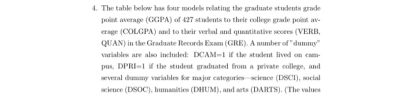 4. The table below has four models relating the graduate students grade point average (GGPA) of 427 students to their college grade point av- erage (COLGPA) and to their verbal and quantitative scores (VERB QUAN) in the Graduate Records Exam (GRE). A number of" dummy" variables are also included: DCAM-1 if the studen lived on ca pus, DPRI-1 if the student graduated from a private college, and several dummy variables for major categories science (DSCI), social science (DSOC), humanities (DHUM),...
8. -/2 points ASWSBE13 3.E.016.MI. My Notes The grade point average for college students is based...
 8. -/2 points ASWSBE13 3.E.016.MI. My Notes The grade point average for college students is based on a weighted mean computation. For most colleges, the grades are given the following data value A (4), (3), (0). Alter 60 credit hours of course work, a student at State University and credit hours of A, 10 credit hours of B, 2 credit hours of C, and 4 credit hours of D. (a) Compute the student's grade point average Ask Your Teacher (2),...
Assignment 1: Bivariate Regression ECO 321 DUE Thursday, February 20 at the beginning of class. You...
 Assignment 1: Bivariate Regression ECO 321 DUE Thursday, February 20 at the beginning of class. You must submit a hard copy of the assignment. 1. Consider the standard bivariate regression Y B + B,X, + a) Suppose that we estimate the above function using a sample of data and the ordinary least square method (OLS). Write down the sample regression function b) Name each of the components in part (a). Then graph an example of the function along with some...
Chapter overview 1. Reasons for international trade Resources reasons Economic reasons Other reasons 2. Difference between...
Chapter overview 1. Reasons for international trade Resources reasons Economic reasons Other reasons 2. Difference between international trade and domestic trade More complex context More difficult and risky Higher management skills required 3. Basic concept s relating to international trade Visible trade & invisible trade Favorable trade & unfavorable trade General trade system & special trade system Volume of international trade & quantum of international trade Commodity composition of international trade Geographical composition of international trade Degree / ratio of...
 4. The following table contains ACT scores and the GPA (grade point average) for eight college students. Grade point average is based on a four-point scale and has been rounded to one digit after the decimal: a. Estimate the relationship between GPA and ACT using OLS; that is, obtain the intercept and slope estimates in the equation Comment on the direction of the relationship. Does the intercept have a useful interpretation here? Explain. How much higher is the GPA predicted to be...
 l wlu yuu gay RsGPA and ACl explain much of the variation in college grade point average. Use α=590 9. Using the data relating stock prices to GDP for the period 1970 to 1987, the following equation was estimated by OLS Y, -10.7849+0.0251x, t(11666) (7.4671) R-0.777 d 0.4618 a) Find out if there is first order autocorrelation in the model on the basis of the d statistic. Hint: Find the value of n, α-5% and check handout given in exam...
 4. The table below has four models relating the graduate students grade point average (GGPA) of 427 students to their college grade point av- erage (COLGPA) and to their verbal and quantitative scores (VERB QUAN) in the Graduate Records Exam (GRE). A number of" dummy" variables are also included: DCAM-1 if the studen lived on ca pus, DPRI-1 if the student graduated from a private college, and several dummy variables for major categories science (DSCI), social science (DSOC), humanities (DHUM),...
 8. -/2 points ASWSBE13 3.E.016.MI. My Notes The grade point average for college students is based on a weighted mean computation. For most colleges, the grades are given the following data value A (4), (3), (0). Alter 60 credit hours of course work, a student at State University and credit hours of A, 10 credit hours of B, 2 credit hours of C, and 4 credit hours of D. (a) Compute the student's grade point average Ask Your Teacher (2),...
 Assignment 1: Bivariate Regression ECO 321 DUE Thursday, February 20 at the beginning of class. You must submit a hard copy of the assignment. 1. Consider the standard bivariate regression Y B + B,X, + a) Suppose that we estimate the above function using a sample of data and the ordinary least square method (OLS). Write down the sample regression function b) Name each of the components in part (a). Then graph an example of the function along with some...
Most questions answered within 3 hours.
-
Where is the error in this code sequence?
String s1 = "Hello";
String s2 = "ello";...
asked 10 months ago -
Financial data for Joel de Paris, Inc., for last year
follow:
Joel de Paris, Inc.
Balance...
asked 10 months ago -
Consider this reaction:
Al2(SO4)3 (aq)+ BaCl3
(aq) Al2Cl6 (aq)- +
3BaSO4(s) . What is the...
asked 10 months ago -
Suppose that Savneet is considering increasing her
recent random sample from 20 car rentals to 40...
asked 10 months ago -
Trucks arrive at an unloading terminal at an average rate of 120
per hour.
Trucks arrive...
asked 10 months ago -
Why are methanol and ethanol completely soluble in water while
octanol is not very little soluble....
asked 10 months ago -
A facilities manager at a university reads in a research report
that the mean amount of...
asked 10 months ago -
When the CuSO4 is rehydrated by adding water to the anhydrous
compound, is this an endothermic...
asked 10 months ago -
A ray of sunlight is passing from diamond into crown glass; the
angle of incidence is...
asked 10 months ago -
A block of mass 0.249 kg is placed on top of a light, vertical
spring of...
asked 10 months ago -
how do the kidneys compensate in the presences of acidosis
a) trigger hyperventilate
b) reserve acid...
asked 10 months ago -
Question 501 pts
The rental rate of capital to the firm increases. Which of the
following...
asked 10 months ago