I need help with both questions!!!! 3. Consider the second order reaction A → products. The...
 I
need help with both questions!!!!
3. Consider the second order reaction A → products. The rate constant for the reaction at 25 deg C is 0.350 M's? If the initial concentration of A is 0.800 M, what is the concentration after 4 seconds? a) .165 M b) .197 M c) .377 M d) .400 M e) .454 M 4....
I
need help with both questions!!!!
3. Consider the second order reaction A → products. The rate constant for the reaction at 25 deg C is 0.350 M's? If the initial concentration of A is 0.800 M, what is the concentration after 4 seconds? a) .165 M b) .197 M c) .377 M d) .400 M e) .454 M 4....
Exercises: Experiment 9 25 pts Name 1. Write the net ionic equations for the reactions which...
 Exercises: Experiment 9 25 pts Name 1. Write the net ionic equations for the reactions which occurred when aqueous KOH was initially added to: 12 pts a. Al(NO3), (aq) b. Fe(NO3)2 (aq) 000000004AAAAAAAAA c. Ni (NO3)2 (aq) AAAAAAUUU 2. How do the results you observed when excess KOH was added illustrate the amphoteric nature of aluminum hydroxide? Explain! 5 pts...
a. Caffeine can be protonated under acidic conditions to form an imidazolium-like species. Draw the structure...
a. Caffeine can be protonated under acidic conditions to form an imidazolium-like species. Draw the structure for this protonated form, then find and report a pKa value for the most acidic proton. b. Draw a reaction scheme between caffeine and water. Which side of the equilibrium is favored for this acid/base reaction? Hint: Use the pKa value from part a....
Alcohols: Substitution of (1R,3S)-3-methylcyclohexanol using HBr. Part A Predict the product(s) formed when the structure shown...
 Alcohols: Substitution of (1R,3S)-3-methylcyclohexanol using
HBr.
Part A Predict the product(s) formed when the structure shown below undergoes a reaction with concentrated HBr. If there is more than one product, draw all the products possible. Interactive 3D display mode ОН CHz Draw the molecule(s) on the canvas by choosing buttons from the Tools (for bonds), Atoms, and Advanced Template toolbars....
Alcohols: Substitution of (1R,3S)-3-methylcyclohexanol using
HBr.
Part A Predict the product(s) formed when the structure shown below undergoes a reaction with concentrated HBr. If there is more than one product, draw all the products possible. Interactive 3D display mode ОН CHz Draw the molecule(s) on the canvas by choosing buttons from the Tools (for bonds), Atoms, and Advanced Template toolbars....
2-Chloropropane Based on what you have learned so far, predict the more stable product in the...
 2-Chloropropane Based on what you have learned so far, predict the more stable product in the reaction of CH2=CH-CH2-CH3 with HBr (circle the arrow for the step that leads to the predicted product), then calculate the energies of intermediates and products. Reactions normally go through the most stable intermediate, irrespective of the stability of the product. Circle the product you...
answer all questions 1. For the following substrates, predict whether a carbocation rearrangement will take place...
 answer all questions
1. For the following substrates, predict whether a carbocation rearrangement will take place in an SN1/E1 mechanism by first drawing the carbocation intermediate, then deciding if the carbocation will rearrange (can it form a more stable carbocation by hydride or methyl shift?): Carbocation: Sturcture Rearrange? If yes, draw the rearranged product. If no, write No н.с Br...
answer all questions
1. For the following substrates, predict whether a carbocation rearrangement will take place in an SN1/E1 mechanism by first drawing the carbocation intermediate, then deciding if the carbocation will rearrange (can it form a more stable carbocation by hydride or methyl shift?): Carbocation: Sturcture Rearrange? If yes, draw the rearranged product. If no, write No н.с Br...
Fill 10 km It w/ tup water and invert it in a 400 ml beaker billed...
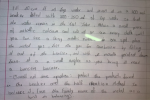 Fill 10 km It w/ tup water and invert it in a 400 ml beaker billed with 300 - 350 ml of top water so that I the water remain in the test tube obtain a small piece of metallic calcium and rub it on an emery cloth until you can see a shiny metallic surten in one spot. place...
Tutored Practice Problem 16.4.1 COUNTS TOWARDS GRADE Predict and calculate the effect of concentration changes on...
 Tutored Practice Problem 16.4.1 COUNTS TOWARDS GRADE Predict and calculate the effect of concentration changes on an equilibrium system. Close Problem Some COCl2 is allowed to dissociate into CO and Cl2 at 873 K. At equilibrium, [COCI2] =0.237 M, and [CO] - [C12] = 0.128 M. Additional CO is added so that (CO)new = 0.193 M and the system is...
Are these answers correct? 19. (Extra credit: 4 pts each) Predict the major expected product or...
 Are these answers correct?
19. (Extra credit: 4 pts each) Predict the major expected product or products of each reaction or reactions shown below. It is recommended that you show your reasoning, such as intermediate compounds produced in any multi-step sets of reactions for partial credit. If stereochemistry at any site is important, be sure to show it clearly. Partial...
Are these answers correct?
19. (Extra credit: 4 pts each) Predict the major expected product or products of each reaction or reactions shown below. It is recommended that you show your reasoning, such as intermediate compounds produced in any multi-step sets of reactions for partial credit. If stereochemistry at any site is important, be sure to show it clearly. Partial...
QUESTIONS 6-109. Predict the product formed in each of the following reactions and give each reactant...
 QUESTIONS 6-109. Predict the product formed in each of the following reactions and give each reactant and product a suitable name: (a) CH3CH,MgBr + CH,0 1. ether 2. H 1. ether b) p-CH,CHMgBr CHCHCO 6-110. Using the Grignard reaction, carry out the following transformations. Any necessary organic or inorganic reagents may be used. Name all reactants and products. OH CH,CH,OH...
 I
need help with both questions!!!!
3. Consider the second order reaction A → products. The rate constant for the reaction at 25 deg C is 0.350 M's? If the initial concentration of A is 0.800 M, what is the concentration after 4 seconds? a) .165 M b) .197 M c) .377 M d) .400 M e) .454 M 4....
I
need help with both questions!!!!
3. Consider the second order reaction A → products. The rate constant for the reaction at 25 deg C is 0.350 M's? If the initial concentration of A is 0.800 M, what is the concentration after 4 seconds? a) .165 M b) .197 M c) .377 M d) .400 M e) .454 M 4....
 Exercises: Experiment 9 25 pts Name 1. Write the net ionic equations for the reactions which occurred when aqueous KOH was initially added to: 12 pts a. Al(NO3), (aq) b. Fe(NO3)2 (aq) 000000004AAAAAAAAA c. Ni (NO3)2 (aq) AAAAAAUUU 2. How do the results you observed when excess KOH was added illustrate the amphoteric nature of aluminum hydroxide? Explain! 5 pts...
 Alcohols: Substitution of (1R,3S)-3-methylcyclohexanol using
HBr.
Part A Predict the product(s) formed when the structure shown below undergoes a reaction with concentrated HBr. If there is more than one product, draw all the products possible. Interactive 3D display mode ОН CHz Draw the molecule(s) on the canvas by choosing buttons from the Tools (for bonds), Atoms, and Advanced Template toolbars....
Alcohols: Substitution of (1R,3S)-3-methylcyclohexanol using
HBr.
Part A Predict the product(s) formed when the structure shown below undergoes a reaction with concentrated HBr. If there is more than one product, draw all the products possible. Interactive 3D display mode ОН CHz Draw the molecule(s) on the canvas by choosing buttons from the Tools (for bonds), Atoms, and Advanced Template toolbars....
 2-Chloropropane Based on what you have learned so far, predict the more stable product in the reaction of CH2=CH-CH2-CH3 with HBr (circle the arrow for the step that leads to the predicted product), then calculate the energies of intermediates and products. Reactions normally go through the most stable intermediate, irrespective of the stability of the product. Circle the product you...
 answer all questions
1. For the following substrates, predict whether a carbocation rearrangement will take place in an SN1/E1 mechanism by first drawing the carbocation intermediate, then deciding if the carbocation will rearrange (can it form a more stable carbocation by hydride or methyl shift?): Carbocation: Sturcture Rearrange? If yes, draw the rearranged product. If no, write No н.с Br...
answer all questions
1. For the following substrates, predict whether a carbocation rearrangement will take place in an SN1/E1 mechanism by first drawing the carbocation intermediate, then deciding if the carbocation will rearrange (can it form a more stable carbocation by hydride or methyl shift?): Carbocation: Sturcture Rearrange? If yes, draw the rearranged product. If no, write No н.с Br...
 Fill 10 km It w/ tup water and invert it in a 400 ml beaker billed with 300 - 350 ml of top water so that I the water remain in the test tube obtain a small piece of metallic calcium and rub it on an emery cloth until you can see a shiny metallic surten in one spot. place...
 Tutored Practice Problem 16.4.1 COUNTS TOWARDS GRADE Predict and calculate the effect of concentration changes on an equilibrium system. Close Problem Some COCl2 is allowed to dissociate into CO and Cl2 at 873 K. At equilibrium, [COCI2] =0.237 M, and [CO] - [C12] = 0.128 M. Additional CO is added so that (CO)new = 0.193 M and the system is...
 Are these answers correct?
19. (Extra credit: 4 pts each) Predict the major expected product or products of each reaction or reactions shown below. It is recommended that you show your reasoning, such as intermediate compounds produced in any multi-step sets of reactions for partial credit. If stereochemistry at any site is important, be sure to show it clearly. Partial...
Are these answers correct?
19. (Extra credit: 4 pts each) Predict the major expected product or products of each reaction or reactions shown below. It is recommended that you show your reasoning, such as intermediate compounds produced in any multi-step sets of reactions for partial credit. If stereochemistry at any site is important, be sure to show it clearly. Partial...
 QUESTIONS 6-109. Predict the product formed in each of the following reactions and give each reactant and product a suitable name: (a) CH3CH,MgBr + CH,0 1. ether 2. H 1. ether b) p-CH,CHMgBr CHCHCO 6-110. Using the Grignard reaction, carry out the following transformations. Any necessary organic or inorganic reagents may be used. Name all reactants and products. OH CH,CH,OH...
Most questions answered within 3 hours.