CONCEPT QUESTIONS Mechanism. While the reaction carried out in lab used potassium hydroxide as the catalyst,...
 CONCEPT QUESTIONS Mechanism. While the reaction carried out in lab used potassium hydroxide as the catalyst, many other catalysts have been developed to increase regioselectivity and stereoselectivity in aldol condensations. One small molecule catalyst commonly used is proline, a naturally occurring amino acid. The mechanism involves the initial formation of an enamine; predict the structure of this enamine intermediate intermediate...
CONCEPT QUESTIONS Mechanism. While the reaction carried out in lab used potasslum hydroxide as the catalyst,...
 CONCEPT QUESTIONS Mechanism. While the reaction carried out in lab used potasslum hydroxide as the catalyst, many other catalysts have been developed to increase regioselectivity and stereoselectivity in aldol condensations. One small molecule catalyst commonly used is proline, a naturally occurring amino acid. The mechanism invoives the initial formation of an enamine; predict the structure of this enamine intermediate (Intermediate...
Mechanism. While the reaction carried out in lab used potassium hydroxide as the catalyst, many other catalysts have be...
 Mechanism. While the reaction carried out in lab used potassium hydroxide as the catalyst, many other catalysts have been developed to increase regioselectivity and stereoselectivity in aldol condensations. One small molecule catalyst commonly used is proline, a naturally occurring amino acid. The mechanism involves the initial formation of an enamine; predict the structure of this enamine intermediate intermediate A), and...
Initial Knowledge Check Question 24 Nitrogen and hydrogen react to form ammonia, like this: N2(e)+3H,(8) 2NH,...
 Initial Knowledge Check Question 24 Nitrogen and hydrogen react to form ammonia, like this: N2(e)+3H,(8) 2NH, (8) S Suppose a mixture of N, H2 and NH, has come to equilitrium in a dosed reaction vessel.,Predict what change.,if any, the perturbations in the table below will cause in the composition of the mixture in the vessel. Also dedide whether the equiabrium...
(a) For the reaction 2NO2 (g) 2NO (g) + 02 (g) K # 0.50. Predict the...
 (a) For the reaction 2NO2 (g) 2NO (g) + 02 (g) K # 0.50. Predict the direction in which the system will move to reach equilibrium if the initial gas pressures are NO: 0.20 atm . NO2: 0.20 atm (answer: to the right because Q< K) .NO2: 0.0961 atm 02: 0.0589 atm NO: 0.280 atm (answer: the system is already...
Given that the initial rate constant is 0.0160s-1 at an initial temperature of 24 deg C,...
 Given that the initial rate constant is 0.0160s-1 at
an initial temperature of 24 deg C, what would the rate constant be
at a temperature of 100 deg C for the same reaction described in
Part A?
From Part A:
The activation energy of a certain reaction is 31.5 kJ/mol. At
24∘C, the rate constant is 0.0160s−1. T2 = 41C...
Given that the initial rate constant is 0.0160s-1 at
an initial temperature of 24 deg C, what would the rate constant be
at a temperature of 100 deg C for the same reaction described in
Part A?
From Part A:
The activation energy of a certain reaction is 31.5 kJ/mol. At
24∘C, the rate constant is 0.0160s−1. T2 = 41C...
Can you check my answers please? To answer the questions below use the following information: Cyanohydrins...
 Can
you check my answers please?
To answer the questions below use the following information: Cyanohydrins are important intermediates in the synthesis of c-hydroxycarboxylic acids from ketones and aldehydes. The nitrile functional group can be hydrolyzed by aqueous acid to yield a carboxylic acid. Nitriles can also be hydrolyzed to carboxylic acids using aqueous base. Unfortunately, when a cyanohydrin is...
Can
you check my answers please?
To answer the questions below use the following information: Cyanohydrins are important intermediates in the synthesis of c-hydroxycarboxylic acids from ketones and aldehydes. The nitrile functional group can be hydrolyzed by aqueous acid to yield a carboxylic acid. Nitriles can also be hydrolyzed to carboxylic acids using aqueous base. Unfortunately, when a cyanohydrin is...
Please answer all parts for good rating! 1) Predict the product(s) for each of the following...
 Please answer all parts for good rating!
1) Predict the product(s) for each of the following reactions. Pay attention to stereochemistry. In each case, a reaction occurs, even if it is simply an acid-base reaction. NaOH H0 EtOH (solvent) SOCI, NaOEt D) HO CH H2SO4 (catalyst) NH H2O (solvent) " H2SO4 (catalytic)
Please answer all parts for good rating!
1) Predict the product(s) for each of the following reactions. Pay attention to stereochemistry. In each case, a reaction occurs, even if it is simply an acid-base reaction. NaOH H0 EtOH (solvent) SOCI, NaOEt D) HO CH H2SO4 (catalyst) NH H2O (solvent) " H2SO4 (catalytic)
15. The solubility of iron (III) hydroxide is 8.96 x 10 g in 100 kL of...
 15. The solubility of iron (III) hydroxide is 8.96 x 10 g in 100 kL of water at 25°C. Determine the solubility product for iron (II) hydroxide. -4 -39 A: 1.33 x 10 12. For the combustion reaction of propane (CH), determine AG (in kJ mol) and predict if the reaction is spontaneous or not. A: -2.07 x 10; spontaneous
1. Which of the following is expected to have a lower pKa? Explain with structures! 2....
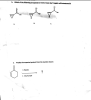 1. Which of the following is expected to have a lower pKa?
Explain with structures!
2. Predice tbe respected product from the reaction
shown:
1. Which of the following is expected to have a lower pK,? Explain with structuresIIII 2. Predict the expected product from the reaction shown: 1. (E), Oli =; 2. CH,CH,CHBr
1. Which of the following is expected to have a lower pKa?
Explain with structures!
2. Predice tbe respected product from the reaction
shown:
1. Which of the following is expected to have a lower pK,? Explain with structuresIIII 2. Predict the expected product from the reaction shown: 1. (E), Oli =; 2. CH,CH,CHBr
 CONCEPT QUESTIONS Mechanism. While the reaction carried out in lab used potassium hydroxide as the catalyst, many other catalysts have been developed to increase regioselectivity and stereoselectivity in aldol condensations. One small molecule catalyst commonly used is proline, a naturally occurring amino acid. The mechanism involves the initial formation of an enamine; predict the structure of this enamine intermediate intermediate...
 CONCEPT QUESTIONS Mechanism. While the reaction carried out in lab used potasslum hydroxide as the catalyst, many other catalysts have been developed to increase regioselectivity and stereoselectivity in aldol condensations. One small molecule catalyst commonly used is proline, a naturally occurring amino acid. The mechanism invoives the initial formation of an enamine; predict the structure of this enamine intermediate (Intermediate...
 Mechanism. While the reaction carried out in lab used potassium hydroxide as the catalyst, many other catalysts have been developed to increase regioselectivity and stereoselectivity in aldol condensations. One small molecule catalyst commonly used is proline, a naturally occurring amino acid. The mechanism involves the initial formation of an enamine; predict the structure of this enamine intermediate intermediate A), and...
 Initial Knowledge Check Question 24 Nitrogen and hydrogen react to form ammonia, like this: N2(e)+3H,(8) 2NH, (8) S Suppose a mixture of N, H2 and NH, has come to equilitrium in a dosed reaction vessel.,Predict what change.,if any, the perturbations in the table below will cause in the composition of the mixture in the vessel. Also dedide whether the equiabrium...
 (a) For the reaction 2NO2 (g) 2NO (g) + 02 (g) K # 0.50. Predict the direction in which the system will move to reach equilibrium if the initial gas pressures are NO: 0.20 atm . NO2: 0.20 atm (answer: to the right because Q< K) .NO2: 0.0961 atm 02: 0.0589 atm NO: 0.280 atm (answer: the system is already...
 Given that the initial rate constant is 0.0160s-1 at
an initial temperature of 24 deg C, what would the rate constant be
at a temperature of 100 deg C for the same reaction described in
Part A?
From Part A:
The activation energy of a certain reaction is 31.5 kJ/mol. At
24∘C, the rate constant is 0.0160s−1. T2 = 41C...
Given that the initial rate constant is 0.0160s-1 at
an initial temperature of 24 deg C, what would the rate constant be
at a temperature of 100 deg C for the same reaction described in
Part A?
From Part A:
The activation energy of a certain reaction is 31.5 kJ/mol. At
24∘C, the rate constant is 0.0160s−1. T2 = 41C...
 Can
you check my answers please?
To answer the questions below use the following information: Cyanohydrins are important intermediates in the synthesis of c-hydroxycarboxylic acids from ketones and aldehydes. The nitrile functional group can be hydrolyzed by aqueous acid to yield a carboxylic acid. Nitriles can also be hydrolyzed to carboxylic acids using aqueous base. Unfortunately, when a cyanohydrin is...
Can
you check my answers please?
To answer the questions below use the following information: Cyanohydrins are important intermediates in the synthesis of c-hydroxycarboxylic acids from ketones and aldehydes. The nitrile functional group can be hydrolyzed by aqueous acid to yield a carboxylic acid. Nitriles can also be hydrolyzed to carboxylic acids using aqueous base. Unfortunately, when a cyanohydrin is...
 Please answer all parts for good rating!
1) Predict the product(s) for each of the following reactions. Pay attention to stereochemistry. In each case, a reaction occurs, even if it is simply an acid-base reaction. NaOH H0 EtOH (solvent) SOCI, NaOEt D) HO CH H2SO4 (catalyst) NH H2O (solvent) " H2SO4 (catalytic)
Please answer all parts for good rating!
1) Predict the product(s) for each of the following reactions. Pay attention to stereochemistry. In each case, a reaction occurs, even if it is simply an acid-base reaction. NaOH H0 EtOH (solvent) SOCI, NaOEt D) HO CH H2SO4 (catalyst) NH H2O (solvent) " H2SO4 (catalytic)
 15. The solubility of iron (III) hydroxide is 8.96 x 10 g in 100 kL of water at 25°C. Determine the solubility product for iron (II) hydroxide. -4 -39 A: 1.33 x 10 12. For the combustion reaction of propane (CH), determine AG (in kJ mol) and predict if the reaction is spontaneous or not. A: -2.07 x 10; spontaneous
 1. Which of the following is expected to have a lower pKa?
Explain with structures!
2. Predice tbe respected product from the reaction
shown:
1. Which of the following is expected to have a lower pK,? Explain with structuresIIII 2. Predict the expected product from the reaction shown: 1. (E), Oli =; 2. CH,CH,CHBr
1. Which of the following is expected to have a lower pKa?
Explain with structures!
2. Predice tbe respected product from the reaction
shown:
1. Which of the following is expected to have a lower pK,? Explain with structuresIIII 2. Predict the expected product from the reaction shown: 1. (E), Oli =; 2. CH,CH,CHBr
Most questions answered within 3 hours.