3. By drawing picture or pictures to explain (5) A "parity" operator and the requirement of...
 3. By drawing picture or pictures to explain (5) A "parity" operator and the requirement of a Hamiltonian for it to be (a) one of the symmetry operators. Give at least one example. As- and a p-wave functions for solutions of the hydrogen atom and (5) (b) give physical reason or reasons to justify your pictures of the wave functions...
3. By drawing picture or pictures to explain (5) A "parity" operator and the requirement of...
 3. By drawing picture or pictures to explain (5) A "parity" operator and the requirement of a Hamiltonian for it to be (a) one of the symmetry operators. Give at least one example. As- and a p-wave functions for solutions of the hydrogen atom and (5) (b) give physical reason or reasons to justify your pictures of the wave functions...
2. A hollow pipe of length L and square cross-section of side a is ter- minated...
 2. A hollow pipe of length L and square cross-section of side a is ter- minated by square faces of side a that are orthogonal to its length dimension which is along the z axis. The walls of the so-formed cavity are perfectly conducting, and the medium filling the cavity is lossless and with a real dielectric permittivity, e'. (a)...
PART A: An electron moves at 3.00×10⁶ m/s through a region in which there is a...
PART A: An electron moves at 3.00×10⁶ m/s through a region in which there is a magnetic field of unspecified direction and magnitude 7.50×10⁻² T . A1: An electron moves at 3.00×10⁶ m/s through a region in which there is a magnetic field of unspecified direction and magnitude 7.50×10⁻² T . A2: What is the smallest possible magnitude of the...
(sorry for the poor quality photo) but any help is appreciated on parts (b) and (c) with work 12- 2. (12 pts total)...
 (sorry for the poor quality photo) but any help is appreciated
on parts (b) and (c) with work
12- 2. (12 pts total) A map of equipotential surfaces is shown below. The equipotential surfaces are labeled with units of Volts and the x-y units on the map are in mm. [mmけ a. (3 pts) Rank the magnitudes of the electric...
(sorry for the poor quality photo) but any help is appreciated
on parts (b) and (c) with work
12- 2. (12 pts total) A map of equipotential surfaces is shown below. The equipotential surfaces are labeled with units of Volts and the x-y units on the map are in mm. [mmけ a. (3 pts) Rank the magnitudes of the electric...
for Antenna which comes first Electric Field or magnetic field?
for Antenna which comes first Electric Field or magnetic field?
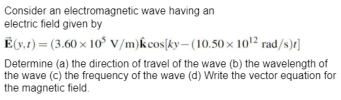
Consider an ellectromagnetic wave having an electric field
3. A 1.0-C point charge is 10 m from a second point charge, and the electric...
 3. A 1.0-C point charge is 10 m from a second point charge, and the electric force on one of them due to N m2/c2) [7] the other is 4.5 N. What is the magnitude of the second charge? (k 9.0x 10⁹ A, 25 C 50 nC E. 25 nC B. 30 nC C. 10 nC _4. IQI-1Q21- 20 HC....
The animation below shows a representation of a particular longitudinal standing wave that is set up...
 The animation below shows a representation of a particular
longitudinal standing wave that is set up in a pipe which is open
at both ends. A somewhat simpler transverse representation of the
standing wave is shown in red, above the pipe. The speed of sound
is 340 m/s, and the frequency of the standing wave is 720 Hz. The
animation...
The animation below shows a representation of a particular
longitudinal standing wave that is set up in a pipe which is open
at both ends. A somewhat simpler transverse representation of the
standing wave is shown in red, above the pipe. The speed of sound
is 340 m/s, and the frequency of the standing wave is 720 Hz. The
animation...
First we define the wave as the real part of E(x,t)=(6×10⁴)ei(0.5×10⁷x−1.5×10¹⁵t)k 1) write the equation for...
First we define the wave as the real part of E(x,t)=(6×10⁴)ei(0.5×10⁷x−1.5×10¹⁵t)k 1) write the equation for the real part of Ez 2) determine the speed at which the wave propagates 3) determine the equation for the traveling wave (real part of Ez) if the wave has a wavelength twice as long as the one that you have been plotting. Make...
 3. By drawing picture or pictures to explain (5) A "parity" operator and the requirement of a Hamiltonian for it to be (a) one of the symmetry operators. Give at least one example. As- and a p-wave functions for solutions of the hydrogen atom and (5) (b) give physical reason or reasons to justify your pictures of the wave functions...
 3. By drawing picture or pictures to explain (5) A "parity" operator and the requirement of a Hamiltonian for it to be (a) one of the symmetry operators. Give at least one example. As- and a p-wave functions for solutions of the hydrogen atom and (5) (b) give physical reason or reasons to justify your pictures of the wave functions...
 2. A hollow pipe of length L and square cross-section of side a is ter- minated by square faces of side a that are orthogonal to its length dimension which is along the z axis. The walls of the so-formed cavity are perfectly conducting, and the medium filling the cavity is lossless and with a real dielectric permittivity, e'. (a)...
 (sorry for the poor quality photo) but any help is appreciated
on parts (b) and (c) with work
12- 2. (12 pts total) A map of equipotential surfaces is shown below. The equipotential surfaces are labeled with units of Volts and the x-y units on the map are in mm. [mmけ a. (3 pts) Rank the magnitudes of the electric...
(sorry for the poor quality photo) but any help is appreciated
on parts (b) and (c) with work
12- 2. (12 pts total) A map of equipotential surfaces is shown below. The equipotential surfaces are labeled with units of Volts and the x-y units on the map are in mm. [mmけ a. (3 pts) Rank the magnitudes of the electric...
 3. A 1.0-C point charge is 10 m from a second point charge, and the electric force on one of them due to N m2/c2) [7] the other is 4.5 N. What is the magnitude of the second charge? (k 9.0x 10⁹ A, 25 C 50 nC E. 25 nC B. 30 nC C. 10 nC _4. IQI-1Q21- 20 HC....
 The animation below shows a representation of a particular
longitudinal standing wave that is set up in a pipe which is open
at both ends. A somewhat simpler transverse representation of the
standing wave is shown in red, above the pipe. The speed of sound
is 340 m/s, and the frequency of the standing wave is 720 Hz. The
animation...
The animation below shows a representation of a particular
longitudinal standing wave that is set up in a pipe which is open
at both ends. A somewhat simpler transverse representation of the
standing wave is shown in red, above the pipe. The speed of sound
is 340 m/s, and the frequency of the standing wave is 720 Hz. The
animation...
Most questions answered within 3 hours.