Draw the structures of the major and minor E1 products of the reaction between 2-methyl-2-butanol and HCl. 3. Draw t...
 Draw the structures of the major and minor E1 products of the
reaction between 2-methyl-2-butanol and HCl.
3. Draw the structures of the major and minor E1 products of the reaction between 2-methyl- 2-butanol and HCI. (2 pts) Major E1 product: Minor E1 product:
Draw the structures of the major and minor E1 products of the
reaction between 2-methyl-2-butanol and HCl.
3. Draw the structures of the major and minor E1 products of the reaction between 2-methyl- 2-butanol and HCI. (2 pts) Major E1 product: Minor E1 product:
Draw and name all of the products that fomed for each reaction 2. Chromic acid test...
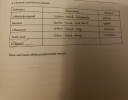 Draw and name all of the products that fomed for each
reaction
2. Chromic acid test (oxidation) Substance 2-Methylpropanal Butanal 2-Butanone Acetic acid Observations Reaction? ostitve rtive ne tatin na veadtwn solution tNnd 。 Draw and name all the products that formed.
Draw and name all of the products that fomed for each
reaction
2. Chromic acid test (oxidation) Substance 2-Methylpropanal Butanal 2-Butanone Acetic acid Observations Reaction? ostitve rtive ne tatin na veadtwn solution tNnd 。 Draw and name all the products that formed.
Drag the terms on the left to the appropriate blanks on the right to complete the...
 Drag the terms on the left to the appropriate blanks on the right to complete the sentences. 14 of 20 Reset Help only reactants only products 1. Reaction rate is the change in the amount of the amount of it is the of a chemical reaction in a given amount of energy speed temperature products or reactants time Submit Request...
Prelab 2- Na Benzoate acidification (10 m) Diagram the reaction you are carrying out and name...
Prelab 2- Na Benzoate acidification (10 m) Diagram the reaction you are carrying out and name the reactants and products? 2m Are the reactants both soluble in water? 1m In the above equation what is the number of molecules of each reactant and what is the number of each of the molecular products? 1m What do you think is the...
Extra credit 2 (8 pts) The above dimethyl-substituted hexatriene can undergo a ring-closing reaction called an...
 Extra credit 2 (8 pts) The above dimethyl-substituted hexatriene can undergo a ring-closing reaction called an electrocyclic reaction. Shown above are two possible products. In fact, only one of the two possible products is formed. This reaction is controlled by orbital symmetry. The key orbital is the HOMO of the triene, which must be converted to an MO of the...
Draw the structure of the products of the reaction. If no reaction occurs, write NR. Вс...
 Draw the structure of the
products of the reaction. If no reaction occurs, write NR.
Вс *HIDIT are isotopes * H. ONE
Draw the structure of the
products of the reaction. If no reaction occurs, write NR.
Вс *HIDIT are isotopes * H. ONE
complete reaction, name reaction and products 0=0 CH2CH3 H' CH +HO H + H20
 complete reaction, name reaction and products
0=0 CH2CH3 H' CH +HO H + H20
complete reaction, name reaction and products
0=0 CH2CH3 H' CH +HO H + H20
.Provide a reasonable synthetic reaction sequence for reagents and expected products for each major reaction step...
 .Provide a reasonable synthetic reaction sequence for reagents and expected products for each major reaction step + enantiomer
Which of the following reactions is correct and which one is not pay attention to the...
 Which of the following reactions is correct and which one is not pay attention to the reaction conditions and the products of the reaction. solvent
OH 4. A Chem 241 student was given an experiment to synthesize compound 1 from ethyl...
 OH 4. A Chem 241 student was given an experiment to synthesize compound 1 from ethyl acetoacetate. The student prepared 1 mole equivalent of methylmagnesium iodide, co Et which was then slowly added to a solution of ethyl acetoacetate in ether. Everything went well; indeed, even without the application of heat, the reaction mixture bubbled merrily. Working carefully with supervision...
 Draw the structures of the major and minor E1 products of the
reaction between 2-methyl-2-butanol and HCl.
3. Draw the structures of the major and minor E1 products of the reaction between 2-methyl- 2-butanol and HCI. (2 pts) Major E1 product: Minor E1 product:
Draw the structures of the major and minor E1 products of the
reaction between 2-methyl-2-butanol and HCl.
3. Draw the structures of the major and minor E1 products of the reaction between 2-methyl- 2-butanol and HCI. (2 pts) Major E1 product: Minor E1 product:
 Draw and name all of the products that fomed for each
reaction
2. Chromic acid test (oxidation) Substance 2-Methylpropanal Butanal 2-Butanone Acetic acid Observations Reaction? ostitve rtive ne tatin na veadtwn solution tNnd 。 Draw and name all the products that formed.
Draw and name all of the products that fomed for each
reaction
2. Chromic acid test (oxidation) Substance 2-Methylpropanal Butanal 2-Butanone Acetic acid Observations Reaction? ostitve rtive ne tatin na veadtwn solution tNnd 。 Draw and name all the products that formed.
 Drag the terms on the left to the appropriate blanks on the right to complete the sentences. 14 of 20 Reset Help only reactants only products 1. Reaction rate is the change in the amount of the amount of it is the of a chemical reaction in a given amount of energy speed temperature products or reactants time Submit Request...
 Extra credit 2 (8 pts) The above dimethyl-substituted hexatriene can undergo a ring-closing reaction called an electrocyclic reaction. Shown above are two possible products. In fact, only one of the two possible products is formed. This reaction is controlled by orbital symmetry. The key orbital is the HOMO of the triene, which must be converted to an MO of the...
 Draw the structure of the
products of the reaction. If no reaction occurs, write NR.
Вс *HIDIT are isotopes * H. ONE
Draw the structure of the
products of the reaction. If no reaction occurs, write NR.
Вс *HIDIT are isotopes * H. ONE
 complete reaction, name reaction and products
0=0 CH2CH3 H' CH +HO H + H20
complete reaction, name reaction and products
0=0 CH2CH3 H' CH +HO H + H20
 .Provide a reasonable synthetic reaction sequence for reagents and expected products for each major reaction step + enantiomer
 Which of the following reactions is correct and which one is not pay attention to the reaction conditions and the products of the reaction. solvent
 OH 4. A Chem 241 student was given an experiment to synthesize compound 1 from ethyl acetoacetate. The student prepared 1 mole equivalent of methylmagnesium iodide, co Et which was then slowly added to a solution of ethyl acetoacetate in ether. Everything went well; indeed, even without the application of heat, the reaction mixture bubbled merrily. Working carefully with supervision...
Most questions answered within 3 hours.