Given the following reaction, CH HBr CH3 anae nism arrow and name the first step of...
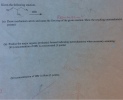 Given the following reaction, CH HBr CH3 anae nism arrow and name the first step of the given reaction. Show the resulting intermediate(s). (a) Draw mecha points) (b) Predict the major organic product(s) formed indicating stereochemistry when necess (b1) concentration of HBr is concentrated (3 points) (b2) concentration of HBr is dilute (3 points)
Predict the product(s) for the reaction of toluene with propanol bromide in the presence of aluminum...
Predict the product(s) for the reaction of toluene with propanol bromide in the presence of aluminum bromide catalyst; what is the name of this reaction? Draw the mechanism of the formation of the major product. Consider whether an additional substitution will take place and at which position. Consider whether an additional substitution will take place and at which position. Consider...
Please help me find the correct reaction including lone pairs and charges! Thank you Testbank, Question...
 Please help me find the correct reaction including lone pairs
and charges! Thank you
Testbank, Question 122 Your answer is incorrect. Try again. Predict the product(s) for the following reaction and draw the curved arrow mechanism. Include Lone Pairs in you BF H3C All Rights Reserved. A Division of MacBook Pro 2 3 4 7
Please help me find the correct reaction including lone pairs
and charges! Thank you
Testbank, Question 122 Your answer is incorrect. Try again. Predict the product(s) for the following reaction and draw the curved arrow mechanism. Include Lone Pairs in you BF H3C All Rights Reserved. A Division of MacBook Pro 2 3 4 7
1. Consider the following reaction: O3(g)→O2(g)+O(g) Using the results of the Arrhenius analysis (Ea=93.1kJ/mol and A=4.36×10¹¹M⋅s−1),...
1. Consider the following reaction: O3(g)→O2(g)+O(g) Using the results of the Arrhenius analysis (Ea=93.1kJ/mol and A=4.36×10¹¹M⋅s−1), predict the rate constant at 298 K . Express the rate constant in liters per mole-second to three significant figures. 2. Why is knowledge of reaction rates important (both practically and theoretically)?
Given the proposed mechanism, predict the rate law for the overall reaction: A2 + 2 B...
Given the proposed mechanism, predict the rate law for the overall reaction: A2 + 2 B → 2 AB (overall reaction) Mechanism A ↔ 2 A Fast A + B → AB Slow Rate = k [A][B] Rate = k[A2][B] Rate = k[A2][B]1/2 Rate = k[A2] Rate = k[A2]1/2[B]
(a) Consider a fusion generator built to create 3.47 GW of power. Determine the rate of fuel burning in grams per hour if the D-T reaction is used 9/h (b) Do the same for the D-D reaction, assuming t...
 (a) Consider a fusion generator built to create 3.47 GW of power. Determine the rate of fuel burning in grams per hour if the D-T reaction is used 9/h (b) Do the same for the D-D reaction, assuming the reaction products are split evenly between (n, 3He) and (p, 3H) 9/h
(a) Consider a fusion generator built to create 3.47...
(a) Consider a fusion generator built to create 3.47 GW of power. Determine the rate of fuel burning in grams per hour if the D-T reaction is used 9/h (b) Do the same for the D-D reaction, assuming the reaction products are split evenly between (n, 3He) and (p, 3H) 9/h
(a) Consider a fusion generator built to create 3.47...
Draw the major and minor product(s) that are expected for the following reaction
 Question 32 Draw the major and minor product(s) that are expected for the following reaction. If only one product is formed, draw it as the major product, and select no reaction for the minor product. Draw all of the minor products if more than one will form in the following reaction. Draw the major product:Draw the minor product(s):Question 31 Draw the major and...
5. (12 points) For the following oxidation reduction reaction: Zn(s)+NO3 (aq) > Zn2*(aq) + N2(g) +...
 5. (12 points) For the following oxidation reduction reaction: Zn(s)+NO3 (aq) > Zn2*(aq) + N2(g) + H20 a. What are the oxidation numbers of the reactants and products? Oxidation Number in products Element Oxidation Number in reactants Zn N b. Write the balanced oxidation half-reaction and the reduction half-reaction. (in acid medium) Balanced oxidation half-reaction: Balanced reduction half-reaction: Write the...
Effect of a Catalyst on Reaction Rate: with a lower Ea than for the uncatalyzed reaction....
 Effect of a Catalyst on Reaction Rate: with a lower Ea than for the uncatalyzed reaction. This is shown as the blue path with Ea in the diagram below t a given temperature, a catalyst increases the rate of a reaction by providing a pathway E (RJ) products Reaction Coordinale Since the potential energy barrier is lower in the presence...
A reactant decomposes with a half-life of 131 s when its initial concentration is 0.269 M....
 A reactant decomposes with a half-life of 131 s when its initial concentration is 0.269 M. When the initial concentration is 0.755 M, this same reactant decomposes with the same half-life of 131 s. What is the order of the reaction? 0 wnat is the value and unit of the rate constant for this reaction? Number
 Given the following reaction, CH HBr CH3 anae nism arrow and name the first step of the given reaction. Show the resulting intermediate(s). (a) Draw mecha points) (b) Predict the major organic product(s) formed indicating stereochemistry when necess (b1) concentration of HBr is concentrated (3 points) (b2) concentration of HBr is dilute (3 points)
 Please help me find the correct reaction including lone pairs
and charges! Thank you
Testbank, Question 122 Your answer is incorrect. Try again. Predict the product(s) for the following reaction and draw the curved arrow mechanism. Include Lone Pairs in you BF H3C All Rights Reserved. A Division of MacBook Pro 2 3 4 7
Please help me find the correct reaction including lone pairs
and charges! Thank you
Testbank, Question 122 Your answer is incorrect. Try again. Predict the product(s) for the following reaction and draw the curved arrow mechanism. Include Lone Pairs in you BF H3C All Rights Reserved. A Division of MacBook Pro 2 3 4 7
 (a) Consider a fusion generator built to create 3.47 GW of power. Determine the rate of fuel burning in grams per hour if the D-T reaction is used 9/h (b) Do the same for the D-D reaction, assuming the reaction products are split evenly between (n, 3He) and (p, 3H) 9/h
(a) Consider a fusion generator built to create 3.47...
(a) Consider a fusion generator built to create 3.47 GW of power. Determine the rate of fuel burning in grams per hour if the D-T reaction is used 9/h (b) Do the same for the D-D reaction, assuming the reaction products are split evenly between (n, 3He) and (p, 3H) 9/h
(a) Consider a fusion generator built to create 3.47...
 5. (12 points) For the following oxidation reduction reaction: Zn(s)+NO3 (aq) > Zn2*(aq) + N2(g) + H20 a. What are the oxidation numbers of the reactants and products? Oxidation Number in products Element Oxidation Number in reactants Zn N b. Write the balanced oxidation half-reaction and the reduction half-reaction. (in acid medium) Balanced oxidation half-reaction: Balanced reduction half-reaction: Write the...
 Effect of a Catalyst on Reaction Rate: with a lower Ea than for the uncatalyzed reaction. This is shown as the blue path with Ea in the diagram below t a given temperature, a catalyst increases the rate of a reaction by providing a pathway E (RJ) products Reaction Coordinale Since the potential energy barrier is lower in the presence...
 A reactant decomposes with a half-life of 131 s when its initial concentration is 0.269 M. When the initial concentration is 0.755 M, this same reactant decomposes with the same half-life of 131 s. What is the order of the reaction? 0 wnat is the value and unit of the rate constant for this reaction? Number
Most questions answered within 3 hours.