What products results from this reaction?
 What products results from this reaction?
please show arrow pushing, and I would upvote your answer thank you 7.33 The agarose gel...
 please show arrow pushing, and I would upvote your
answer thank you
7.33 The agarose gel used for the electrophoresis of DNA is seaweed polysaccharide containing an unusual bicyclic subunit. An enzyme isolated from the red seaweed that produces the related polysaccharide porphyran has been shown to convert galactose 6-sulfate residues into the anhydrogalactosyl residues of agarose. Suggest a plausible!...
please show arrow pushing, and I would upvote your
answer thank you
7.33 The agarose gel used for the electrophoresis of DNA is seaweed polysaccharide containing an unusual bicyclic subunit. An enzyme isolated from the red seaweed that produces the related polysaccharide porphyran has been shown to convert galactose 6-sulfate residues into the anhydrogalactosyl residues of agarose. Suggest a plausible!...
Hi. Can you please show me the step-by-step solution on this one. (Please put labels on...
 Hi. Can you please show me the step-by-step solution on
this one. (Please put labels on any formula so I can understand it
better). Thank you so much.
2Nal + Pb(NO3)2 + Pbl2 + 2NaNO3 32. If 4.61 grams of Pbl, was isolated from the reaction of Pb(NO3), and Nal, what will be the calculated amount of Nal that reacted...
Hi. Can you please show me the step-by-step solution on
this one. (Please put labels on any formula so I can understand it
better). Thank you so much.
2Nal + Pb(NO3)2 + Pbl2 + 2NaNO3 32. If 4.61 grams of Pbl, was isolated from the reaction of Pb(NO3), and Nal, what will be the calculated amount of Nal that reacted...
PRACTICE the skill 19.8 Draw a plausible mechanism for each of the following transformations: EtO OEt...
 PRACTICE the skill 19.8 Draw a plausible mechanism for each of the following transformations: EtO OEt MeO OMe H,SO excess EtOH [H2SO) excess MeOH -н.о H,O (b) (a) но Он M,SO но он H,SO -н,о O -н,о (d) (c) 19.9 The natural product frontalin is a pheromone isolated from the pine beetle Dendroctonus frontalis, a species that accounts for much...
A particular reactant decomposes with a half-life of 131 s when its initial concentration is 0.285...
 A particular reactant decomposes with a half-life of 131 s when its initial concentration is 0.285 M. The same reactant decomposes with a half-life of 221 s when its initial concentration is 0.169 M. Determine the reaction order. What is the value and units of the rate constant for this reaction? Units k =
A reactant decomposes with a half-life of 35.1 s when its initial concentration is 0.359 M....
A reactant decomposes with a half-life of 35.1 s when its initial concentration is 0.359 M. When the initial concentration is 0.733 M, this same reactant decomposes with a half‑life of 71.7 s. What is the order of the reaction? 1 2 0 What is the value and unit of the rate constant for this reaction? ?= Unit:
11. Define dynamic equilibriunm A) no reactants react B) no products are formed C) the rate...
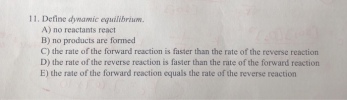 11. Define dynamic equilibriunm A) no reactants react B) no products are formed C) the rate of the forward reaction is faster than the rate of the reverse reaction D) the rate of the reverse reaction is faster than the rate of the forward reaction E) the rate of the forward reaction equals the rate of the reverse reaction
1. Predict the product(s) (or no reaction) and reagent(s). (31 pts; no partial point) ནོ། reagent(s):...
 1. Predict the product(s) (or no reaction) and reagent(s). (31
pts; no partial point)
ནོ། reagent(s): oH reagent(s): oH reagent(s): oH OH reagent(s): Br OFT reagent(s);
1. Predict the product(s) (or no reaction) and reagent(s). (31
pts; no partial point)
ནོ། reagent(s): oH reagent(s): oH reagent(s): oH OH reagent(s): Br OFT reagent(s);
4. Ouestion. Draw both Markovnikov and anti-Markovnikov proudu tur me following reaction, and predict the number...
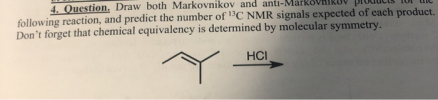 4. Ouestion. Draw both Markovnikov and anti-Markovnikov proudu tur me following reaction, and predict the number of 'C NMR signals expected of each product Don't forget that chemical equivalency is determined by molecular symmetry. HCI
(d) A 7.22 Predict the product of the reaction between phenol (C6H5OH) and each of the...
 (d) A 7.22 Predict the product of the reaction between phenol (C6H5OH) and each of the compounds shown here. Hint: First determine which elementary step is likely to occur. O MgBr (a) CH,OK MgBr (d) LIAIH CHELI
 please show arrow pushing, and I would upvote your
answer thank you
7.33 The agarose gel used for the electrophoresis of DNA is seaweed polysaccharide containing an unusual bicyclic subunit. An enzyme isolated from the red seaweed that produces the related polysaccharide porphyran has been shown to convert galactose 6-sulfate residues into the anhydrogalactosyl residues of agarose. Suggest a plausible!...
please show arrow pushing, and I would upvote your
answer thank you
7.33 The agarose gel used for the electrophoresis of DNA is seaweed polysaccharide containing an unusual bicyclic subunit. An enzyme isolated from the red seaweed that produces the related polysaccharide porphyran has been shown to convert galactose 6-sulfate residues into the anhydrogalactosyl residues of agarose. Suggest a plausible!...
 Hi. Can you please show me the step-by-step solution on
this one. (Please put labels on any formula so I can understand it
better). Thank you so much.
2Nal + Pb(NO3)2 + Pbl2 + 2NaNO3 32. If 4.61 grams of Pbl, was isolated from the reaction of Pb(NO3), and Nal, what will be the calculated amount of Nal that reacted...
Hi. Can you please show me the step-by-step solution on
this one. (Please put labels on any formula so I can understand it
better). Thank you so much.
2Nal + Pb(NO3)2 + Pbl2 + 2NaNO3 32. If 4.61 grams of Pbl, was isolated from the reaction of Pb(NO3), and Nal, what will be the calculated amount of Nal that reacted...
 PRACTICE the skill 19.8 Draw a plausible mechanism for each of the following transformations: EtO OEt MeO OMe H,SO excess EtOH [H2SO) excess MeOH -н.о H,O (b) (a) но Он M,SO но он H,SO -н,о O -н,о (d) (c) 19.9 The natural product frontalin is a pheromone isolated from the pine beetle Dendroctonus frontalis, a species that accounts for much...
 A particular reactant decomposes with a half-life of 131 s when its initial concentration is 0.285 M. The same reactant decomposes with a half-life of 221 s when its initial concentration is 0.169 M. Determine the reaction order. What is the value and units of the rate constant for this reaction? Units k =
 11. Define dynamic equilibriunm A) no reactants react B) no products are formed C) the rate of the forward reaction is faster than the rate of the reverse reaction D) the rate of the reverse reaction is faster than the rate of the forward reaction E) the rate of the forward reaction equals the rate of the reverse reaction
 1. Predict the product(s) (or no reaction) and reagent(s). (31
pts; no partial point)
ནོ། reagent(s): oH reagent(s): oH reagent(s): oH OH reagent(s): Br OFT reagent(s);
1. Predict the product(s) (or no reaction) and reagent(s). (31
pts; no partial point)
ནོ། reagent(s): oH reagent(s): oH reagent(s): oH OH reagent(s): Br OFT reagent(s);
 4. Ouestion. Draw both Markovnikov and anti-Markovnikov proudu tur me following reaction, and predict the number of 'C NMR signals expected of each product Don't forget that chemical equivalency is determined by molecular symmetry. HCI
 (d) A 7.22 Predict the product of the reaction between phenol (C6H5OH) and each of the compounds shown here. Hint: First determine which elementary step is likely to occur. O MgBr (a) CH,OK MgBr (d) LIAIH CHELI
Most questions answered within 3 hours.