pRINTER VERSION BACK Chapter 16, Problem 005 In Figure below the hand moves the end of...
 pRINTER VERSION BACK Chapter 16, Problem 005 In Figure below the hand moves the end of the Slinky up and down through two complete cycles in one second. The wave moves along the Slinky at a speed of 0.720 m/s. Find the distance between two adjacent crests on the wave Number Units lem the tolerance is +/-2% Click if you...
3. Consider the wave function (x, t) = Ae-2 -ut Where A, 2, and are positive...
 3. Consider the wave function (x, t) = Ae-2 -ut Where A, 2, and are positive real constants. (a) Normalize Y. (b) Determine the expectation values of x and x?. (c) Find the standard deviation of x. Sketch the graph of V', as a function of x, and mark the points (x) + a) and (x) -o to illustrate the...
Please explain Constants Part A (Figure 1)A cube has one comer at the origin and the...
 Please explain
Constants Part A (Figure 1)A cube has one comer at the origin and the opposite corner at the point (L, L, L). The sides of the cube are parallel to the coordinate planes. The electric field in and around the cube is given by Find the total electric flux dE through the surface of the cube. Express your...
Please explain
Constants Part A (Figure 1)A cube has one comer at the origin and the opposite corner at the point (L, L, L). The sides of the cube are parallel to the coordinate planes. The electric field in and around the cube is given by Find the total electric flux dE through the surface of the cube. Express your...
Part A Constants Find the total electric flux ФЕ through the surface of the cube (Figure...
 Part A Constants Find the total electric flux ФЕ through the surface of the cube (Figure 1)A cube has one corner at the origin and the opposite corner at the point (L, L, L) , where L = 5.5 m The sides of the cube are parallel to the coordinate planes. The electric field in and around the cube is...
TW6 traveling waves in opposite directions produce a standing wave. The individual wave functions are: Th6...
 TW6 traveling waves in opposite directions produce a standing wave. The individual wave functions are: Th6 traveling waves in opposite diretions produce a standing wave. The individual wave 4. y,-(4.0 cm) sin (3.0-2.00 y,-(4.0 cm) sin (3.0x + 2.00 where x and y are measured in centimeters. (a) Find the amplitude of the simple harmonic motion of the element of...
A standing wave pattern is created on a string with mass density μ = 3.1 ×...
A standing wave pattern is created on a string with mass density μ = 3.1 × 10⁻⁴ kg/m. A wave generator with frequency f = 68 Hz is attached to one end of the string and the other end goes over a pulley and is connected to a mass (ignore the weight of the string between the pulley and mass)....
The differences in electric potential or voltage (we use both terms interchangeably) can be used to...
The differences in electric potential or voltage (we use both terms interchangeably) can be used to determine changes in the electric potential energy of a charged object. If I have a particle with a charge q that is moving between two points in space which have a difference in electric potential (or voltage) of ΔV, the change in electric potential...
The differences in electric potential or voltage (we use both terms interchangeably) can be used to...
The differences in electric potential or voltage (we use both terms interchangeably) can be used to determine changes in the electric potential energy of a charged object. If I have a particle with a charge q that is moving between two points in space which have a difference in electric potential (or voltage) of ΔV, the change in electric potential...
A small, rectangular single loop of wire with dimensions l and a is placed, as shown...
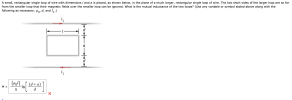 A small, rectangular single
loop of wire with dimensions l and a is placed, as shown below, in
the plane of a much larger, rectangular single loop of wire. The
two short sides of the larger loop are so far from the smaller loop
that their magnetic fields over the smaller loop can be ignored.
What is the mutual inductance...
A small, rectangular single
loop of wire with dimensions l and a is placed, as shown below, in
the plane of a much larger, rectangular single loop of wire. The
two short sides of the larger loop are so far from the smaller loop
that their magnetic fields over the smaller loop can be ignored.
What is the mutual inductance...
This project involves writing a program with functionality of your choosing. You must include the programming...
This project involves writing a program with functionality of your choosing. You must include the programming elements as described below and must adhere to the general requirements below. Programming elements: The code must contain the following elements: (You may complete one program containing all of these elements or you may submit more than one program where all program together contain...
 pRINTER VERSION BACK Chapter 16, Problem 005 In Figure below the hand moves the end of the Slinky up and down through two complete cycles in one second. The wave moves along the Slinky at a speed of 0.720 m/s. Find the distance between two adjacent crests on the wave Number Units lem the tolerance is +/-2% Click if you...
 3. Consider the wave function (x, t) = Ae-2 -ut Where A, 2, and are positive real constants. (a) Normalize Y. (b) Determine the expectation values of x and x?. (c) Find the standard deviation of x. Sketch the graph of V', as a function of x, and mark the points (x) + a) and (x) -o to illustrate the...
 Please explain
Constants Part A (Figure 1)A cube has one comer at the origin and the opposite corner at the point (L, L, L). The sides of the cube are parallel to the coordinate planes. The electric field in and around the cube is given by Find the total electric flux dE through the surface of the cube. Express your...
Please explain
Constants Part A (Figure 1)A cube has one comer at the origin and the opposite corner at the point (L, L, L). The sides of the cube are parallel to the coordinate planes. The electric field in and around the cube is given by Find the total electric flux dE through the surface of the cube. Express your...
 Part A Constants Find the total electric flux ФЕ through the surface of the cube (Figure 1)A cube has one corner at the origin and the opposite corner at the point (L, L, L) , where L = 5.5 m The sides of the cube are parallel to the coordinate planes. The electric field in and around the cube is...
 TW6 traveling waves in opposite directions produce a standing wave. The individual wave functions are: Th6 traveling waves in opposite diretions produce a standing wave. The individual wave 4. y,-(4.0 cm) sin (3.0-2.00 y,-(4.0 cm) sin (3.0x + 2.00 where x and y are measured in centimeters. (a) Find the amplitude of the simple harmonic motion of the element of...
 A small, rectangular single
loop of wire with dimensions l and a is placed, as shown below, in
the plane of a much larger, rectangular single loop of wire. The
two short sides of the larger loop are so far from the smaller loop
that their magnetic fields over the smaller loop can be ignored.
What is the mutual inductance...
A small, rectangular single
loop of wire with dimensions l and a is placed, as shown below, in
the plane of a much larger, rectangular single loop of wire. The
two short sides of the larger loop are so far from the smaller loop
that their magnetic fields over the smaller loop can be ignored.
What is the mutual inductance...
Most questions answered within 3 hours.