Diisopropyl ether reacts with concentrated aqueous HI to form two initial organic products (A and B). Further reactio...
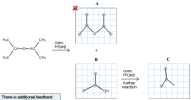 Diisopropyl ether reacts with concentrated aqueous HI to form two
initial organic products (A and B). Further reaction with HI
produces organic product C from product B. Draw the structures of
these three products.
Diisopropyl ether reacts with concentrated aqueous HI to form two
initial organic products (A and B). Further reaction with HI
produces organic product C from product B. Draw the structures of
these three products.
Benzyl ethyl ether reacts with concentrated aqueous HI to form two initial organic products (A and B). Further reaction...
Benzyl ethyl ether reacts with concentrated aqueous HI to form two initial organic products (A and B). Further reaction of product B with HI produces organic product C. Draw the structures of these three products.
Benzyl ethyl ether reacts with concentrated aqueous HI to form two initial organic products (A and B). Further reacti...
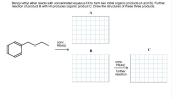 Benzyl ethyl ether reacts with concentrated aqueous HI to form
two initial organic products (A and B). Further reaction of product
B with HI produces organic product C. Draw the structures of these
three products.
Benzyl ethyl ether reacts with concentrated aqueous HI to form
two initial organic products (A and B). Further reaction of product
B with HI produces organic product C. Draw the structures of these
three products.
Given the activity series below (with cation charges listed), predict the outcome of the following mixtures....
 Given the activity series below (with cation charges listed), predict the outcome of the following mixtures. (Ifa reaction occurs, write formulas for the products and include phase labels and oefficients. If no reaction occurs, complete the equrtion by writing"NR.") Activity SeriesC) AMCNo a) 3co(NoCaa+ Au Cr/Cr3 Co/Co Au(s) + Cr NO3)3 (aq) resourcestnntes-
page d REACTIONS 3 Predict the maier productis) of the folowing reactions it you believe twe...
 page d REACTIONS 3 Predict the maier productis) of the folowing reactions it you believe twe products wil form show both (do not show more than twe) if you believe that no reaction willccur write "No Reaction (4 pts each) (2) н., но 1) NaBH (2) H" H3 c. 0 -СН d. + HO
9. Predict the products of the reactions below and balance the equations. If no reaction would...
 9. Predict the products of the reactions below and balance the equations. If no reaction would occur, write NR. (4 points each) (a) 241 +312 -2A113 (b) Ba(OH)2 + HBI BaBr 2 + H2O (c) C&H 206 + O2 → 10. What volume of a 2.00 M solution of AuCl2 would be necessary to give 1.65 g of AuCiz? (5...
(a) Calculate ?G for the reaction: 2H,000 H()+OH (ag) at 25 C given the following initial...
 (a) Calculate ?G for the reaction: 2H,000 H()+OH (ag) at 25 C given the following initial concentrations. HO] 1.0x 10⁻¹² M and (OH]- 20 x10* M (b) Predict the direction in which the reaction will proceed spontaneously to establish equilibrium. 10. The AG° for the reaction: N,(g)+3H,(g)0 2NH,(g) is 33.3 kJ/mol at 25°C. What is the value of Kp?
I need help with this. If possible be as thorough as possible. Any explanations would be...
 I need help with this. If possible be as thorough as possible.
Any explanations would be greatly appreciated. This wasn't covered
very well so I'm trying to understand it.
(1) Radical bromination- predict the structure of the major and minor products in the overall reaction given below. Provide a mechanism leading to each, using appropriate curved arrow notation, and a...
I need help with this. If possible be as thorough as possible.
Any explanations would be greatly appreciated. This wasn't covered
very well so I'm trying to understand it.
(1) Radical bromination- predict the structure of the major and minor products in the overall reaction given below. Provide a mechanism leading to each, using appropriate curved arrow notation, and a...
Predict the products of the acid-base reaction between the following substances: Interactive 3D display mode Draw...
 Predict the products of the acid-base reaction between the following substances: Interactive 3D display mode Draw the molecules or ions on the canvas by choosing buttons from the Tools (for bonds), Atoms, and Advanced Template toolbars, including charges where needed. The single bond is active by default.
Question 3 (a) Predict the products A-F of the following reactions (no mechanisms are required): Na...
 Question 3 (a) Predict the products A-F of the following reactions (no mechanisms are required): Na CO2 A NO2 Na SME HNMez POCI3 HNO3, H2SO4 H2, Pd/C NaNO2, HCI then H2O, warm [6 marks) (b) Suggest a mechanism for the following reaction: H2SO4
 Benzyl ethyl ether reacts with concentrated aqueous HI to form
two initial organic products (A and B). Further reaction of product
B with HI produces organic product C. Draw the structures of these
three products.
Benzyl ethyl ether reacts with concentrated aqueous HI to form
two initial organic products (A and B). Further reaction of product
B with HI produces organic product C. Draw the structures of these
three products.
 Given the activity series below (with cation charges listed), predict the outcome of the following mixtures. (Ifa reaction occurs, write formulas for the products and include phase labels and oefficients. If no reaction occurs, complete the equrtion by writing"NR.") Activity SeriesC) AMCNo a) 3co(NoCaa+ Au Cr/Cr3 Co/Co Au(s) + Cr NO3)3 (aq) resourcestnntes-
 page d REACTIONS 3 Predict the maier productis) of the folowing reactions it you believe twe products wil form show both (do not show more than twe) if you believe that no reaction willccur write "No Reaction (4 pts each) (2) н., но 1) NaBH (2) H" H3 c. 0 -СН d. + HO
 9. Predict the products of the reactions below and balance the equations. If no reaction would occur, write NR. (4 points each) (a) 241 +312 -2A113 (b) Ba(OH)2 + HBI BaBr 2 + H2O (c) C&H 206 + O2 → 10. What volume of a 2.00 M solution of AuCl2 would be necessary to give 1.65 g of AuCiz? (5...
 (a) Calculate ?G for the reaction: 2H,000 H()+OH (ag) at 25 C given the following initial concentrations. HO] 1.0x 10⁻¹² M and (OH]- 20 x10* M (b) Predict the direction in which the reaction will proceed spontaneously to establish equilibrium. 10. The AG° for the reaction: N,(g)+3H,(g)0 2NH,(g) is 33.3 kJ/mol at 25°C. What is the value of Kp?
 I need help with this. If possible be as thorough as possible.
Any explanations would be greatly appreciated. This wasn't covered
very well so I'm trying to understand it.
(1) Radical bromination- predict the structure of the major and minor products in the overall reaction given below. Provide a mechanism leading to each, using appropriate curved arrow notation, and a...
I need help with this. If possible be as thorough as possible.
Any explanations would be greatly appreciated. This wasn't covered
very well so I'm trying to understand it.
(1) Radical bromination- predict the structure of the major and minor products in the overall reaction given below. Provide a mechanism leading to each, using appropriate curved arrow notation, and a...
 Predict the products of the acid-base reaction between the following substances: Interactive 3D display mode Draw the molecules or ions on the canvas by choosing buttons from the Tools (for bonds), Atoms, and Advanced Template toolbars, including charges where needed. The single bond is active by default.
 Question 3 (a) Predict the products A-F of the following reactions (no mechanisms are required): Na CO2 A NO2 Na SME HNMez POCI3 HNO3, H2SO4 H2, Pd/C NaNO2, HCI then H2O, warm [6 marks) (b) Suggest a mechanism for the following reaction: H2SO4
Most questions answered within 3 hours.