There is a loop with a radius of R, on the xy plane. The non-uniform time...
 There is a loop with a radius of R, on the xy plane. The
non-uniform time dependent magnetic field is
What is the electric field in the wire, and at what
direction?
There is a loop with a radius of R, on the xy plane. The
non-uniform time dependent magnetic field is
What is the electric field in the wire, and at what
direction?
3. How can the motion of a charged particle be used to distinguish between a magnetic...
3. How can the motion of a charged particle be used to distinguish between a magnetic and an electric field? -Step by Step -Please draw diagram
Help please This question has several parts that must be completed sequentially. If you skip a...
 Help please
This question has several parts that must be completed sequentially. If you skip a part of the question, you will not receive any points for the skipped part, and you will not be able to come back to the skipped part. Two point charges Q_1 = +4.85 nC and Q_2= -2.15 nC are separated by 40.0 cm. (a)...
Help please
This question has several parts that must be completed sequentially. If you skip a part of the question, you will not receive any points for the skipped part, and you will not be able to come back to the skipped part. Two point charges Q_1 = +4.85 nC and Q_2= -2.15 nC are separated by 40.0 cm. (a)...
BONUS: Electron Cloud In the Bohr model of hydrogen, the electron is treated as a point...
 BONUS: Electron Cloud In the Bohr model of hydrogen, the electron is treated as a point particle orbiting the nucleus at a distance of Og . 5.3. 10-11 m Reality is not so simple, however. The charge of the electron is distributed around the nucleus in a spherically symmetrie, nonuniform manner. (ais merely the most probable distance between the electron...
At a specific point along a rope the displacement of a transverse wave can be described...
At a specific point along a rope the displacement of a transverse wave can be described by the equation y=(5.20cm)sin(8.00*π*t). What is the angular frequency of the wave?
Problem from NN Rao Fundamentals Of Electromagnetic Engineering 2a, - 2a, + a). and ps is positive. Find ps and J at that I.J.H point. 0.1 535. Two infinite plane conducting sheets occupy the plan...
 Problem from NN Rao Fundamentals Of Electromagnetic
Engineering
2a, - 2a, + a). and ps is positive. Find ps and J at that I.J.H point. 0.1 535. Two infinite plane conducting sheets occupy the planes0and electric 5.35. Two infinite plane conducting sheets occupy the planes 0and 0.1 m. Anelectric field given by E - Epsin 10ms cos 3r x 10%...
Problem from NN Rao Fundamentals Of Electromagnetic
Engineering
2a, - 2a, + a). and ps is positive. Find ps and J at that I.J.H point. 0.1 535. Two infinite plane conducting sheets occupy the planes0and electric 5.35. Two infinite plane conducting sheets occupy the planes 0and 0.1 m. Anelectric field given by E - Epsin 10ms cos 3r x 10%...
4) A proton (q 1.6x10" C. m-1.67 10 kg) is accelerated from rest vo a speed of 5 0x 104 m's then ...
 4) A proton (q 1.6x10" C. m-1.67 10 kg) is accelerated from rest vo a speed of 5 0x 104 m's then the proton enters a magnetic neid of 0 080 T oriented perpendioar to its direction of motion (into tha page) al Draw the trajectory of the proton (4) n the magnetic field Which way the does the trajecory...
Think of the square as one face of a cube with edge d.) d/2 6 At...
 Think of the square as one face of a cube with edge d.) d/2 6 At each point on the surface of the cube shown in Fig. 23-27, the electric field is parallel to the z axis. The length of each edge of the cube is 3.0 m. On the top face of the cube the field is E= Fig....
Two uniform spherical charge distributions (see figure below) each have a total charge of 86.8 mC...
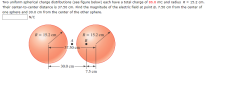 Two uniform spherical charge distributions (see figure below) each have a total charge of 86.8 mC and radius R15.2 cm. Their center-to-center distance is 37.50 cm. Find the magnitude of the electric field at point B, 7.50 cm from the center of one sphere and 30.0 cm from the center of the other sphere. R 15.2 cm R 15.2 cm...
At a distance of 1.62 m from a point charge of +2.53 μC, there is an...
At a distance of 1.62 m from a point charge of +2.53 μC, there is an equipotneial surface. At greater distances there are additional equipotential surfaces. The potential difference between any two successive surfaces is 2.18 x 10³ V. Starting at a distance of 1.62 m and moving radially outward, how many of the additional equipotential surfaces are crossed by...
 There is a loop with a radius of R, on the xy plane. The
non-uniform time dependent magnetic field is
What is the electric field in the wire, and at what
direction?
There is a loop with a radius of R, on the xy plane. The
non-uniform time dependent magnetic field is
What is the electric field in the wire, and at what
direction?
 Help please
This question has several parts that must be completed sequentially. If you skip a part of the question, you will not receive any points for the skipped part, and you will not be able to come back to the skipped part. Two point charges Q_1 = +4.85 nC and Q_2= -2.15 nC are separated by 40.0 cm. (a)...
Help please
This question has several parts that must be completed sequentially. If you skip a part of the question, you will not receive any points for the skipped part, and you will not be able to come back to the skipped part. Two point charges Q_1 = +4.85 nC and Q_2= -2.15 nC are separated by 40.0 cm. (a)...
 BONUS: Electron Cloud In the Bohr model of hydrogen, the electron is treated as a point particle orbiting the nucleus at a distance of Og . 5.3. 10-11 m Reality is not so simple, however. The charge of the electron is distributed around the nucleus in a spherically symmetrie, nonuniform manner. (ais merely the most probable distance between the electron...
 Problem from NN Rao Fundamentals Of Electromagnetic
Engineering
2a, - 2a, + a). and ps is positive. Find ps and J at that I.J.H point. 0.1 535. Two infinite plane conducting sheets occupy the planes0and electric 5.35. Two infinite plane conducting sheets occupy the planes 0and 0.1 m. Anelectric field given by E - Epsin 10ms cos 3r x 10%...
Problem from NN Rao Fundamentals Of Electromagnetic
Engineering
2a, - 2a, + a). and ps is positive. Find ps and J at that I.J.H point. 0.1 535. Two infinite plane conducting sheets occupy the planes0and electric 5.35. Two infinite plane conducting sheets occupy the planes 0and 0.1 m. Anelectric field given by E - Epsin 10ms cos 3r x 10%...
 4) A proton (q 1.6x10" C. m-1.67 10 kg) is accelerated from rest vo a speed of 5 0x 104 m's then the proton enters a magnetic neid of 0 080 T oriented perpendioar to its direction of motion (into tha page) al Draw the trajectory of the proton (4) n the magnetic field Which way the does the trajecory...
 Think of the square as one face of a cube with edge d.) d/2 6 At each point on the surface of the cube shown in Fig. 23-27, the electric field is parallel to the z axis. The length of each edge of the cube is 3.0 m. On the top face of the cube the field is E= Fig....
 Two uniform spherical charge distributions (see figure below) each have a total charge of 86.8 mC and radius R15.2 cm. Their center-to-center distance is 37.50 cm. Find the magnitude of the electric field at point B, 7.50 cm from the center of one sphere and 30.0 cm from the center of the other sphere. R 15.2 cm R 15.2 cm...
Most questions answered within 3 hours.