125% Zoom T Insert HE Table T Text View Chart Shape Media Comment Collaborate Format Document...
 125% Zoom T Insert HE Table T Text View Chart Shape Media Comment Collaborate Format Document Text Body Question 2 (Parts A-C, 20 points): Use the energy diagrams shown below to answer parts A and B. Style Layout More Font Transition state Transition state - Products Arial ..... ............ Regular 12 pt Reactants Energy Energy Character Styles None* Reactants Products...
The net-ionic equation for an acid base reaction involves transfer of a proton (H ion) from...
 The net-ionic equation for an acid base reaction involves transfer of a proton (H ion) from the acid to the base. The products represent the conjugate base and acid of the reacting acid and base. The net-ionic equation for this system is shown here. HF-CN= F-HCN If you compare two acids and one is stronger than the other, how do...
Problem 2 (15 points, 3 points each). Supply the substrates), reaction condition(s) or the produc...
 Problem 2 (15 points, 3 points each). Supply the substrates), reaction condition(s) or the products) needed to complete each of the following transformations. If multiple enantiomers, diastereomers, or regioisomers are formed, they must be indicated for full credit. You do not need to labal major and minor products. In some cases, no reaction may occur. Assume an aqueous workup step...
this queastions are related to Organic chemistry I they are a numbers QUESTIOON 4 Order the general strategy for the...
 this queastions are related to Organic chemistry I
they are a numbers
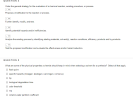
QUESTIOON 4 Order the general strategy for the evaluation of a chemical reaction, existing procedure, or process Propose a modification to the reaction or process. Further identify, modify, and test. Identify potential hazards and/or inefficiencies Analyze the existing process by identifying starting materials, solvent(s), reaction conditions, efficiency, products...
this queastions are related to Organic chemistry I
they are a numbers
QUESTIOON 4 Order the general strategy for the evaluation of a chemical reaction, existing procedure, or process Propose a modification to the reaction or process. Further identify, modify, and test. Identify potential hazards and/or inefficiencies Analyze the existing process by identifying starting materials, solvent(s), reaction conditions, efficiency, products...
The table shows the rate of reaction for two unknown time intervals during the course of a reaction. Reaction Rates...
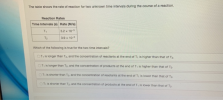 The table shows the rate of reaction for two unknown time intervals during the course of a reaction. Reaction Rates Time Intervals (s) Rate (M/s) 3.2 x 10⁻³ T1 3.9 x 10⁻³ T2 Which of the following is true for the two time intervals? OTis longer than T2, and the concentration of reactants at the end of T is higher...
Using the activity series, predict whether the following reactions would be expected to proceed spontaneously. Cu...
 Using the activity series, predict whether the following reactions would be expected to proceed spontaneously. Cu (*) + 2Ag (aq) → Cu²+ (aq) + 2Ag (6) a.) Will proceed spontaneously b.) will not proceed spontaneously Using the activity series, predict whether the following reactions would be expected to proceed spontaneously. Mg (6) + Fe2+ → Mg²+ (aq) + Fe (3)...
estion 13 of 16 > Initial rate data at a certain temperature is given in the...
 estion 13 of 16 > Initial rate data at a certain temperature is given in the table for the following reaction. 2 NOBr(g) 2 NO(g) + Br, (g) [NOBr),(M) 0.600 Initial rate of formation of Br, (M/s) 1.08 x 10 1.69 x 10 2.43 x 10² 0.750 0.900 Determine the value and units of the rate constant, k. k= Units:
2. The rate of the reaction 2A+B → has been observed at 25°C. From the following...
 2. The rate of the reaction 2A+B → has been observed at 25°C. From the following data, determine the rate law for the reaction and calculate the rate constant. Experiment ) 2 3 4 5 Initial IAI(M) 0.100 0.200 0.400 0.100 0.100 Initial ( B M 0.100 0.100 0.100 0.300 0.600 Initial rate (M/s) 5.50 x 10⁶ 2.20 x 10...
In the following reaction: N,04(8) Na(g) +20,(g) + energy, if the temperature is increased the equilibrium...
 In the following reaction: N,04(8) Na(g) +20,(g) + energy, if the temperature is increased the equilibrium will shift to favor. a. the forward reaction (more products) c. both the forward and the reverse reaction b. the reverse reaction (more reactants) d. neither the forward nor the reverse reaction c o Od
 125% Zoom T Insert HE Table T Text View Chart Shape Media Comment Collaborate Format Document Text Body Question 2 (Parts A-C, 20 points): Use the energy diagrams shown below to answer parts A and B. Style Layout More Font Transition state Transition state - Products Arial ..... ............ Regular 12 pt Reactants Energy Energy Character Styles None* Reactants Products...
 The net-ionic equation for an acid base reaction involves transfer of a proton (H ion) from the acid to the base. The products represent the conjugate base and acid of the reacting acid and base. The net-ionic equation for this system is shown here. HF-CN= F-HCN If you compare two acids and one is stronger than the other, how do...
 Problem 2 (15 points, 3 points each). Supply the substrates), reaction condition(s) or the products) needed to complete each of the following transformations. If multiple enantiomers, diastereomers, or regioisomers are formed, they must be indicated for full credit. You do not need to labal major and minor products. In some cases, no reaction may occur. Assume an aqueous workup step...
 this queastions are related to Organic chemistry I
they are a numbers
QUESTIOON 4 Order the general strategy for the evaluation of a chemical reaction, existing procedure, or process Propose a modification to the reaction or process. Further identify, modify, and test. Identify potential hazards and/or inefficiencies Analyze the existing process by identifying starting materials, solvent(s), reaction conditions, efficiency, products...
this queastions are related to Organic chemistry I
they are a numbers
QUESTIOON 4 Order the general strategy for the evaluation of a chemical reaction, existing procedure, or process Propose a modification to the reaction or process. Further identify, modify, and test. Identify potential hazards and/or inefficiencies Analyze the existing process by identifying starting materials, solvent(s), reaction conditions, efficiency, products...
 The table shows the rate of reaction for two unknown time intervals during the course of a reaction. Reaction Rates Time Intervals (s) Rate (M/s) 3.2 x 10⁻³ T1 3.9 x 10⁻³ T2 Which of the following is true for the two time intervals? OTis longer than T2, and the concentration of reactants at the end of T is higher...
 Using the activity series, predict whether the following reactions would be expected to proceed spontaneously. Cu (*) + 2Ag (aq) → Cu²+ (aq) + 2Ag (6) a.) Will proceed spontaneously b.) will not proceed spontaneously Using the activity series, predict whether the following reactions would be expected to proceed spontaneously. Mg (6) + Fe2+ → Mg²+ (aq) + Fe (3)...
 estion 13 of 16 > Initial rate data at a certain temperature is given in the table for the following reaction. 2 NOBr(g) 2 NO(g) + Br, (g) [NOBr),(M) 0.600 Initial rate of formation of Br, (M/s) 1.08 x 10 1.69 x 10 2.43 x 10² 0.750 0.900 Determine the value and units of the rate constant, k. k= Units:
 2. The rate of the reaction 2A+B → has been observed at 25°C. From the following data, determine the rate law for the reaction and calculate the rate constant. Experiment ) 2 3 4 5 Initial IAI(M) 0.100 0.200 0.400 0.100 0.100 Initial ( B M 0.100 0.100 0.100 0.300 0.600 Initial rate (M/s) 5.50 x 10⁶ 2.20 x 10...
 In the following reaction: N,04(8) Na(g) +20,(g) + energy, if the temperature is increased the equilibrium will shift to favor. a. the forward reaction (more products) c. both the forward and the reverse reaction b. the reverse reaction (more reactants) d. neither the forward nor the reverse reaction c o Od
Most questions answered within 3 hours.