5. This reaction uses water as a solvent to efficiently prepare the Diels-Alder product, even though the reactants...
 5. This reaction uses water as a solvent to efficiently prepare the Diels-Alder product, even though the reactants and products are not soluble in water. Explain what is meant by "hydrophobic effect" and how it is used in the context of this reaction. You may use the back side of this worksheet to answer the question. (4 pts) IC
5....
5. This reaction uses water as a solvent to efficiently prepare the Diels-Alder product, even though the reactants and products are not soluble in water. Explain what is meant by "hydrophobic effect" and how it is used in the context of this reaction. You may use the back side of this worksheet to answer the question. (4 pts) IC
5....
Enthalpy of Combustion -- Alkanes Write a balanced equation for the combustion of C9H20(l) (nonane) --...
Enthalpy of Combustion -- Alkanes Write a balanced equation for the combustion of C9H20(l) (nonane) -- i.e. its reaction with O2(g) forming the products CO2(g) and H2O(l). Given the following standard heats of formation: ΔHf° of CO2(g) is -393.5 kJ/mol ΔHf° of H2O(l) is -286 kJ/mol ΔHf° of C9H20(l) is -229.0 kJ/mol What is the standard heat of reaction (ΔH°)...
Complete the mechanism for the reaction of butanone hydrate to produce butanone under conditinos of NaOH...
 Complete the mechanism for the reaction of butanone hydrate to produce butanone under conditinos of NaOH in water. A reversible reaction takes place, but we will just draw the arrows for formation of the carbonyl in this problem. :0: Hö: OH NaOH H2O :0: Step Step H-Ö ÖH OH : HT Two One :0H Draw the arrows for the 3-step...
just 18&19 The following questions refer to the reaction shown below: Initial Rate of Initial [A...
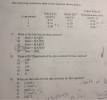 just 18&19
The following questions refer to the reaction shown below: Initial Rate of Initial [A (mol/L) 0.16 Initial [B] (mol/L) 0.15 Disappearance of A (mol/L s) Experiment 1 0.08 N 0.30 0.082 2 0.16 *2 0.08 0.30 0.30 3 17. What is the rate law for this reaction? Rate = k[A][B] a) Rate k[A][B] b) Rate = k[A][B]2 c)...
just 18&19
The following questions refer to the reaction shown below: Initial Rate of Initial [A (mol/L) 0.16 Initial [B] (mol/L) 0.15 Disappearance of A (mol/L s) Experiment 1 0.08 N 0.30 0.082 2 0.16 *2 0.08 0.30 0.30 3 17. What is the rate law for this reaction? Rate = k[A][B] a) Rate k[A][B] b) Rate = k[A][B]2 c)...
28 its Data representing initial concentrations and initial rates for the following reaction are given below....
 28 its Data representing initial concentrations and initial rates for the following reaction are given below. Choose the correct rate expression. 20102(aq) + 2OH"(aq) + CIO, (aq) + CO2 (aq) + H2O(1) Exp. No. 1 [CIO2lo (M) 0.060 0.020 0.020 [OH-]o (M) 0.030 0.030 0.090 2 3 Initial Rate (Ms) 0.0248 0.00276 0.00828 rate = k (CIO) (OH)2 ratek (CIO)...
here is the questions The Equilibrium Reaction to Form Ethyl Ethanoate at 20°C Initial Initial Equilibrium...
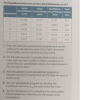 here is the questions
The Equilibrium Reaction to Form Ethyl Ethanoate at 20°C Initial Initial Equilibrium Total CH,COOH(aq) CH.CH, OH(aq) CH,COOH(aq) volume Experiment (mol) (mol) mol (ml) 0.220 0.114 0.125 38.1 2 0.184 0.115 0.0917 40.3 3 0.152 0.121 0.0631 39.4 0.214 0.132 0.110 42.6 0.233 0.137 0.122 41.5 1. Enter the data into a spreadsheet program and use the...
here is the questions
The Equilibrium Reaction to Form Ethyl Ethanoate at 20°C Initial Initial Equilibrium Total CH,COOH(aq) CH.CH, OH(aq) CH,COOH(aq) volume Experiment (mol) (mol) mol (ml) 0.220 0.114 0.125 38.1 2 0.184 0.115 0.0917 40.3 3 0.152 0.121 0.0631 39.4 0.214 0.132 0.110 42.6 0.233 0.137 0.122 41.5 1. Enter the data into a spreadsheet program and use the...
20) Part 1: Provide a step-by-step mechanism (using arrows to show electron movement) to show how...
 20) Part 1: Provide a step-by-step mechanism (using arrows to show electron movement) to show how the below reaction occurs. Be sure to draw ALL intermediates and movement of electrons to appropriately justify the given product. NOTE: It is not necessary for you to add other reagents that are not shown OR include other possible products that can be formed...
Test Your Skill: Initial Rate Given the following data write the rate law for the reaction:...
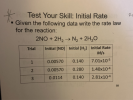 Test Your Skill: Initial Rate Given the following data write the rate law for the reaction: 2NO 2H2 N2+2H20 Initial Rate Initial [H,] Trial Initial [NO] M/s 7.01x10⁻⁵ 0.140 0.00570 1 1.40x10⁴ 0.280 0.00570 2 2.81x10⁻⁴ 0.140 0.0114 3 89
2. Kinetics of an Oscillating Reaction Oscillating reactions are a special kind of chemical reactions and are characterized by an elementary reaction in which at least one of the reactant is also...
 2. Kinetics of an Oscillating Reaction Oscillating reactions are a special kind of chemical reactions and are characterized by an elementary reaction in which at least one of the reactant is also a product. An example of a series of elementary reactions of an oscilating reaction is below: ka (a) Identify the autocatalytic reacton i.e, a reaction in which the...
Exercises Predict which of the following will react spontaneously in the standard state. Keep in mind...
 Exercises Predict which of the following will react spontaneously in the standard state. Keep in mind that not all reactions are oxidation-reduction. Write balanced net ionic equations for reactions which occur. If no reaction occurs in the forward direction, write "no reaction". 1. H2(g) + Ag*(aq) 2. r(aq) + Zn2+(ag) 3. Cl(aq) + Agt(ag) 4. Fe2(aq) + MnO4 (aq) (in...
 5. This reaction uses water as a solvent to efficiently prepare the Diels-Alder product, even though the reactants and products are not soluble in water. Explain what is meant by "hydrophobic effect" and how it is used in the context of this reaction. You may use the back side of this worksheet to answer the question. (4 pts) IC
5....
5. This reaction uses water as a solvent to efficiently prepare the Diels-Alder product, even though the reactants and products are not soluble in water. Explain what is meant by "hydrophobic effect" and how it is used in the context of this reaction. You may use the back side of this worksheet to answer the question. (4 pts) IC
5....
 Complete the mechanism for the reaction of butanone hydrate to produce butanone under conditinos of NaOH in water. A reversible reaction takes place, but we will just draw the arrows for formation of the carbonyl in this problem. :0: Hö: OH NaOH H2O :0: Step Step H-Ö ÖH OH : HT Two One :0H Draw the arrows for the 3-step...
 just 18&19
The following questions refer to the reaction shown below: Initial Rate of Initial [A (mol/L) 0.16 Initial [B] (mol/L) 0.15 Disappearance of A (mol/L s) Experiment 1 0.08 N 0.30 0.082 2 0.16 *2 0.08 0.30 0.30 3 17. What is the rate law for this reaction? Rate = k[A][B] a) Rate k[A][B] b) Rate = k[A][B]2 c)...
just 18&19
The following questions refer to the reaction shown below: Initial Rate of Initial [A (mol/L) 0.16 Initial [B] (mol/L) 0.15 Disappearance of A (mol/L s) Experiment 1 0.08 N 0.30 0.082 2 0.16 *2 0.08 0.30 0.30 3 17. What is the rate law for this reaction? Rate = k[A][B] a) Rate k[A][B] b) Rate = k[A][B]2 c)...
 28 its Data representing initial concentrations and initial rates for the following reaction are given below. Choose the correct rate expression. 20102(aq) + 2OH"(aq) + CIO, (aq) + CO2 (aq) + H2O(1) Exp. No. 1 [CIO2lo (M) 0.060 0.020 0.020 [OH-]o (M) 0.030 0.030 0.090 2 3 Initial Rate (Ms) 0.0248 0.00276 0.00828 rate = k (CIO) (OH)2 ratek (CIO)...
 here is the questions
The Equilibrium Reaction to Form Ethyl Ethanoate at 20°C Initial Initial Equilibrium Total CH,COOH(aq) CH.CH, OH(aq) CH,COOH(aq) volume Experiment (mol) (mol) mol (ml) 0.220 0.114 0.125 38.1 2 0.184 0.115 0.0917 40.3 3 0.152 0.121 0.0631 39.4 0.214 0.132 0.110 42.6 0.233 0.137 0.122 41.5 1. Enter the data into a spreadsheet program and use the...
here is the questions
The Equilibrium Reaction to Form Ethyl Ethanoate at 20°C Initial Initial Equilibrium Total CH,COOH(aq) CH.CH, OH(aq) CH,COOH(aq) volume Experiment (mol) (mol) mol (ml) 0.220 0.114 0.125 38.1 2 0.184 0.115 0.0917 40.3 3 0.152 0.121 0.0631 39.4 0.214 0.132 0.110 42.6 0.233 0.137 0.122 41.5 1. Enter the data into a spreadsheet program and use the...
 20) Part 1: Provide a step-by-step mechanism (using arrows to show electron movement) to show how the below reaction occurs. Be sure to draw ALL intermediates and movement of electrons to appropriately justify the given product. NOTE: It is not necessary for you to add other reagents that are not shown OR include other possible products that can be formed...
 Test Your Skill: Initial Rate Given the following data write the rate law for the reaction: 2NO 2H2 N2+2H20 Initial Rate Initial [H,] Trial Initial [NO] M/s 7.01x10⁻⁵ 0.140 0.00570 1 1.40x10⁴ 0.280 0.00570 2 2.81x10⁻⁴ 0.140 0.0114 3 89
 2. Kinetics of an Oscillating Reaction Oscillating reactions are a special kind of chemical reactions and are characterized by an elementary reaction in which at least one of the reactant is also a product. An example of a series of elementary reactions of an oscilating reaction is below: ka (a) Identify the autocatalytic reacton i.e, a reaction in which the...
 Exercises Predict which of the following will react spontaneously in the standard state. Keep in mind that not all reactions are oxidation-reduction. Write balanced net ionic equations for reactions which occur. If no reaction occurs in the forward direction, write "no reaction". 1. H2(g) + Ag*(aq) 2. r(aq) + Zn2+(ag) 3. Cl(aq) + Agt(ag) 4. Fe2(aq) + MnO4 (aq) (in...
Most questions answered within 3 hours.