2. Predict the major product formed in each of the following reactions, write if the reaction...
 2. Predict the major product formed in each of the following reactions, write if the reaction is regioselective and/ or stereospecific (particular stereoisomers are obtained) in relevant cases (5 x 2 = 10 points): Ô 1 mol of t, Parc 1 mole of H2, Pd/C e. MeQH is in a large excess. Write product/s of the reaction using Fischer projection....
The carboxylate group on the amino acid valine is activated in an early step in the...
 The carboxylate group on the amino acid valine is activated in an early step in the biosynthesis of the antibiotic penicillin. Predict the product of this reaction and draw the likely intermediate of the phosphate group transfer reaction. Feel free to use "R" for the adenosine (nucleic acid and sugar) portion of ATP in your structures. ATP PP H₃N co...
1. Draw all constitutional isomers formed in the elimination reaction and predict the major product using...
 1. Draw all constitutional isomers formed in the elimination reaction and predict the major product using the Zaitsev rule. A . KOCICH ! KOC(CH) 2. Draw all possible elimination reaction product(s) for the following alkyl halide. 4. Classify the following alkenes as mono, di-, tri, or tetra- substituted alkenes. Then, circle the most stable one. thayo by my 5. Which...
Data Sheet Table 2: Temperature, Pressure, and Volume Data Temperature of Tap Water (°C) Room (or...
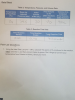 Data Sheet Table 2: Temperature, Pressure, and Volume Data Temperature of Tap Water (°C) Room (or regional) Pressure (atm) Initial Volume of Air (mL) Final Volume of Air (after reaction) (mL) Volume of O2 Collected (Final Volume - Initial Volume) 24 29.5 TO 40mL Table 3: Reaction Time Data Time Reaction Started Time Reaction Ended Total Reaction Time 0,00 0.40...
8. From standard enthalpies of formation, standard entropies, and standard heat capacities available from tables in...
 8. From standard enthalpies of formation, standard entropies, and standard heat capacities available from tables in the Data section (pp 572-579), calculate the standard enthalpies and entropies at 298 K and 398 K for the reaction CO2(g)+ H2(g) -> CO(g) + H20(g). Assume that the heat capacities are constant over the temperature range involved. Recall that the standard reaction enthalpy...
please help 13. The reaction of 3-methyl-1-phenylbutane with chlorine yields four different monochlorination products via a...
 please help
13. The reaction of 3-methyl-1-phenylbutane with chlorine yields four different monochlorination products via a free radical mechanism. The experimental distribution of these products is given below. Use this information to determine the relative reactivity of the primary, secondary, tertiary and secondary benzylic hydrogens under these reaction conditions. SHOW ALL WORK!!! on a ou on oso ona 66.27% 12.54%...
please help
13. The reaction of 3-methyl-1-phenylbutane with chlorine yields four different monochlorination products via a free radical mechanism. The experimental distribution of these products is given below. Use this information to determine the relative reactivity of the primary, secondary, tertiary and secondary benzylic hydrogens under these reaction conditions. SHOW ALL WORK!!! on a ou on oso ona 66.27% 12.54%...
11) Circle the compounds shown below that are classifed as Arrhenius acids, and underline the compounds...
 11) Circle the compounds shown below that are classifed as Arrhenius acids, and underline the compounds shown below that are classified as Arrhenius bases. Do nothing to molecules that are neither acids or bases: NaOH Pb(OH). Pb(CO), (NHJ),CO, H.PO KCIO, HCIO, (6) 2) Consider the acid base reaction shown below. CO + H,SO. HCO, + HSO. a) Which of these...
Most reactions occur by a series of steps. The energy profile for a certain reaction that...
 Most reactions occur by a series of steps. The energy profile for a certain reaction that proceeds by a two-step mechanism is shown below. 2 1 Reaction coordinate In regard to the energy profile, identify the following. (a) The positions of reactants and products reaction coordinate for reactants 1 reaction coordinate for products 3 (b) The activation energy for the...
5 2. Predict the products of the following reactions. HOOH H30+ 1. excess CH3CH2MgBr 2. H30*...
 5 2. Predict the products of the following reactions. HOOH H30+ 1. excess CH3CH2MgBr 2. H30* H30* 8 carbonyl and amine H30* 3. The following reactions are incorrect, showing the wrong product (or at least not the major product). Please provide the correct product and a brief explanation. HO 2. excess CH3LI 3. H30* Correct Product H30* Correct Product
3. (5pts each) For the following reactions, in each box please provide the missing reage or...
 3. (5pts each) For the following reactions, in each box please provide the missing reage or predict the reactants or major products. 1) LDA 2) a. Br Br b. ОН ix x PPh3 c. H d. NaOH, H2O, heat 2eq GE2 e. キミのIII f. -GEN 1) Me-MgBr 2) H,0
 2. Predict the major product formed in each of the following reactions, write if the reaction is regioselective and/ or stereospecific (particular stereoisomers are obtained) in relevant cases (5 x 2 = 10 points): Ô 1 mol of t, Parc 1 mole of H2, Pd/C e. MeQH is in a large excess. Write product/s of the reaction using Fischer projection....
 The carboxylate group on the amino acid valine is activated in an early step in the biosynthesis of the antibiotic penicillin. Predict the product of this reaction and draw the likely intermediate of the phosphate group transfer reaction. Feel free to use "R" for the adenosine (nucleic acid and sugar) portion of ATP in your structures. ATP PP H₃N co...
 1. Draw all constitutional isomers formed in the elimination reaction and predict the major product using the Zaitsev rule. A . KOCICH ! KOC(CH) 2. Draw all possible elimination reaction product(s) for the following alkyl halide. 4. Classify the following alkenes as mono, di-, tri, or tetra- substituted alkenes. Then, circle the most stable one. thayo by my 5. Which...
 Data Sheet Table 2: Temperature, Pressure, and Volume Data Temperature of Tap Water (°C) Room (or regional) Pressure (atm) Initial Volume of Air (mL) Final Volume of Air (after reaction) (mL) Volume of O2 Collected (Final Volume - Initial Volume) 24 29.5 TO 40mL Table 3: Reaction Time Data Time Reaction Started Time Reaction Ended Total Reaction Time 0,00 0.40...
 8. From standard enthalpies of formation, standard entropies, and standard heat capacities available from tables in the Data section (pp 572-579), calculate the standard enthalpies and entropies at 298 K and 398 K for the reaction CO2(g)+ H2(g) -> CO(g) + H20(g). Assume that the heat capacities are constant over the temperature range involved. Recall that the standard reaction enthalpy...
 please help
13. The reaction of 3-methyl-1-phenylbutane with chlorine yields four different monochlorination products via a free radical mechanism. The experimental distribution of these products is given below. Use this information to determine the relative reactivity of the primary, secondary, tertiary and secondary benzylic hydrogens under these reaction conditions. SHOW ALL WORK!!! on a ou on oso ona 66.27% 12.54%...
please help
13. The reaction of 3-methyl-1-phenylbutane with chlorine yields four different monochlorination products via a free radical mechanism. The experimental distribution of these products is given below. Use this information to determine the relative reactivity of the primary, secondary, tertiary and secondary benzylic hydrogens under these reaction conditions. SHOW ALL WORK!!! on a ou on oso ona 66.27% 12.54%...
 11) Circle the compounds shown below that are classifed as Arrhenius acids, and underline the compounds shown below that are classified as Arrhenius bases. Do nothing to molecules that are neither acids or bases: NaOH Pb(OH). Pb(CO), (NHJ),CO, H.PO KCIO, HCIO, (6) 2) Consider the acid base reaction shown below. CO + H,SO. HCO, + HSO. a) Which of these...
 Most reactions occur by a series of steps. The energy profile for a certain reaction that proceeds by a two-step mechanism is shown below. 2 1 Reaction coordinate In regard to the energy profile, identify the following. (a) The positions of reactants and products reaction coordinate for reactants 1 reaction coordinate for products 3 (b) The activation energy for the...
 5 2. Predict the products of the following reactions. HOOH H30+ 1. excess CH3CH2MgBr 2. H30* H30* 8 carbonyl and amine H30* 3. The following reactions are incorrect, showing the wrong product (or at least not the major product). Please provide the correct product and a brief explanation. HO 2. excess CH3LI 3. H30* Correct Product H30* Correct Product
 3. (5pts each) For the following reactions, in each box please provide the missing reage or predict the reactants or major products. 1) LDA 2) a. Br Br b. ОН ix x PPh3 c. H d. NaOH, H2O, heat 2eq GE2 e. キミのIII f. -GEN 1) Me-MgBr 2) H,0
Most questions answered within 3 hours.