Hello guys! Just reviewing my Chemistry study guide, we did a lab where we nitrated Napthalene....
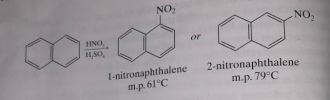 Hello guys! Just reviewing my Chemistry study guide, we did a
lab where we nitrated Napthalene. Something to know, the
mononitration of Napthalene gives me 1 of 2 possible products:
1-nitronaphthalene or 2-nitronaphthalene.
Please predict the reaction by drawing ALL resonance
structures for the carbocation intermediate (arenium ion) for both
1-nitronaphthalene and
2-nitronaphthalene and predict the
major product based off...
Hello guys! Just reviewing my Chemistry study guide, we did a
lab where we nitrated Napthalene. Something to know, the
mononitration of Napthalene gives me 1 of 2 possible products:
1-nitronaphthalene or 2-nitronaphthalene.
Please predict the reaction by drawing ALL resonance
structures for the carbocation intermediate (arenium ion) for both
1-nitronaphthalene and
2-nitronaphthalene and predict the
major product based off...
Consider the reaction A ⟶ Products. The rate law for this reaction is rate = k[A]...
Consider the reaction A ⟶ Products. The rate law for this reaction is rate = k[A] where k= 3.00 X × 10-3 s-1 at a particular temperature. If the initial [A] = 0.500 M, what will be the concentration of A after 2.00 minutes
4. Predict the products of the following reactions, including physical states. Then balance each reaction. A....
4. Predict the products of the following reactions, including physical states. Then balance each reaction. A. ____ Pb(NO3)2(aq) + ____ KCl(aq) → B. ____ H2SO4(aq) + ____ LiOH(aq) → C. ____ Na2S(aq) + ____ FeI2(aq) → D. ____ Fe(C2H3O2)3(aq) + ____ NH4OH(aq) →
Use the different oxidizing agents (KMnO4, Na2Cr2O7, NaOCl, PCC) and predict the product for the following...
 Use the different oxidizing agents (KMnO4, Na2Cr2O7, NaOCl, PCC) and predict the product for the following compound. 4. aa Он CH2OH 5. For the reaction sequence below, identify the expected major products. 1. MСРВА ? 2. H30* What will be the product if OsO4, NaHSO3/H20 is used.
Predict the most likely reaction mechanism (SN1, SN2, E1, E2) and draw all products. Nato=CH₂ E2 ran Br major 2. Dr...
 Predict the most likely reaction mechanism (SN1, SN2, E1, E2) and draw all products. Nato=CH₂ E2 ran Br major 2. Draw complete mechanism with arrows for the SN1/E1 mechanism. Check for carbocation rearrangements. CH3 SMI 애 + H₂O7
2. Predict whether the reaction willl go by SN1, SN2, E1, or E2, or some combination of these. Explain. Also give the p...
 2. Predict whether the reaction willl go by SN1, SN2, E1, or E2, or some combination of these. Explain. Also give the products with correct stereochemistry if applicable. SoI Na CN Br dimethyl sulfoxide (DMSO) CI CH,онн,0 Br CH3S Na* + acetone
Predict the products of the following reactions, and balance the chemical equations. Don't forget to write...
 Predict the products of the following reactions, and balance the chemical equations. Don't forget to write the physical states. If no reaction occurs write NR. a. calcium carbonate and nitric acid b. calcium and hydrochloric acid c. calcium oxide and sulfuric acid d. calcium hydroxide and hydrobromic acid
3. Predict the product(s) obtained when each of the following compounds is treated with chloromethane and...
 3. Predict the product(s) obtained when each of the following compounds is treated with chloromethane and aluminum trichloride. Some of the compounds may be unreactive (in this case, write "no reaction")! For those that are reactive, assume that conditions are controlled to favor monoalkylation. If multiple products are obtained, label the major product NO2 or
In Questions 6.1-6.4, you will be presented with four samples of student work related to problems...
 In Questions 6.1-6.4, you will be presented with four samples of student work related to problems in thermodynamics and energy transfer. In each case, your task is to determine if the student's conclusion is true or false. If you determine their conclusion to be "false," you must then point out the inaccurate parts of their statement and/or suggest a more...
4. Short Answers (28 pts). A. (8 pts, 2 pts each) Classify each of the reactions...
 4. Short Answers (28 pts). A. (8 pts, 2 pts each) Classify each of the reactions below as stereospecific (A), only stereoselective (B), not stereoselective (C). Write the appropriate letter in the boxes next to each reaction. Only one letter should be written in each box. Only the actual products isolated in each reaction is shown. In other words, if...
 Hello guys! Just reviewing my Chemistry study guide, we did a
lab where we nitrated Napthalene. Something to know, the
mononitration of Napthalene gives me 1 of 2 possible products:
1-nitronaphthalene or 2-nitronaphthalene.
Please predict the reaction by drawing ALL resonance
structures for the carbocation intermediate (arenium ion) for both
1-nitronaphthalene and
2-nitronaphthalene and predict the
major product based off...
Hello guys! Just reviewing my Chemistry study guide, we did a
lab where we nitrated Napthalene. Something to know, the
mononitration of Napthalene gives me 1 of 2 possible products:
1-nitronaphthalene or 2-nitronaphthalene.
Please predict the reaction by drawing ALL resonance
structures for the carbocation intermediate (arenium ion) for both
1-nitronaphthalene and
2-nitronaphthalene and predict the
major product based off...
 Use the different oxidizing agents (KMnO4, Na2Cr2O7, NaOCl, PCC) and predict the product for the following compound. 4. aa Он CH2OH 5. For the reaction sequence below, identify the expected major products. 1. MСРВА ? 2. H30* What will be the product if OsO4, NaHSO3/H20 is used.
 Predict the most likely reaction mechanism (SN1, SN2, E1, E2) and draw all products. Nato=CH₂ E2 ran Br major 2. Draw complete mechanism with arrows for the SN1/E1 mechanism. Check for carbocation rearrangements. CH3 SMI 애 + H₂O7
 2. Predict whether the reaction willl go by SN1, SN2, E1, or E2, or some combination of these. Explain. Also give the products with correct stereochemistry if applicable. SoI Na CN Br dimethyl sulfoxide (DMSO) CI CH,онн,0 Br CH3S Na* + acetone
 Predict the products of the following reactions, and balance the chemical equations. Don't forget to write the physical states. If no reaction occurs write NR. a. calcium carbonate and nitric acid b. calcium and hydrochloric acid c. calcium oxide and sulfuric acid d. calcium hydroxide and hydrobromic acid
 3. Predict the product(s) obtained when each of the following compounds is treated with chloromethane and aluminum trichloride. Some of the compounds may be unreactive (in this case, write "no reaction")! For those that are reactive, assume that conditions are controlled to favor monoalkylation. If multiple products are obtained, label the major product NO2 or
 In Questions 6.1-6.4, you will be presented with four samples of student work related to problems in thermodynamics and energy transfer. In each case, your task is to determine if the student's conclusion is true or false. If you determine their conclusion to be "false," you must then point out the inaccurate parts of their statement and/or suggest a more...
 4. Short Answers (28 pts). A. (8 pts, 2 pts each) Classify each of the reactions below as stereospecific (A), only stereoselective (B), not stereoselective (C). Write the appropriate letter in the boxes next to each reaction. Only one letter should be written in each box. Only the actual products isolated in each reaction is shown. In other words, if...
Most questions answered within 3 hours.